
How AI Agents Are Doing Research and Outreach Automatically for Real Estate Agencies
Google's Gemini 3 and its new agent mode move AI from answering questions to taking actions. For real estate agencies, this shift transforms how research, lead qualification, and seller outreach can be handled at scale.

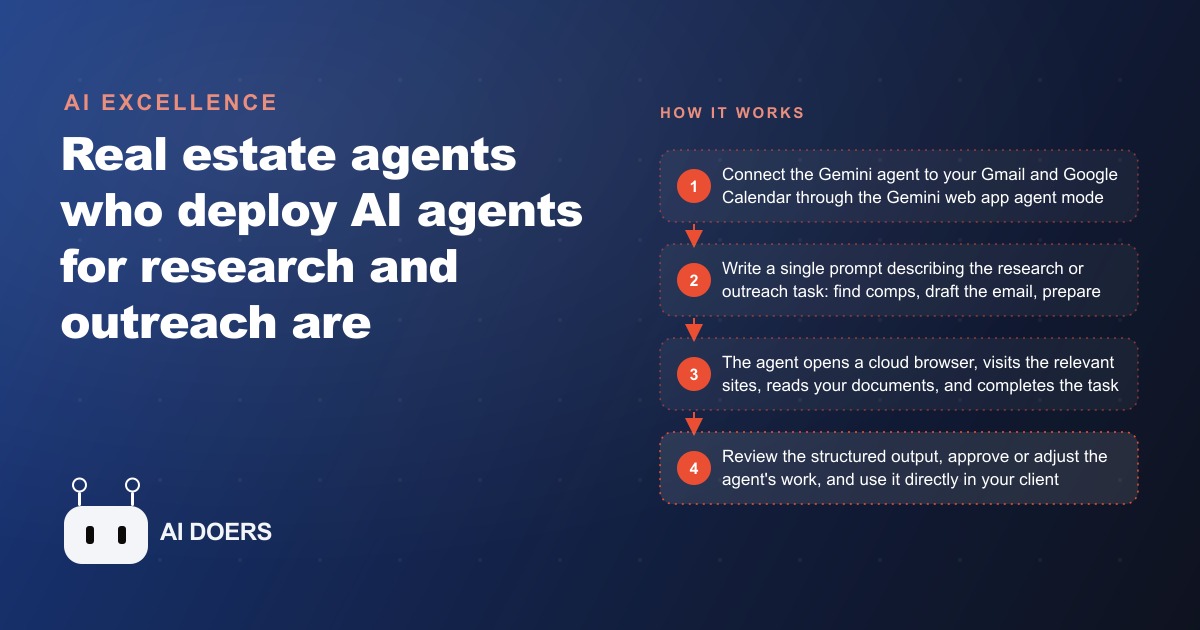
This week Google's Gemini stopped answering questions and started taking actions. The distinction is not marketing language. It is the difference between a research assistant who tells you what to do and one who goes and does it.
I am Madhuranjan Kumar, and I want to walk through exactly what changed, why real estate agencies are positioned to benefit most immediately, and what the concrete workflow looks like for a team that wants to move on this now.
Gemini just crossed from advisor to operator
Gemini 3 launched with what Google calls agent mode: a feature that connects the AI to your Gmail, Google Calendar, Google Drive, and a cloud-based browser, then gives it the ability to use all of those tools to complete tasks rather than explain how you could complete them yourself.
The demonstrating example from Google's own testing is exact and repeatable. They gave the agent a single prompt: book a restaurant reservation for a specific type of restaurant with outdoor seating on a specific evening. The agent navigated to a reservation platform independently, ran the search with the specified criteria, filtered for outdoor seating, selected a matching option, and reached the booking confirmation page entirely without human input. No human typed a search query. No human clicked a filter. No human selected a time. The agent did all of that, and the human's only remaining action was to confirm the final booking.
That demonstration is a simple task, but the underlying capability transfers directly to real work. Research, drafting, scheduling, sorting, and summarizing are all multi-step tasks that follow a predictable structure. The Gemini agent executes that structure on your behalf.
Gemini 3 Pro is also currently the top-ranked model on multi-step reasoning benchmarks, scoring higher than every competing model from OpenAI, Anthropic, and the broader field on the standard battery of complex reasoning tests. The agent is powered by the strongest available model for the kinds of tasks real estate involves.
Real estate agencies are the immediate beneficiary of this shift
Real estate agencies benefit most immediately from this shift for a structural reason that is specific to the business: the tasks that consume the most time in a real estate agency are not the client conversations. Those are what agents are hired to do well. The tasks that eat time are the research, preparation, prospecting, documentation, and follow-up communication that surrounds every transaction.
A buyer's agent preparing for a showing needs comparable sales data, school ratings, transit access, neighborhood context, and ideally a summary of recent news about the area. None of that is difficult to find. It is simply time-consuming, requiring visits to multiple websites, note-taking across them, and manual organization into something presentable. A listing agent preparing for a seller meeting needs a market absorption analysis, the pricing history of similar properties, and an assessment of current active competition. The information is available. Finding it and organizing it is the work.
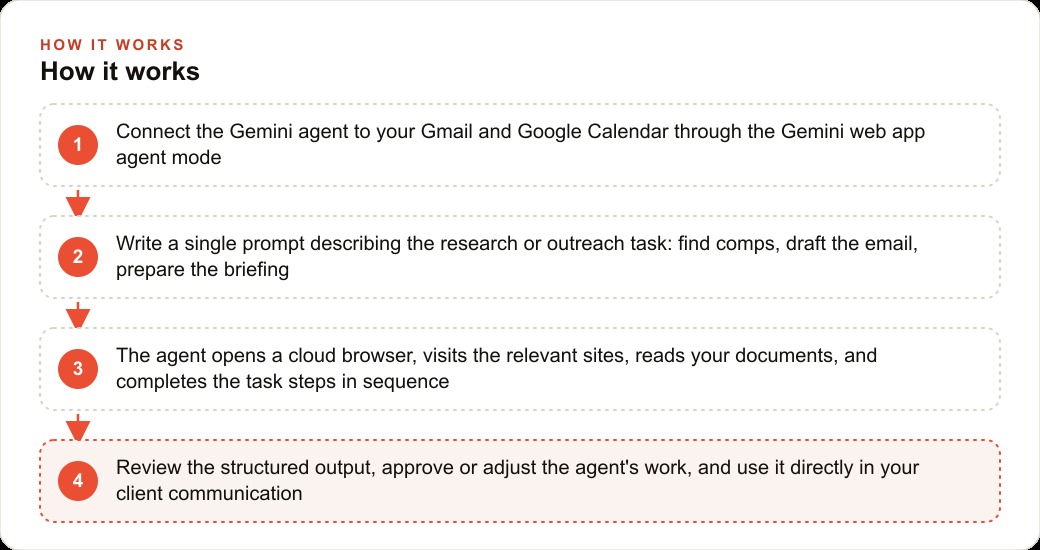
When an AI agent does that research by opening a cloud browser, visiting the relevant sites, extracting the data, and compiling it into a structured output, the research task shifts from something the agent does to something the agent supervises. That is where the productivity gain lives. The real estate professional's expertise goes into knowing which questions to ask and what to do with the answers, not into the mechanics of gathering the information.
The Gmail integration adds a layer that is specific to how real estate businesses actually run. Most real estate agencies operate almost entirely through email. Inquiries arrive by email. Offers and counteroffers are exchanged by email. Client relationships are maintained by email. An AI agent that can monitor your inbox, identify messages signaling seller or buyer intent, summarize client threads, and flag anything requiring a same-day response is working inside the infrastructure your business already uses, not adding another platform to manage.
The actions the Gemini agent can now take on your behalf in a single prompt
Here is a specific list of what the Gemini agent can execute today, based on the current agent mode capabilities available in the Gemini web app.
It can open a browser and visit a list of websites, extracting specific information from each one: comparable sale prices, property details, school ratings, walkability scores, neighborhood news, zoning information. It compiles this information into a structured format you specify in the prompt.
It can read your Gmail inbox and identify messages matching criteria you define: emails from a specific client, emails containing specific phrases, emails that arrived in the past 30 days without a reply. It can summarize threads, flag time-sensitive items, and draft responses for your review.
It can cross-reference your Google Calendar with your Gmail to prepare pre-meeting briefings: here is what you are meeting about, here are all emails from this client in the past 60 days, here are any outstanding items from your last meeting, here is publicly available information about the property or area relevant to the conversation.
It can draft outreach messages based on the research it just completed. Ask it to research three target properties and draft a personalized seller outreach letter for each one based on the comparable data it found, and it produces three distinct drafts that reference specific market conditions relevant to each property rather than a single template with placeholder names.
Lead research time that took 25 minutes now takes four
Here is the specific productivity shift for seller outreach, which is the highest-value repeatable task in most listing-focused real estate businesses.
Before agent mode, preparing a targeted seller outreach package for one prospect required the agent to visit the county assessor site to confirm current ownership, pull comparable recent sales from the MLS or a data aggregator, check the street's listing history to identify how many homes sold in the past two years and at what spread to asking price, and then draft a personalized letter that referenced the specific market conditions relevant to that owner's property. Done carefully, that sequence takes 20 to 30 minutes per prospect.
An unnamed real estate agency tracking this task reported that their agents were completing 8 to 12 prospect research packages per week when doing the work manually, constrained by research time rather than by the number of qualified prospects in their target neighborhoods.
With the Gemini agent running the research portion, the same task takes four to six minutes of agent execution time and two to three minutes of human review. The agent visits the relevant sites, extracts the data, and drafts the outreach letter. The human reviews the output, adjusts the tone if needed, and approves the communication. The review step is shorter than the previous manual research step by a factor of roughly six.
At four to six minutes per prospect, the same weekly time budget covers 40 to 50 prospect packages instead of 8 to 12. The agency's seller outreach volume increases by a factor of four to five without adding staff or extending working hours. In a market where listing inventory is constrained and competition for seller relationships is intense, contacting four times as many qualified prospects per week is a structural advantage that compounds over months.
To put illustrative numbers on this: if each outreach package previously took 25 minutes and the team's goal was 50 prospects per week, completing that volume manually required approximately 1,250 minutes of research time per week across the team. At the agent-assisted pace of five minutes per package, the same 50 prospects require 250 minutes total. The 1,000 minutes recovered per week across the team can go into client meetings, showing preparation, or expanding the prospect list further.
The concrete setup a real estate agency can run starting this week
The entry point is a Gemini account. Google AI Studio is free and allows testing Gemini 3 on real tasks without a subscription. For agent mode with Gmail and Calendar integration, the Gemini AI Pro subscription at $20 per month is the appropriate starting tier. Ultra at $250 per month adds Deepthink mode for complex strategic analysis, but Pro covers all the core outreach and research automations.
In the Gemini web app, enable agent mode through Google Labs settings. The feature requests permission to access your Gmail, Calendar, and Drive. Before approving, review what the access covers. For testing, some agents prefer to connect a secondary Google account used specifically for business communication rather than a personal account with mixed content, which keeps the agent's access scope contained while you build confidence in its behavior.
Start with a research task, not an outreach task. Ask the agent to find the three most recent comparable sales within one mile of a specific address, including sale price, days on market, and square footage, formatted as a table. Compare the output to what your manual research would have found. Evaluate accuracy and completeness before any agent-generated research appears in a client-facing document.
After validating the research output on three to five tasks, add the outreach draft step. Give the agent the research results it produced and ask it to draft a personalized seller outreach letter for the target property owner based on those market conditions. Review the draft before anything goes to a prospect.
For Gmail monitoring, start simple: ask the agent to find all emails from the past 14 days mentioning a specific property address and summarize the thread. Evaluate whether the summary is accurate enough to use in a client meeting before building more complex inbox monitoring workflows.
Mistakes that will cost you a listing or a client relationship
The first and most consequential mistake is sending agent-drafted outreach to prospects without careful review. The Gemini agent produces accurate and professional output on most research tasks, but it occasionally misreads a data point, attributes a sale to the wrong address, or produces a tone that is slightly wrong for a sensitive client situation. Every piece of agent-generated communication must pass through human review before it reaches anyone outside your office. One inaccurate market figure in a seller letter, or one tonally misread message to a recently bereaved seller, costs more in relationship damage than all the time savings combined.
The second mistake is using agent-generated research without spot-checking the sources. Real estate data has its own accuracy issues independent of the AI: MLS records lag, county assessor data refreshes on variable schedules, and some off-market sales do not appear in any data source the agent can access. Any figure you present in a listing conversation must be verified against the primary source before you state it as confirmed market data.
The third mistake is connecting the agent to your primary Gmail without understanding the access scope. The Gemini agent reads your inbox to complete research tasks, and for most real estate agents that inbox contains confidential negotiation details, client financial information, and sensitive personal communications about clients' life circumstances. Review the data usage terms for agent mode and consider a dedicated business email address for agent access while you evaluate the feature.
The fourth mistake is treating the agent as an autonomous system rather than a capable draft generator. The agent's research is a thorough starting point that your expertise then improves. It finds the comparable data. You decide which comps are actually comparable for the conversation you are having with that specific seller. It drafts the outreach letter. You adjust the phrasing to reflect the relationship you are trying to build. Agents who invest in reviewing and improving the output extract significantly more value than those who route agent output directly to clients.
The competitive window for agencies that move now is measured in months, not years
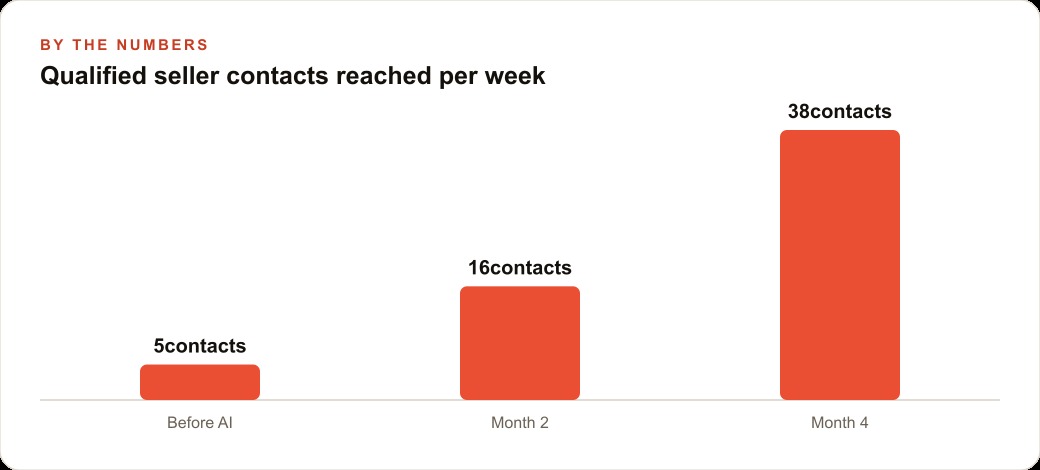
The agencies that build reliable Gemini agent workflows in the next 60 to 90 days will be contacting more qualified sellers per week than competitors who are still doing everything manually. In real estate, where listing inventory is the binding constraint in most markets and seller relationships start months before a listing agreement is signed, the compounding effect of four to five times more prospect contacts per week is a structural advantage.
The 30-day starting plan is straightforward. Week one: create a Gemini account, enable agent mode, and test it on five seller prospect research packages, comparing output to your manual process on the same inputs. Evaluate accuracy. Week two: test the Gmail monitoring capability on a real matter thread. Evaluate whether the summary is accurate enough to rely on before a client call. Week three: run your first end-to-end workflow, research plus outreach draft, on a prospect list of five. Review everything before any contact goes out. Week four: assess the output quality across all tests and identify which two or three tasks are reliable enough to include in your regular weekly cadence.
At the end of 30 days you either have a running agent-assisted workflow that is expanding your outreach capacity, or you have a clear-eyed understanding of where the current agent mode falls short for your specific market and what to watch for in the next update cycle. Either outcome is more useful than waiting for the technology to mature further before you engage with it.
If you want help structuring a full AI-assisted seller outreach system for your agency, including the research workflow, the outreach messaging framework, and the follow-up sequence that converts initial contact into listing meetings, that is the kind of systematic build I work through with real estate teams.
That is exactly what we do at AI DOERS. Book a private 30-minute call with Madhuranjan Kumar and we will map the fastest path to it for your specific business.
Book your call →
Madhuranjan Kumar
Madhuranjan Kumar brings 20 years of performance-marketing experience and has managed over $200 million in Facebook ad spend for brands across the United States and beyond. His expertise spans the full modern marketing stack: Meta, Google Ads, TikTok, email automation, CRM, and the websites that hold it together. At AI DOERS he turns that track record into lead-generation systems for businesses across every industry.