
AI Agents Fundamentals: The Mental Model That Finally Makes Them Click
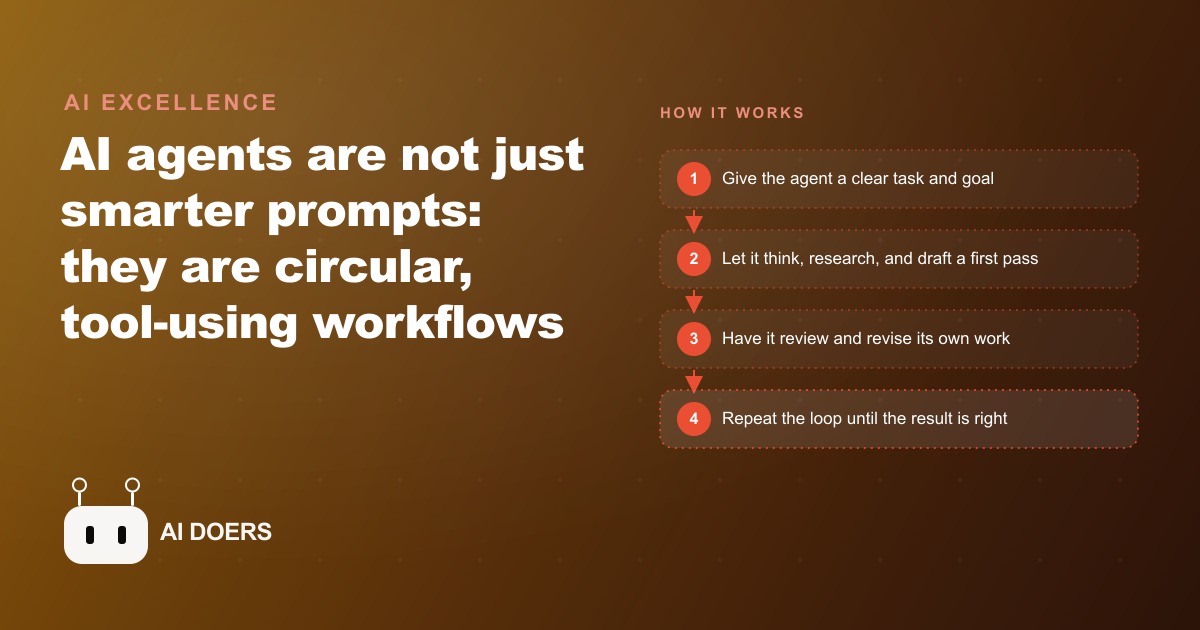
An AI agent is not a smarter prompt. It is a workflow that loops through thinking, research, drafting, and revising until the task is done, built on four patterns: reflection, tool use, planning, and multi-agents.

Most people who say they use AI every day have never actually used an agent. They open a chatbot, type a request, read the answer, and move on. That habit feels productive, and it is quietly holding their business back. The one-shot prompt is the cheapest, weakest way to use a modern model, and treating it as the whole toolkit is like buying a truck and only ever using it to sit in the driveway.
I am Madhuranjan Kumar, and I set up agent systems for businesses, so let me stake a clear position. An AI agent is not a smarter prompt. It is a circular, tool-using workflow that revises its own work until the job is done. Once you see that difference, you cannot unsee it, and you start noticing how much output you have been accepting on the first draft that never deserved to ship.
The one-shot prompt is the habit to break first
Here is the trap. You open a chat window and type please write me a full proposal, or write this email, or plan this whole campaign, and you expect a finished product in one pass. You get a coherent block of text, so it feels like it worked. But read it closely and it is vague, generic, and just off-target enough that you spend twenty minutes fixing it. That is one-shot prompting. It is the AI equivalent of asking someone to write an essay start to finish with no outline, no research, and no second read, then grading whatever falls out.
Humans do not work that way when the work matters. You think, you sketch, you look something up, you draft, you reread, you fix the weak parts. The gap between amateur and professional is almost never the first draft. It is the revision. So the strange thing is that most people demand from AI exactly the workflow they would never accept from themselves or from an employee: one attempt, no review, ship it. The reason the output disappoints is not that the model is dumb. It is that you asked it to skip every step that produces quality.
Breaking this habit is the single highest-leverage change most owners can make with AI, and it costs nothing. You do not need a new tool or a bigger budget. You need to stop treating the first answer as the answer.
A straight line is not a workflow, a loop is
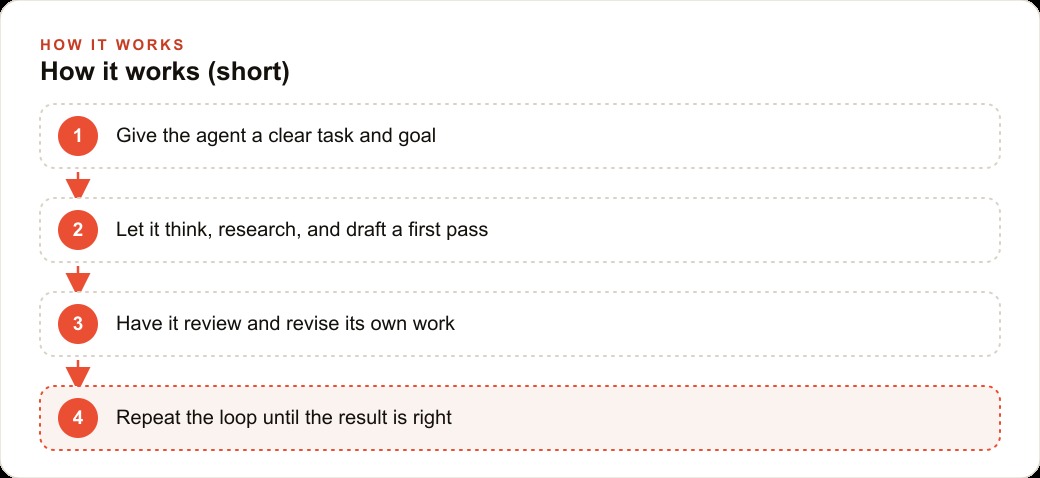
The honest definition of an agent is embarrassingly simple. A plain workflow runs in a straight line: input goes in one end, output comes out the other, nobody looks back. An agentic workflow is a circle. It thinks about the task, does some research, produces a draft, decides what is wrong with that draft, revises, and repeats until the result is actually good. The loop is the whole point. Everything people find impressive about agents comes from the fact that the system checks its own work before it hands it to you.
Think about the levels of autonomy as a ladder with three rungs. On the bottom rung is the plain workflow, straight up and down, no revision, the thing most people are already doing. On the middle rung is the agentic workflow, where the model loops and revises with a bit of guidance from you about the goal and the standard. On the top rung is the fully autonomous agent that picks its own steps, chooses its own tools, and runs the loop with no hand-holding at all.
Here is the contrarian part. Everyone is excited about that top rung, the fully autonomous agent that supposedly runs your business while you sleep. That is not where the money is right now. The middle rung is where the real, reliable leverage lives today. An agentic workflow that loops and revises under a little human direction is dependable, easy to trust, and easy to fix when it drifts. Chasing full autonomy before you have mastered the loop is how people end up with an impressive demo that quietly makes expensive mistakes in production. Master the loop first. The autonomy comes later, and it comes safely.
Reflection is the cheapest quality upgrade you are ignoring
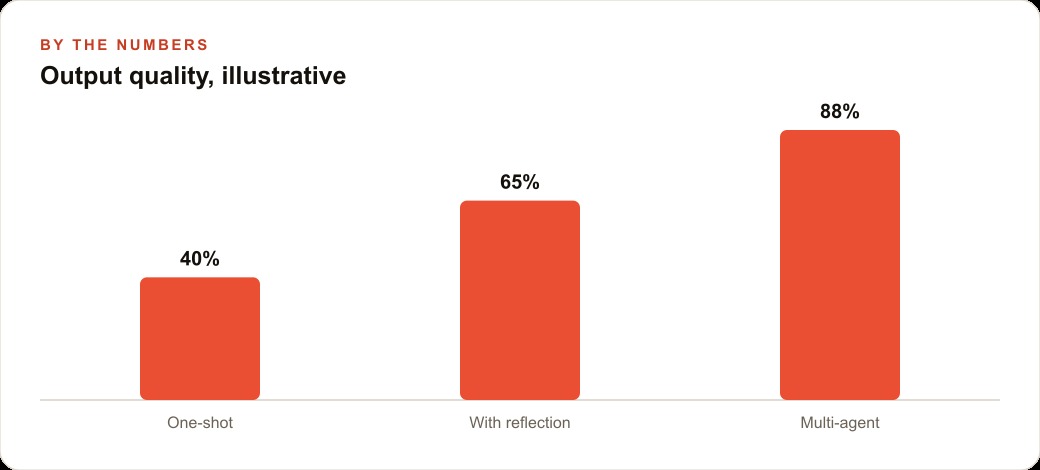
There are four design patterns that turn a straight line into a real agent, and there is a memory hook that keeps them straight: red turtles paint murals, standing for Reflection, Tool use, Planning, and Multi-agents. Learn those four and you can rebuild the entire mental model from scratch, but if you only ever adopt one, make it reflection, because it is nearly free and almost nobody uses it.
Reflection just means asking the model to review its own output. Have it write something, then in the next breath ask it to critique that work for correctness, style, and efficiency. It will frequently catch the exact line it got wrong and fix it, without you pointing at anything. People pay for fancier tooling while skipping the one move that costs a single extra instruction and reliably lifts quality. That is backwards.
Tool use is the pattern that unlocks real tasks instead of confident guessing. Give the model web search and it can compare actual options rather than inventing them. Give it a way to run code and it can compute compound interest correctly instead of hand-waving a number that looks plausible and is wrong. Tools are what let an agent break a job into steps it can genuinely execute rather than describe.
Planning is the pattern where you hand over a goal and the model works out the steps and which tool each step needs on its own. Instead of you scripting every move, it sequences the work, deciding that this step needs a search, that step needs a calculation, and the next step needs a draft. It can chain several capabilities together toward a single outcome without being told the order in advance.
Multi-agents is the fourth pattern, and it deserves its own argument, because it overturns the default most people reach for.
One giant model is the wrong default, a crew is right
When a task gets complicated, the instinct is to write one enormous prompt for one powerful model and ask it to juggle everything at once. That is the wrong default. The better structure is a crew of specialists, each owning one clear job, the same way a good team beats one overloaded person trying to do six roles at the same time. A model asked to do everything spreads itself thin and drops details. A model given one narrow job does it sharply, and the research on this points the same direction: the multi-agent final product is generally better than what a single model produces alone.
Before you can build a crew, you need the anatomy of a single agent, and there is a hook for that too: tired alpacas mix tea, for Task, Answer, Model, and Tools. Every agent has a task it is responsible for, an answer it is trying to produce, a model such as Claude doing the actual thinking, and tools it can reach for. A travel-planner agent, for example, has the task of planning a trip, the answer of a finished itinerary, a model doing the reasoning, and tools like a maps service and a booking site. Define those four things and you have defined an agent. Skip them and you have defined a wish.
Once each agent is clearly scoped, you assemble them into a crew, and crews run in a few shapes. Sequential is an assembly line, where each agent finishes and passes its work to the next. Hierarchical puts a manager agent on top that hands out jobs and compiles the results. Hybrid mixes both, with feedback loops running between the workers and the manager. The rule to keep in mind is blunt: more agents mean more power and more chaos to manage. A crew is stronger than a solo model, but only if each member has a real boundary. Add agents without giving them clean, separate jobs and you have not built a team, you have built a committee that argues with itself.
An agent crew handling service requests, with real numbers
Let me make this concrete with a business I work with often, an HVAC company drowning in inbound service requests every summer. Say the office fields around 60 new requests a day through the website and the phone, and each one currently eats about 8 minutes of someone's time to read, check the schedule, and write back. That is roughly 8 hours a day of pure administrative churn before a single technician turns a wrench.
A one-shot prompt would hand that office a generic reply template and call it done, which is worse than useless because it still needs a human to check availability and pricing. An agent crew is a different animal. The first agent handles intake and scheduling. It thinks about what the request actually needs, uses a tool to check the technician calendar for open slots, drafts a reply that quotes a realistic arrival window and the correct service fee, then reflects on that draft to confirm the date is genuinely open and the price matches the service before anything goes out. The loop is doing the quality control that a rushed person skips at 4 p.m. on the hottest day of the year.
A second agent owns follow-up. It watches for customers who got a quote but did not book, and after a set interval it drafts a warm nudge referencing their specific request. A third agent drafts the post-visit review request once a job is marked complete. Run them as an assembly line, one passing to the next, or put a manager agent on top that compiles the day's output for the office to glance at. Because each agent has one job, when something looks off you know precisely which agent to inspect, instead of picking apart one giant prompt trying to guess which of its ten responsibilities failed.
Now the illustrative math. If the intake agent handles even 70 percent of those 60 daily requests end to end and the office only reviews the rest, the 8 hours of churn drops toward roughly 2.5 hours, freeing on the order of 5 hours a day. The follow-up agent matters even more to revenue. If the company was quietly losing 15 un-booked quotes a week to silence and the follow-up agent recovers just 3 of them at an average ticket of 400 dollars, that is about 1,200 dollars a week, or nearly 60,000 dollars a year, from a step nobody had time to do before. The office stops living in the inbox, the dispatcher gets real hours back, and the customer gets a faster and more accurate reply than an exhausted human could manage during a heat wave when every line is ringing. None of these figures are promises. They are the shape of the return, and the shape is the point.
The agent version of your favorite tool is coming for it
Here is the position that should change how you think about the next few years. The guidance floating around the startup world is that for every software company, there will be a corresponding AI agent company. Take any software tool your business pays for every month and imagine its agent equivalent, the version that does not just store your information and wait for you to click, but actually does the work the software was helping you do by hand. That is not a distant sci-fi scenario. People are already wiring up working assistants with no-code tools, no engineering team required.
This is why the one-shot prompt habit is so costly. While you are copy-pasting answers out of a chat window, the category is moving toward systems that loop, use tools, and revise themselves inside the workflows you already run. The businesses that learn to think in agents now, starting with one humble loop on one annoying task, will be the ones fluent when the agent version of their whole stack arrives. This connects directly to the rest of how a modern business gets found and gets paid, from Facebook and Instagram ad campaigns and Google Ads that fill the pipeline, to the SEO and organic search that earns attention over time, to the CRM and website stack where an agent crew can finally do the follow-up work that always slips.
So start smaller than you think you are allowed to. Take one task you do the same way every week. Turn it into a loop of think, research, draft, revise, repeat. Add reflection first because it is free. Add a tool when guessing is not good enough. Give it a plan when the steps vary. Split it into a crew only when one agent is clearly carrying too much. You can absolutely build your first agent yourself with a bit of patience, and you should, because the fastest way to stop trusting one-shot answers is to feel a loop produce something better. And if you would rather skip to a reliable crew designed around your real workflows and wired into the tools you already use, that is exactly the kind of system I build for businesses, and the best time to start was before the agent version of your competitor's stack showed up.
That is exactly what we do at AI DOERS. Book a private 30-minute call with Madhuranjan Kumar and we will map the fastest path to it for your specific business.
Book your call →
Madhuranjan Kumar
Madhuranjan Kumar brings 20 years of performance-marketing experience and has managed over $200 million in Facebook ad spend for brands across the United States and beyond. His expertise spans the full modern marketing stack: Meta, Google Ads, TikTok, email automation, CRM, and the websites that hold it together. At AI DOERS he turns that track record into lead-generation systems for businesses across every industry.