
AI Agents Can Only Do 2% of Remote Work, and Why That's Good News
A new benchmark shows top AI agents complete only about two percent of real remote work to a human standard. The smart move is to deploy them in narrow, well defined slices with a human on the finish line.

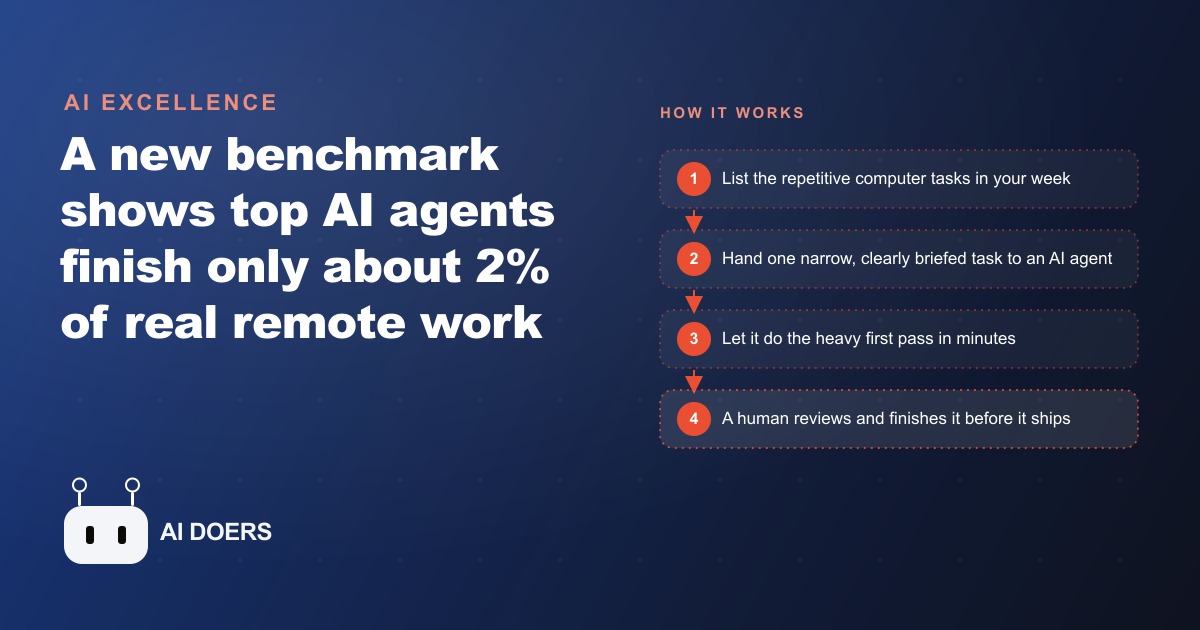
The best AI agents in the world completed about 2 percent of real freelance work to a human professional standard on a new benchmark, and the coverage around that number has landed in two wrong places at once. One reading treats the 2 percent as evidence that AI agents are premature and not worth investing attention in. Another uses the same figure to argue that even this low pass rate signals an impending labor crisis. I am Madhuranjan Kumar, and the reading that makes the most practical sense for a business owner is neither of those. The 2 percent figure is a deployment map. It tells you, with unusual precision, which task categories agents can already handle at a useful threshold and which ones they cannot reach yet. That is a map worth understanding correctly.
The benchmark is called the remote labor index, and it tests agents on genuine freelance work: 3D product renders, architectural drawings produced from a PDF brief, interactive data dashboards, small physics-based games built from a description, animated advertisements. These are not toy puzzles assembled to expose model weaknesses. They are the kinds of projects a business would post on a platform and expect a usable deliverable from. Scoring runs on an Elo-style scale where a competent human professional sits at roughly 1000. The best agents landed between 400 and 500. That is approximately half the human standard across this varied set of tasks. The same week the benchmark results circulated, a major technology company acquired the agent sitting at the top of the index. Those two facts belong in the same analysis.
The 2 percent score separates where agents are already commercially useful from where they are not
A benchmark that evaluates agents across a diverse range of task categories will always produce an aggregate pass rate that undersells usefulness on any specific narrow task. The 2 percent represents the proportion of these varied tasks that agents complete to the full human professional standard, end to end, without assistance. That is a demanding bar and it should be. But it measures something different from what a business owner actually needs to know, which is: can an agent produce a useful first draft of this specific well-defined task, narrow enough that a human reviewer can take the output to finished faster than starting without it?
Those two questions have different answers. An agent that produces a 3D product render requiring twenty minutes of adjustment from a designer would not pass the benchmark scoring. The judge compares the output to a human professional standard and finds it short. But from the designer's perspective, the agent compressed three to four hours of work into twenty minutes of review. That is not a failure of automation. That is the automation working correctly with a human at the finish line, which is where the human belongs in this model. The useful map the benchmark provides is this: which task categories can agents reach the partial-completion threshold on, where a human can take the first draft and finish it faster than building from a blank file? Architectural plans, dashboards, and animated advertisements are already in that territory. That is where to aim agents now.
The strongest agents in the benchmark do not rely on proprietary models. They are scaffolding systems that wrap general-purpose models and give those models a virtual workspace: a browser, a code interpreter, a file system. The agent plans and coordinates. The model provides the intelligence. This architecture means capability improves automatically as the underlying models improve, without the scaffolding needing to be rebuilt. And the improvement rate is measurable. The length of tasks agents can complete autonomously is doubling roughly every four months. The map changes at that rate. The task categories where agents can reach a useful partial-completion threshold today are not the only ones they will reach it on in 18 months.
Reading the 2 percent as a static verdict misses this dynamic. The useful posture is to look at the current map, deploy agents on the tasks that already clear the partial-completion bar, and build the habits and review processes around those tasks now. As the map expands you absorb the new capability without having to build a new operating model from scratch each time the ceiling rises.
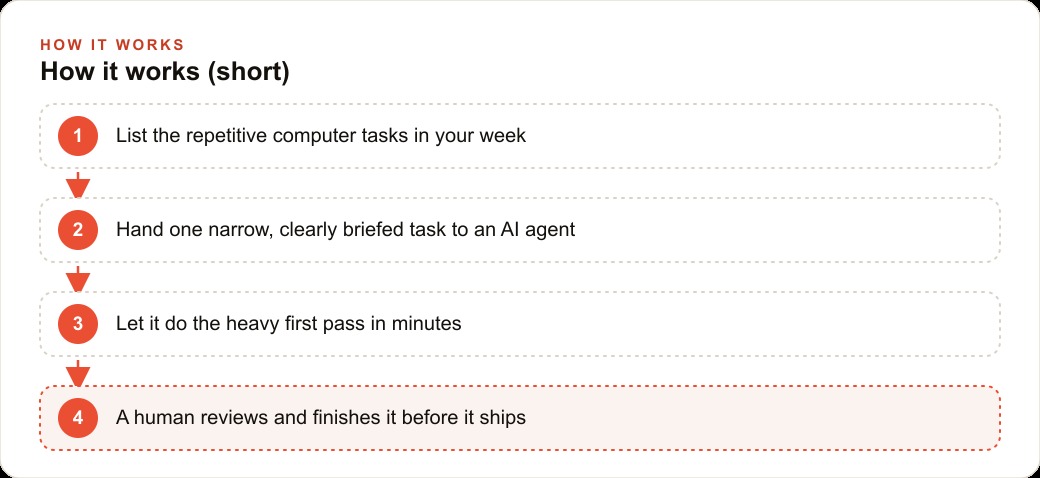
The narrow-brief and human-review model makes a 400 Elo agent commercially productive
The owners who extract genuine value from agents right now all share one operating habit: they write a narrow, specific brief, let the agent produce the heavy first pass, and keep a human at the finish line. They do not hand over a complete project and ship whatever arrives. They hand over a scoped task, review the output, and invest whatever human time is needed to bring it to standard. The economics of this model are positive even at low capability scores, because the time compression on first-pass production is real, and review is always faster than creation.
Think of this as the capable junior employee model. A junior in their first few months on the job does not own complex projects end to end. They take a bounded piece, produce a first draft, and a more senior person reviews and completes it. The output is better than nothing, the cost is lower than full senior production, and the review time is shorter than starting from zero. That is precisely where agents sit right now. Reliably useful on narrow, well-defined tasks where the goal is specific and the success criteria are checkable. Unreliable on open-ended, judgment-heavy work that requires contextual adaptation, relationship knowledge, or professional accountability.
For Facebook and Instagram ad campaigns, the narrow-brief model maps directly. An agent can produce five ad copy variants, five headline options, and a structured visual brief in the time it previously took to write a single polished ad. A human reviews, cuts the two weakest options, adjusts the brand voice, and refines what remains. The agent output was not at human standard when it arrived. It was at a draft standard that made the human's remaining time significantly more productive. Briefing the agent to produce a specific set of outputs with defined constraints returns something usable. Briefing it to handle an entire campaign without constraints returns something that needs to be scrapped.
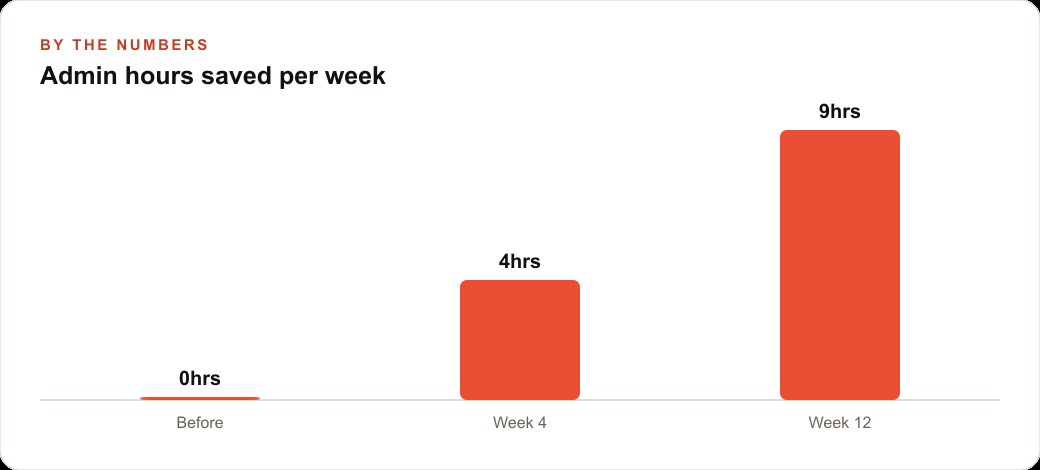
Here is a concrete illustration with numbers. A marketing agency managing twelve client accounts was spending roughly six hours per account per week on content production: research, drafting, internal review, client submission. That is 72 hours per week across the client base. When they shifted to a narrow-brief agent model for the drafting phase, the agent produced a first-pass content set for each account in about 25 minutes. A human editor then spent 90 minutes per account on review, selection, tone adjustment, and fact verification. Total production time per account dropped from six hours to roughly two hours. The agent output was not publish-ready. It was draft-quality material that made the 90 minutes of human editing more productive than six hours of human drafting had been. That is the partial-completion model working as designed.
The same principle applies to SEO and organic content. A structured brief with a target keyword, a defined content structure, and specific constraints on tone and length produces a first-draft article a human edits to finished rather than builds from a blank page. The ratio of time spent drafting to time spent editing shifts sharply in the human's favor, which means more content gets produced per skilled hour without quality dropping. A content team that used to publish four articles per month at full manual effort can publish ten articles per month at the same total staff hours when agents handle the first draft and humans handle the final edit. The quality stays consistent because the editing step is where professional judgment applies, and that step is preserved.
The same principle applies to SEO and organic content. A structured brief with a target keyword, a defined content structure, and specific constraints on tone and length produces a first-draft article a human edits to finished rather than builds from a blank page. The ratio of time spent drafting to time spent editing shifts sharply in the human's favor, which means more content gets produced per skilled hour without quality dropping.
Briefing discipline is the key variable that most people underweight. An agent given a vague instruction returns output that requires as much work to correct as it saved in drafting. An agent given a tight brief with a specific goal, a defined scope, a clear output format, and explicit constraints returns something a human can take to finished quickly. Nearly every failed agent deployment traces back to a brief that was too open-ended. The 2 percent aggregate score on the benchmark reflects partly how hard it is to write a good brief for a varied, complex, real-world task. On a narrow task with a well-written brief, the effective useful-output rate is considerably higher.
The acquisition and the task-length trend tell you where to place your strategic attention now
When a major technology company acquires the agent that scored best on a benchmark where the best score is 2 percent, the acquisition is not about that score. It is a bet on trajectory. The acquirer is buying the architecture, the people, the operational learning, and the position in a market where being 18 months early is a structural advantage. The current score is the starting point of the investment thesis, not the destination of it.
Task length doubling every four months is a compounding trend with real business implications. The ceiling that limits agents today is not the ceiling in 18 months. The categories where agents already reach a useful partial-completion threshold will expand. Owners who have built the habits of precise deployment now, narrow briefs, draft review, structured human finish, will absorb each upward shift in capability naturally. The workflow already exists. The review process already runs. New task categories get added to an operation that already knows how to handle them. Owners who wait for agents to be fully capable before engaging will need to build those habits against a moving target, competing with operators who have months of practical experience ahead of them.
Your CRM and website stack holds several strong candidates for a first narrow-task experiment. Email sequence drafts, customer feedback summaries, product catalog inconsistency checks, first-pass landing page copy sections: these all fit the partial-completion model. The agent produces a useful draft. A human finishes it. The time saved on drafting more than compensates for the time invested in review. That net positive on the first measurement is the only confirmation you need before adding a second task to the agent-first rotation.
A practical starting point is to pick three tasks from the benchmark's strongest categories: a data compilation or report, a first-pass content brief, and a research or monitoring task. Write a specific brief for each. Hand it to an agent. Measure the review time against the drafting time saved. A net positive means the task belongs in the rotation. A net negative means the brief needs tightening or the task was the wrong starting point. That measurement discipline, applied consistently to three tasks, builds the operational instinct for deploying agents correctly across many more tasks as the benchmark percentage climbs. The 2 percent figure is an honest current measurement. It is not a reason to stand back. It is precise information about the operating model that makes agents commercially productive today. Narrow briefs, draft-quality output, human review and finish. That model works now and compounds as the capability expands. Businesses that get ahead on this read the benchmark not as an obstacle but as a specification. They know which task types to start with, they know the operating model that makes the math work, and they build the habits now while most competitors are still debating whether the percentage is high enough to bother. By the time the debate resolves, the operators who started will have months of tuning, review processes that run smoothly, and a library of well-briefed tasks that expand naturally as the capability expands. The map is in the benchmark. The only question is whether you are reading it.
That is exactly what we do at AI DOERS. Book a private 30-minute call with Madhuranjan Kumar and we will map the fastest path to it for your specific business.
Book your call →
Madhuranjan Kumar
Madhuranjan Kumar brings 20 years of performance-marketing experience and has managed over $200 million in Facebook ad spend for brands across the United States and beyond. His expertise spans the full modern marketing stack: Meta, Google Ads, TikTok, email automation, CRM, and the websites that hold it together. At AI DOERS he turns that track record into lead-generation systems for businesses across every industry.