
AI Agents Can Build Your Business Tools Overnight: A Practical Guide
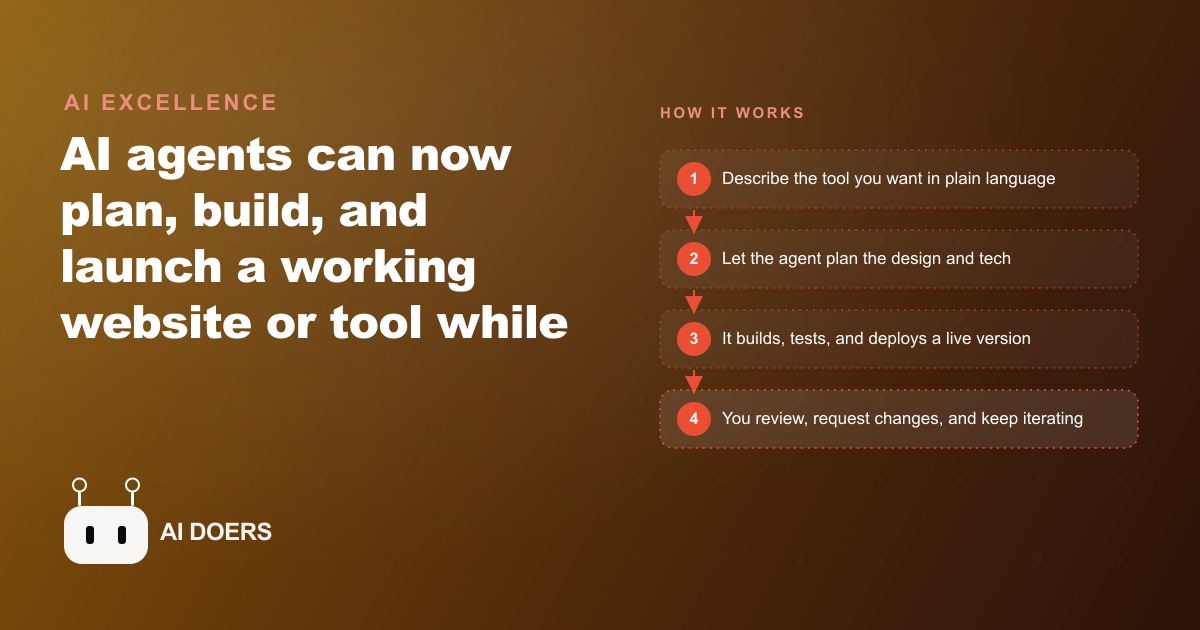
AI agents can now plan, build, and launch a working website or tool while you sleep. Here is what that means and how an owner can put it to work without writing code.

At 10pm, the agent received a description of a tool a business needed built. By 1:30am it had pushed 28 updates, chosen its own technology stack, designed the user flow, written the backend, built the frontend, connected the database, and deployed to a live URL. The person who requested it was asleep the entire time. By morning, there was working software.
That is not a future scenario. It happened, and it changes the fundamental question you should be asking about software development. The question used to be "can we afford to build this?" Now it is "which tool do we build first?"
Choose one specific tool your business actually needs, not a platform
The most common mistake when someone first encounters this capability is to think about the largest, most ambitious thing they could build and start there. A platform. A marketplace. An all-in-one system. These instincts are understandable, but they are the wrong starting point.
The right starting point is the smallest, most specific tool that solves a real problem your business has right now. Not a tool that might be useful to customers someday. Not a platform that would open up a new business line eventually. A tool that your team is currently either doing manually, doing badly, or paying someone else to do.
The specificity is what makes the overnight build possible and what makes the output useful. A specific tool has clear inputs, clear outputs, and a clear definition of success. A platform has none of those things until someone makes hundreds of decisions about scope and features, and those decisions cannot all be made in one night by one agent.
Consider a roofing company that gives quotes. Currently someone on the team takes information over the phone, looks up material costs in a spreadsheet, applies a standard labor estimate, and sends a number by email the next day. That is a tool: a quote estimator. It takes inputs (roof dimensions, material type, location, job complexity) and produces an output (an itemized estimate with a total). The agent can build that tool overnight. A "roofing business management platform" cannot be built overnight because it is not a tool, it is a category.
Start with the one thing. The agent builds it, it works, you use it. Then you decide what to build next based on what you learned from using the first tool.
Describe the goal in plain words, not a feature list
When you describe what you want to the agent, the instinct is to write a requirements document: a bulleted list of features, user stories, technical specifications. Resist this instinct.
Agents work better with goal-oriented descriptions than with feature lists. A feature list tells the agent what to build. A goal description tells the agent what problem needs to be solved and lets it figure out what to build. That distinction matters because the agent often knows more about the best technical approach than a non-developer writing a feature list.
In the overnight build scenario described above, the agent pushed back when the person who commissioned it suggested using a particular technology. The agent was right. It had assessed the requirements and determined that the suggested technology was the wrong tool for the job. Because the instruction was goal-oriented rather than prescriptive, the agent had the latitude to make that call and explain why.
Describe the goal this way: what problem is the tool solving, who uses it, what do they put in, what do they get out, and what does success look like in practice. "Roofing customers can enter their roof dimensions and get an accurate estimate within three minutes without calling anyone" is a goal description. The agent can design a system that achieves it. "Build a form with fields for length, width, pitch, and material type that connects to a database of material prices and displays a line-item estimate" is a feature list. The agent will build exactly what you described, even if a different approach would serve the goal better.
Trust the agent to make technology and design decisions. Your job at this stage is to be clear about the goal, not to specify the implementation.
Let the agent plan the technology and the design before it writes a line
Before the agent writes any code, it should produce a plan: what technology it intends to use, why, what the main components are, how they connect to each other, and what the user experience will look like at each step. Review the plan before the agent proceeds.
This planning step is not overhead. It is the most important part of the process. A five-minute review of a plan prevents a four-hour rebuild of something that went in the wrong direction from the first line.
The plan review serves two purposes. First, it lets you catch misunderstandings about the goal before they are baked into code. If the plan shows a multi-step form when you needed a one-step calculator, you catch that now. If the plan shows authentication when the tool is meant to be publicly accessible, you catch that now. Second, it lets you learn what the agent knows about your problem that you did not. The agent may have included a caching layer you had not thought about, or structured the data model in a way that makes adding features later much easier. Reading the plan teaches you about the problem and the solution.
For the quote estimator, the plan might show: a serverless function that reads material prices from a simple JSON file the owner can update without code, a front-end form with client-side validation to reduce server load, a PDF generator that formats the estimate for printing, and a simple email delivery so the customer gets a copy automatically. Each of those components is visible in the plan before a line is written. If the owner wants to approve estimates manually before they are emailed, they can say so now. If they want to add their logo to the PDF, they can say so now. Those requests, taken at the planning stage, cost almost nothing. The same requests after the system is built cost real rework.
Treat the plan review as a conversation. Ask questions. Push back where something seems wrong. Then approve and let the agent build.
Take the leadership seat: review, request changes, and keep the iteration moving
Once the agent is building, your role changes. You are not a passive observer and you are not a developer. You are a project owner: someone who reviews what exists at each iteration, makes decisions about what is right and what needs to change, and keeps the work moving toward the goal.
The 28 updates in the overnight build were not 28 random changes. Each one was the agent testing something, finding a problem, and fixing it. The agent iterated through design decisions, caught deployment issues, corrected a database schema mismatch, and refined the UI based on how the working version actually looked. That iteration is where most of the work happens, and it happens continuously without requiring approval on each step.
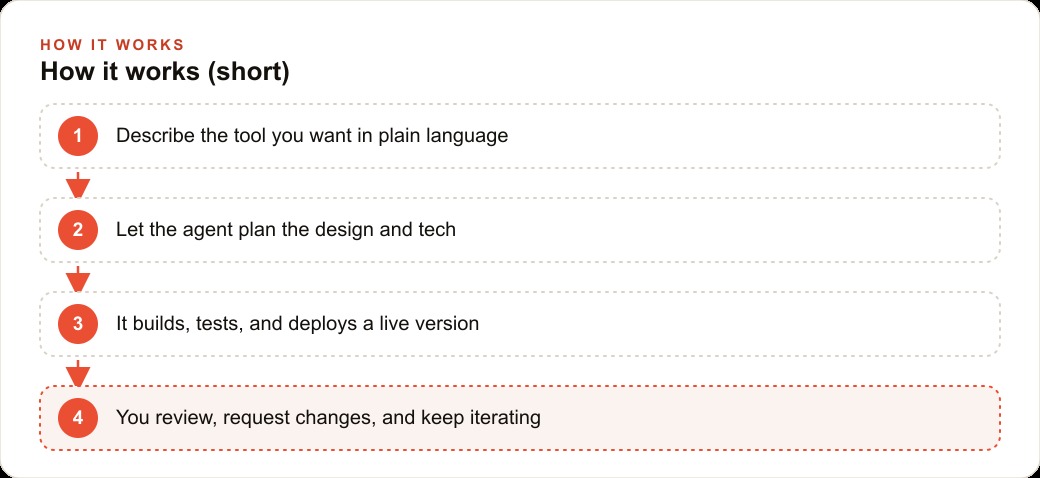
Your involvement comes at natural review points: when the agent has something working well enough to show, when the agent hits a decision point where it needs a business preference to proceed, and when you want to request a change in a specific direction. Between those moments, the agent runs.
This is the leadership model. You define the goal, you review the progress, you make the decisions that require business context, and you release the agent to work. Running Facebook and Instagram ad campaigns to drive traffic to a tool you just built requires your knowledge of the audience. Building the tool itself does not require you to write code.
One practical discipline: keep a running document of things you notice during reviews that you want to change. Instead of interrupting the agent mid-task with every small observation, batch your feedback and provide it at the next natural review point. The agent can address three things in one pass better than it can address one thing three times.
A roofing company that built a live quote estimator overnight
Here is how this plays out end to end for the roofing company.
At the start of the session, the owner describes the goal: customers can get an accurate quote by entering information about their roof without calling anyone, the quote should show materials and labor separately, and the owner wants to be able to update material prices without needing a developer.
The agent produces a plan in about ten minutes: a front-end form capturing roof dimensions, material type, pitch, and zip code; a serverless function that pulls material prices from a JSON file in the owner's cloud storage; a labor calculation based on square footage and pitch complexity; a line-item PDF generated on request; email delivery of the PDF to the customer. The owner approves the plan and asks one addition: the system should flag any quotes above a certain dollar amount for a manual review call, rather than delivering the PDF automatically.
The agent incorporates the flag into the plan and starts building. Over the next several hours it builds the form, the calculation function, the PDF generator, the email delivery, and the flagging logic. It deploys to a hosting environment with free tier pricing -- the first version costs nothing to run. It iterates through a styling pass to match the company's colors and logo.
By morning there is a working URL. The owner reviews it, requests one change to the label on the material type selector, and the agent makes it. The tool is in use that afternoon.
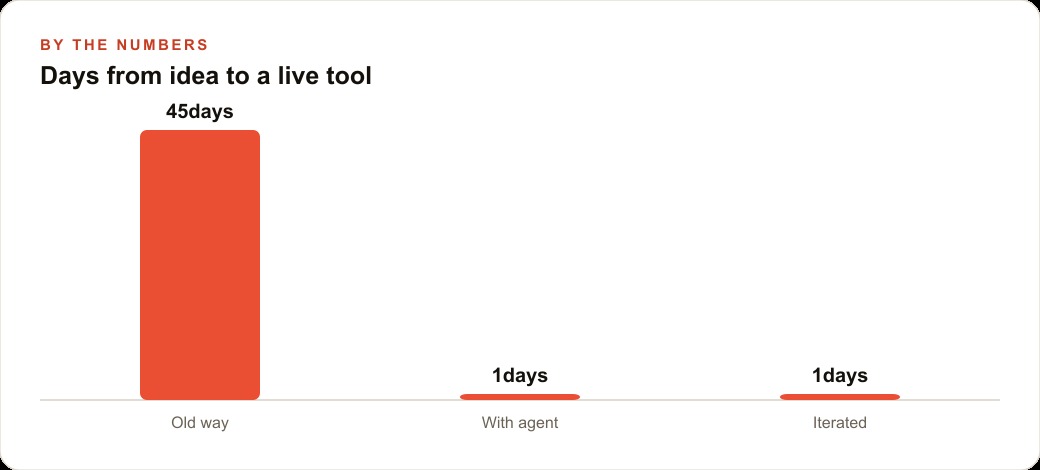
The old quote process took a staff member twenty minutes per inquiry and delivered the estimate by end of the next day. The new process takes three minutes, the estimate is instant, and no one on the staff needs to be involved unless the quote is flagged for review.
That business just gained back a meaningful amount of staff time every week and improved the customer experience at the same time. The cost was one evening and a clear description of the goal.
This is the real opportunity in AI-assisted software development right now. Building software is suddenly cheap while the world still prices it as expensive. The gap between what a tool like this would have cost eighteen months ago and what it costs now is enormous. Businesses that take advantage of that gap while it exists will have operational tools their competitors are still paying to have built.
The first tool to build is not the biggest thing you can imagine. It is the one specific thing your team does manually today that a working piece of software could do better. Start there. Build it overnight. Then decide what comes next.
For any business using Google Ads or SEO and organic search to drive inbound inquiries, a tool like a quote estimator also converts better than a contact form. Someone who can get an estimate immediately has fewer reasons to leave and call a competitor. A landing page that says "enter your roof dimensions and get an instant estimate" is a stronger call to action than "fill out this form and we will call you." The tool is the offer.
This compounds as you build more tools. The first tool makes one process faster. The second tool makes a different process faster. After four or five tools, the business is running a different kind of operation than its competitors. The tools reinforce each other: the quote estimator feeds into a scheduling tool, which feeds into a job status tracker, which feeds into an invoice generator. None of those tools needed to be designed in a single session. Each one was the next obvious step from what existed before.
The question is not whether you can build it. The question is which one to build first. Answering that question well means looking at your team's time honestly, finding the process that costs the most hours per week in manual work, and starting there. That is the first overnight build. Everything else follows from it.
That is exactly what we do at AI DOERS. Book a private 30-minute call with Madhuranjan Kumar and we will map the fastest path to it for your specific business.
Book your call →
Madhuranjan Kumar
Madhuranjan Kumar brings 20 years of performance-marketing experience and has managed over $200 million in Facebook ad spend for brands across the United States and beyond. His expertise spans the full modern marketing stack: Meta, Google Ads, TikTok, email automation, CRM, and the websites that hold it together. At AI DOERS he turns that track record into lead-generation systems for businesses across every industry.