
AI Agents Are Overused: The 4-Layer Pyramid of What to Build Instead
Not every problem needs a fully autonomous AI agent. The AI systems pyramid sorts custom GPTs, simple automations, AI workflows, and agents so you build the simplest thing that solves the problem.

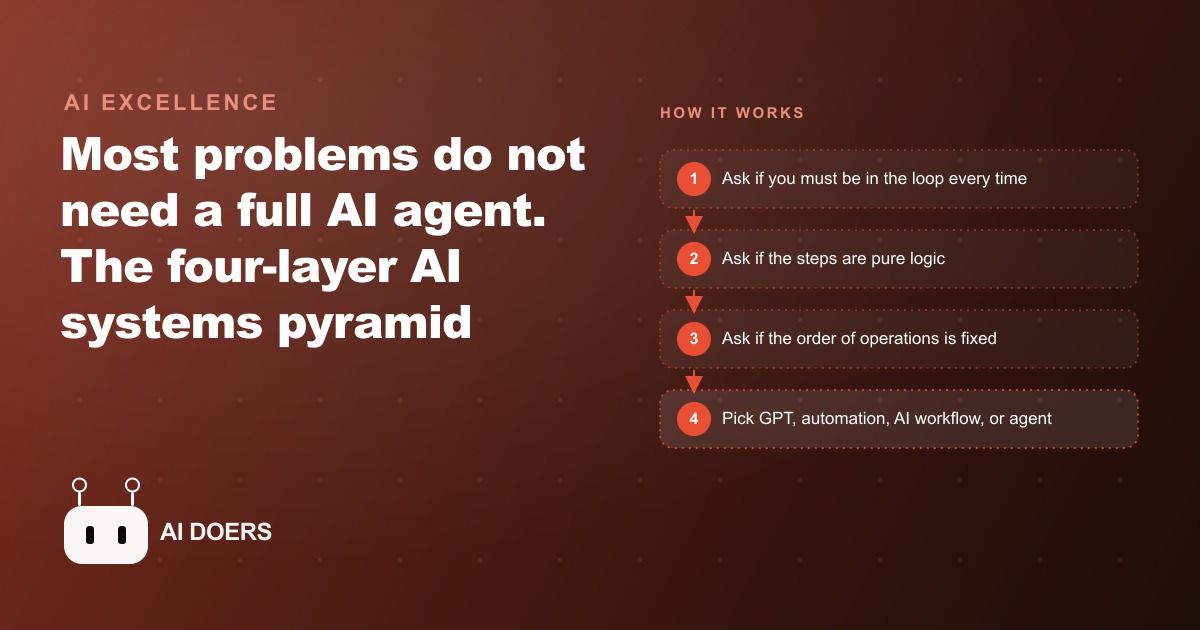
Sophistication is a trap; simplicity is a discipline
There is a quiet pressure in the AI space right now that I think is doing real harm to a lot of businesses, and I want to talk about it plainly. The pressure is this: every week, the tools and the conversation around them tilt toward complexity. New agent frameworks launch with impressive demonstrations. New automation platforms offer more powerful and more autonomous capabilities than the ones before them. Every newsletter has a tutorial on building systems that decide for themselves what to do next. And the implicit message in all of it is that the more sophisticated the thing you build, the more seriously you are engaging with AI in your business.
I have built hundreds of these systems across the four layers I am going to describe. Custom GPTs, simple automations, AI workflows, and true autonomous agents. I have seen what happens when a business chooses the wrong layer for a problem, when they reach for an agent when a custom GPT would have been faster to build, cheaper to run, and easier to fix when something went wrong. And my honest view, arrived at through building and maintaining these systems rather than just reading about them, is this: defaulting to the most sophisticated option is not ambition. It is a failure of judgment. The discipline worth building is not knowing how to deploy an agent. It is knowing when not to.
The framework I use to think about this is a four-layer pyramid. At the base sit custom GPTs, sometimes called projects or gems depending on the platform: preconfigured conversational assistants you trigger manually and stay in the loop with. One level up are simple automations, pure if-then logic that runs on a trigger with zero AI, completely predictable, completely reliable in a way that no AI system can match. Above those are AI workflows, fixed sequences that add AI for a narrow reasoning step, like reading and classifying a message, while the rest of the path stays predictable and deterministic. At the top sit true AI agents, systems that receive a goal, decide which tools to use, and determine the order of operations on their own based on what they discover as they go.
Every layer has genuine value. I want to be clear about that because the argument I am making is not that agents are bad or that simple tools are always better. The argument is more precise: building at a higher layer than the problem requires is waste. Not ambition. Waste. And recognizing the difference requires developing a kind of discipline that goes against the grain of a tech culture that rewards novelty and complexity over reliability and fit.
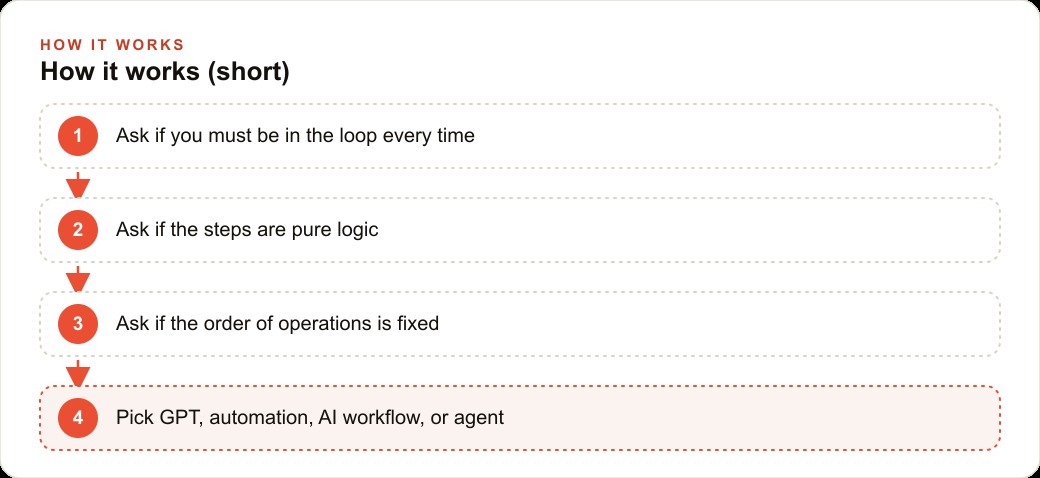
The way I start every conversation about which layer to build at is with four diagnostic questions, and the questions have to be asked in order because each one narrows the space.
The first question is whether you need to be in the loop every time the task runs. Not whether you want to be, and not whether you feel more comfortable being in the loop. Whether the task, done well, genuinely requires a human judgment call in the chain. If someone needs to review the output before anything consequential happens, the task belongs at the base layer. A custom GPT that drafts a recurring client report introduction, a proposal template, or a weekly team update is perfect for this situation. It is an assistant who knows your company and always has a first draft ready. You review it, approve the parts that are right, adjust the parts that are not, and the output goes out with your judgment behind it. The tool is reactive by design. It runs when you ask it to and waits otherwise. For many tasks, that is exactly the right behavior.
The second question is whether the steps involved are pure logic. If a trigger fires and the same actions happen in the same order every time, with no judgment required at any step, that is a simple automation. The thing that surprises most people when they first hear this is how many genuinely valuable business tasks fall into this category. Somewhere around half of the automations most businesses actually need involve no AI at all. A new form submission creates a record, sends a notification, and adds a line to a spreadsheet. A daily trigger pulls a report and emails it. A payment confirmation updates a status field. These are valuable automations. They run in the background reliably for years at low cost and require almost no maintenance once they are set up.
Adding an AI layer to these tasks would not make them better. It would make them more expensive to run, harder to debug when something breaks, and slightly unpredictable in ways that pure logic systems never are. A simple automation that fails always fails the same way. An AI-augmented version of the same task might fail differently each time, which makes diagnosing the failure exponentially harder. Choosing simplicity here is not timidity. It is engineering judgment.
The third question is whether the order of operations is fixed. If the sequence is always the same but one step inside that sequence requires reading and understanding unstructured text, that is an AI workflow. The canonical example is classifying incoming messages. A support ticket arrives. An AI reads it and decides whether it belongs in the billing queue, the technical queue, or the escalation queue. Then the system routes it down the appropriate path. The routing logic after the classification is fixed and predictable. Only the classification step requires language understanding, which traditional keyword logic struggles with because real messages do not use the same words every time. The AI step makes the workflow smarter without making the whole system unpredictable. The fixed structure contains the AI so its variability does not propagate through the rest of the process.
Only if the answer to all three questions comes back as "no" should you reach for a true agent. An agent is appropriate when the goal is defined but the path to it genuinely cannot be predetermined. When the order of tool calls needs to vary based on what the agent discovers mid-task. When the number of steps might be two or might be eight depending on what the environment looks like when the agent starts. A research agent that decides whether to go deeper on a particular source based on what it finds in the first pass is a genuine agent use case. The path is not known in advance because it depends on information the agent discovers as it goes.
Consider a restaurant. An owner might want AI help across several different problems: drafting social content about daily specials, sending confirmation texts when reservations arrive, sorting incoming emails into useful categories, and handling customer service messages with replies tailored to the specific question. Walked through the four questions, each of those tasks belongs on a different layer, and getting the layer wrong for any one of them has a real cost.
Drafting social content is a base-layer job. The owner wants to stay in the loop because the tone matters, the specials change daily, and a human eye on every post catches things an AI cannot anticipate about the local audience and the current moment. A custom GPT with detailed instructions about the restaurant's voice and its audience, fed the day's specials and any context the owner wants to include, returns a few caption options in thirty seconds. The owner picks one, adjusts the wording if needed, and posts it. Total time: two minutes instead of twenty.
Sending reservation confirmations is a simple automation with no AI anywhere in it. A new reservation record triggers a text message with the date, time, and address. The message is the same template every time. No judgment required at any step. The automation runs reliably in the background and the owner never thinks about it again.
Sorting incoming emails needs AI, but not an agent. A traditional keyword approach would fail immediately because guests write "I was wondering about your private dining room" and "we are planning a corporate event" and "do you do large group bookings" to ask essentially the same question, and none of those phrases match a keyword filter reliably. An AI workflow reads the email, identifies the category, and routes it. After the routing, the path is fixed: catering inquiries go to one folder and receive a templated acknowledgment, support questions go to another, general feedback is logged. The AI makes one smart decision at the classification step. Everything after it is predictable.
Customer service responses might justify a true agent if the questions are genuinely varied and require checking multiple systems to answer well. An agent that can look up a reservation, check the current menu, consult a policy document, and compose a tailored reply is drawing on four different tools in an order that depends on the specific question asked. That is real autonomy serving a real need where an AI workflow would not work because the order of operations cannot be fixed in advance.
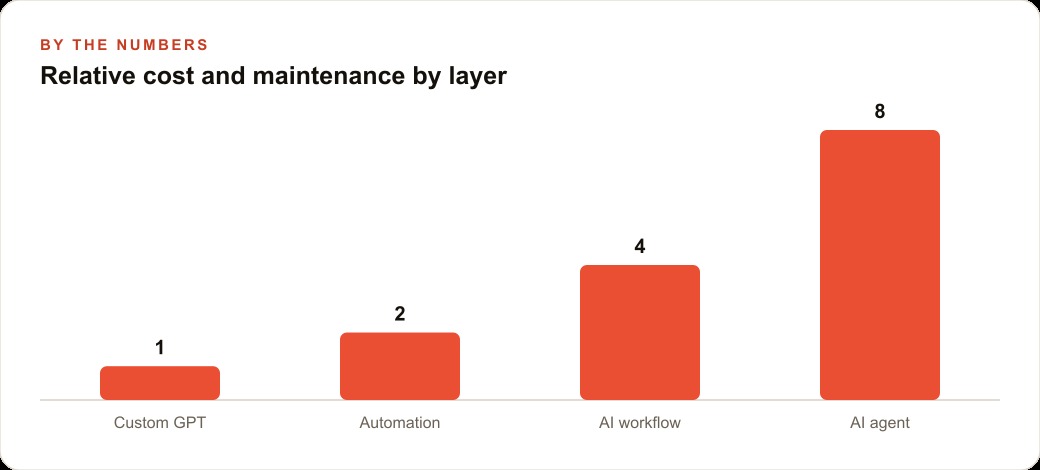
The restaurant owner who builds all four of those systems with the right layer for each gets reliable, low-maintenance tools that serve their actual needs. The owner who defaults to building an agent for every task ends up with four systems that all require monitoring, all carry a per-run model cost, and all fail in harder-to-diagnose ways when something goes wrong. None of them are more effective for their task than the simpler version would have been.
The pressure I mentioned at the start, the culture tilt toward complexity in how we talk about these tools, creates a subtle distortion in how people make building decisions. It makes staying at a simpler layer feel like settling. Like you are not serious about AI if you are using a custom GPT instead of an agent. That feeling is worth pushing back against directly, because it leads to real waste.
Picking the simplest layer that works for a given task is not settling. It is engineering judgment. It reflects an understanding that every layer above the minimum adds cost, complexity, and fragility without adding value for that specific problem. The people who are genuinely skilled at building with AI are not the ones who always reach for agents. They are the ones who can look at a task and immediately see which layer fits, then build at that layer without feeling the pull toward unnecessary sophistication.
The other thing worth saying is that getting the layer wrong on the first try is recoverable, and the willingness to adjust is itself a discipline. Some tasks that look like custom GPT jobs turn out to be so consistent and so volume-driven that moving them to a simple automation makes sense once you see the patterns in how they run. Some agents, after a month of real use, turn out to be doing the same thing every time, which means an AI workflow would do the same job at a fraction of the cost and with more predictable behavior. Noticing that gap and scaling the system down when simpler would serve better is not failure. It is how good engineering judgment actually looks in practice.
What I have found after building hundreds of these systems is that the teams with the longest track records of successful AI deployments share a common trait: they are ruthlessly honest about which layer they need. They do not build agents to signal sophistication. They build agents when the path genuinely cannot be predetermined, and they build everything else at the simplest layer that solves the problem reliably. That honesty, applied consistently across every new task they encounter, is what keeps their maintenance costs low, their systems reliable, and their trust in the tools high. The pyramid is not a constraint on ambition. It is the structure that makes ambition sustainable. Simplicity is not the absence of ambition. It is evidence that you are building for the problem, not for the audience. The discipline of reaching for the most efficient fix, the one that solves the real problem with the least complexity and cost, is the skill that produces systems worth keeping.
That is exactly what we do at AI DOERS. Book a private 30-minute call with Madhuranjan Kumar and we will map the fastest path to it for your specific business.
Book your call →
Madhuranjan Kumar
Madhuranjan Kumar brings 20 years of performance-marketing experience and has managed over $200 million in Facebook ad spend for brands across the United States and beyond. His expertise spans the full modern marketing stack: Meta, Google Ads, TikTok, email automation, CRM, and the websites that hold it together. At AI DOERS he turns that track record into lead-generation systems for businesses across every industry.