
How to Build an AI Agent That Produces 70,000 Words of Structured Content Automatically, and What That Means for Your Business
Using a multi-node automation workflow in Mind Studio, it is possible to generate a complete 10-chapter book from a title and genre in under 15 minutes. The architecture behind it applies to any business that produces long-form content repeatedly.

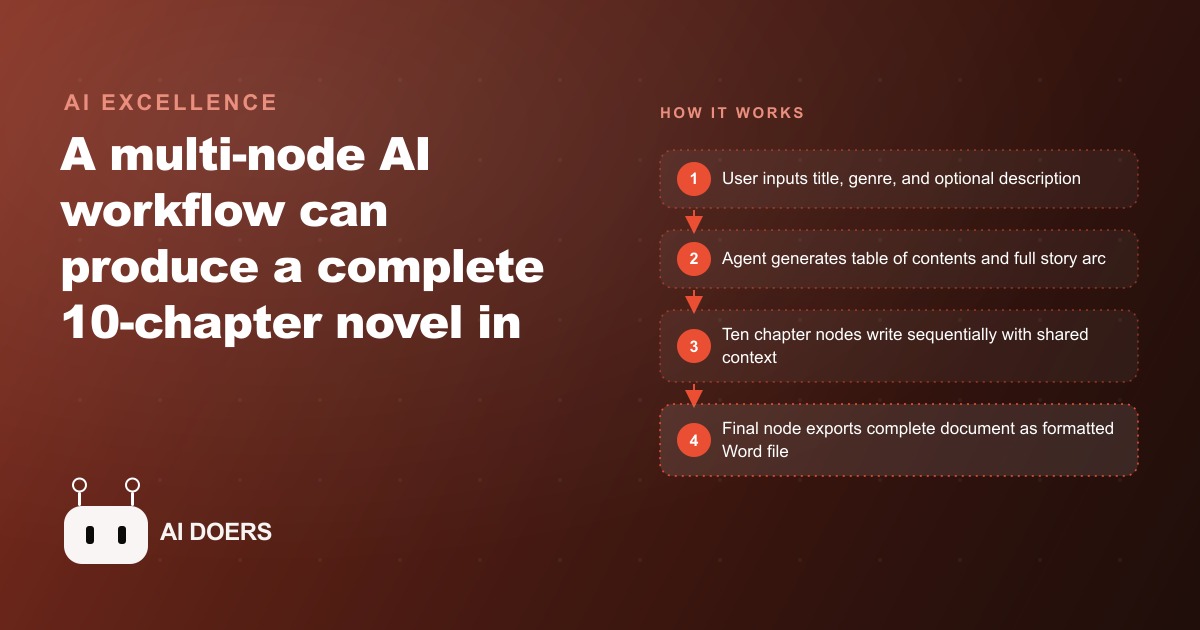
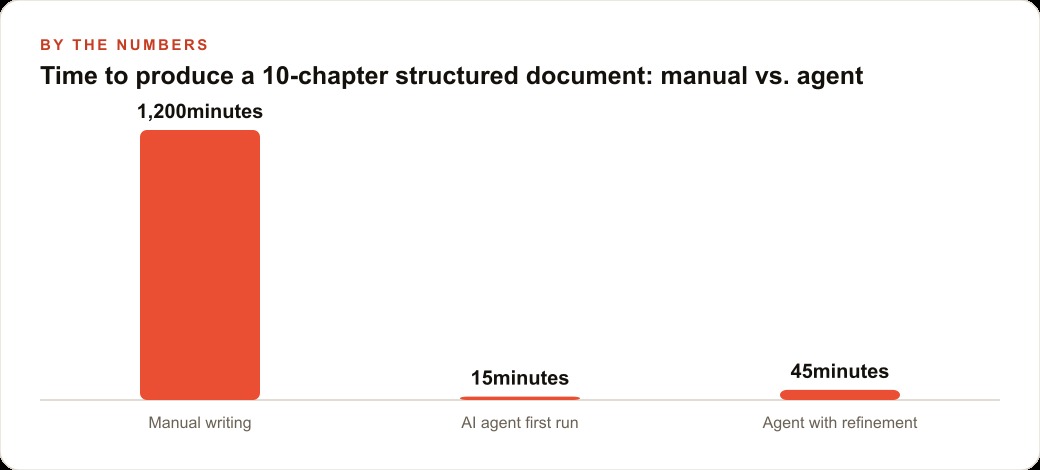
A documented demonstration this week showed a multi-node AI agent workflow in Mind Studio producing a complete 10-chapter, 70,000-word novel from just a title and a genre in under 15 minutes. The workflow ran without manual intervention between the user providing the title and receiving a formatted Word document of the finished manuscript. I am Madhuranjan Kumar, and the reason this demonstration matters is not the novel. It is what the architecture behind it reveals about how any business that produces recurring long-form structured content should now be thinking about its production process.
GPT-5 prose quality has crossed a threshold. The chapter text produced in the demonstration contained coherent dialogue, consistent characterization, and narrative continuity across thousands of words from a single prompt. A year ago, AI writing at that length tended to drift in tone, repeat character details inconsistently, and lose the thread of an established plot. The current output does not have those problems at first-pass quality, at least not in the ways that make a draft unusable as a starting point for editing. That change in baseline quality is what makes the architecture worth understanding. It was theoretically possible before. It is commercially viable now.
A 10-chapter, 70,000-word manuscript from a title and genre in under 15 minutes is a documented result
The workflow was built in Mind Studio, a platform that provides a visual canvas for connecting AI-powered nodes in sequence. Each node performs one specific function: collecting input, making a logical decision, generating text, or displaying output. The output of each node becomes the input to the next, so the full workflow runs from a simple user input to a complete formatted document without any manual steps in between.
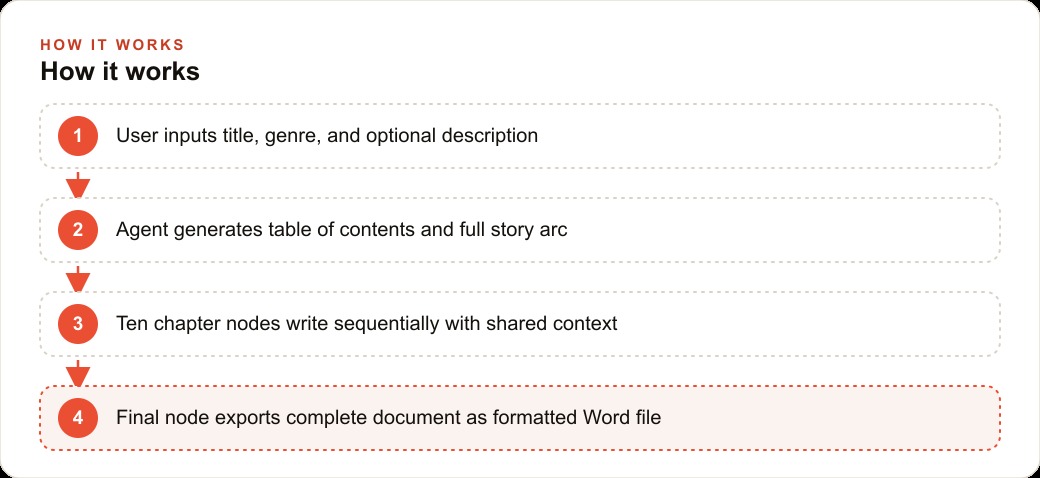
The specific workflow demonstrated used seven functional stages. A user input node collected the book title, the genre, and an optional longer description. A logic node inspected whether the description field had been filled. If it was empty, the workflow routed to a generation node that wrote a three-paragraph description using the title and genre. If it was already filled, the workflow skipped that step and moved forward directly. This conditional branching meant a user with only a title and a rough genre could use the workflow immediately, while a user with a detailed brief could provide it and get output that reflected it.
After the description existed, a table of contents node generated 10 chapter titles formatted consistently. A full story arc node used all the prior inputs together to produce a detailed synopsis of every chapter: character names, key locations, major plot events, and how each chapter connects to the next. This arc document became the shared context that all 10 chapter-writing nodes referenced. Each chapter node used the full arc plus the text of the immediately preceding chapter, so the prose in chapter seven was written with full knowledge of what chapters one through six established. The final node assembled everything and exported a formatted Word document.
The prose quality, using GPT-5 as the writing model for the chapter nodes, was good enough on a first pass for many content types. Not every sentence was publish-ready. But the structure was coherent, the voice was consistent, and the 70,000-word draft would take hours of editing to reach publication quality rather than weeks of rewriting. The ratio of production time to editing time is what changed.
The architecture runs on shared context passed forward through every node, not just sequential prompts
The design decision that makes this workflow produce coherent long-form output rather than disconnected sections is the shared context pass. Every node that generates content in the workflow receives not just its own specific instructions but the accumulated context of everything that came before it. The table of contents node receives the description. The story arc node receives the description and the table of contents. Each chapter node receives the description, the table of contents, the full story arc, and the text of the chapter that immediately precedes it.
This chain of shared context is what prevents the problems that plagued early AI long-form writing attempts. When each prompt section is independent, the model writing chapter seven has no knowledge of what chapter three established. Character names shift. Plot details contradict each other. The tone of chapter seven does not connect to the momentum that chapter six built. Passing the prior chapter text as explicit context for the next chapter node means each section of the manuscript reads as a continuation of what preceded it rather than a fresh start.
The conditional logic node is the second design decision worth understanding. Making the description field optional rather than required means the workflow is usable with minimal input while still supporting detailed briefing when the user has it. A user who provides only "The Last Mountain" as a title and "historical fiction" as a genre gets a complete manuscript. A user who provides a detailed plot outline, named characters, and a specified setting gets a manuscript that reflects all of that specificity. The same workflow handles both inputs because the logic node routes around the description generation step when a description already exists.
The multi-model flexibility is the third decision. Each node in Mind Studio can use a different AI model. The structural nodes, table of contents and story arc, use a capable but cost-efficient model since the task is organizing information rather than generating polished prose. The chapter-writing nodes use GPT-5, which produces the highest-quality prose. This allocation keeps the cost of running the workflow proportional to the value of the task at each step rather than using the most expensive model everywhere.
Every business that produces recurring structured long-form content now has a different operating option
The novel is a demonstration of the capability, not the primary business application. The same node architecture applies to any content that has a defined structure and requires multiple connected sections where each section needs to be informed by what came before. White papers, sales playbooks, employee handbooks, course curricula, and product documentation all follow this pattern. A 30-page white paper is ten sections with a shared context thread. A product onboarding handbook is seven modules where each module builds on the previous one. A course curriculum is twelve lessons where each lesson references the concepts introduced in earlier lessons. The workflow does not care whether it is producing a fantasy novel or a compliance handbook. It processes the structure the same way.
For SEO and organic content, this architecture has an immediate application in buying guide production. A comprehensive buying guide for a single product category, written to a standard that ranks in search results and actually helps a shopper make a decision, typically runs 2,000 to 4,000 words and takes a skilled content writer 3 to 5 hours. A brand with 20 product categories needs 60 to 100 hours of writing time just to produce a first-generation buying guide library. At a mid-range freelance content rate, that is $4,500 to $7,500 in direct cost before any editing.
Here is what the same production looks like with this workflow architecture. A user input node collects the product category name, the target customer profile, and the top five purchase considerations for that category. A generation node produces a detailed buyer persona and purchase journey summary. A structure node creates a 10-section outline for the guide. Ten content nodes write each section with the full outline and buyer persona as shared context, each section also receiving the text of the prior section. The final node outputs a formatted document. Running this workflow for 20 product categories takes one afternoon. The brand's content team then spends one to two hours per guide on editing, fact-checking specific product claims, and adding proprietary data the AI does not have access to. Total production time drops from roughly 100 hours to roughly 30 hours for the same content library. The saving on a single content initiative of this type is over $5,000.
The editing layer is where professional judgment remains the essential contribution
The demonstration's creator was explicit about this: AI-written books produced this way are first drafts. They are strong first drafts, notably stronger than what was possible at first-draft quality 18 months ago, but they are not finished manuscripts. The same is true for any business content produced through this architecture. The workflow produces the structure and the prose. A skilled human produces the accuracy, the proprietary insight, and the expert framing that distinguishes useful professional content from competent generic output.
For fiction, that editing layer involves character consistency checks, pacing adjustments, dialogue that sounds natural rather than constructed, and the specific decisions about what to include and exclude that define a writer's voice. The AI provides a first pass at all of these. The editor makes them right. For business content, the editing layer involves fact verification, proprietary case studies and data the AI cannot access, expert judgment calls about which claims need qualification, and the specific framing that makes content genuinely useful to a professional audience rather than merely accurate on a general level.
The ratio is still highly favorable. Three weeks to produce versus three days to review and refine is the kind of shift that changes what a content team can accomplish in a quarter. A content operation that could previously produce two white papers per quarter can now produce eight with the same staff, spending the recovered time on editing and expert input rather than on drafting and organizing. The web and CRM stack implications extend to product documentation, onboarding guides, and internal knowledge bases, all of which benefit from the same first-draft compression while still requiring human review for accuracy and completeness.
The architectural insight from this demonstration is broader than the novel example makes it appear. Structured long-form content with a defined section order, where each section builds on prior ones, is now automatable at the first-draft level for any business that produces it regularly. The key word is regularly. The architecture is most valuable when the same type of document is produced repeatedly, because the node configuration can be reused and refined across each production run. A company that produces four white papers per year gets more value from this architecture than a company that produces one. A course creator who produces two new courses per year gets more value than one who produces one. The investment in building the workflow pays off faster when the output format is consistent and the production frequency is high. For any business that finds itself producing the same kind of structured document more than twice a year, the question is not whether this architecture saves time. The question is why it has not been set up yet. The bottleneck has moved from production to review. Review is a better use of skilled human time than production, and skilled humans do it faster than they produce from scratch. That is the operating shift the 15-minute manuscript represents.
For businesses that have avoided building a content library because production time made it impractical, this architecture removes the main constraint. The reasons that made a comprehensive buying guide library, a complete FAQ database, or a detailed operations handbook feel like multi-month projects no longer hold at the same weight when the first-draft production time drops by 90 percent. The work that remains, the review, the fact-checking, the proprietary additions, the expert judgment calls, is the work that was always the valuable part. The architecture just removes the friction that was preventing businesses from doing enough of it. The demonstration this week made that point more concretely than any theoretical description could. A 70,000-word manuscript in 15 minutes is the kind of result that changes how a business owner thinks about what is now possible. The bottleneck was never the idea. It was always the time between having the idea and having the finished document. That gap just got dramatically smaller for any business willing to set up the workflow.
That is exactly what we do at AI DOERS. Book a private 30-minute call with Madhuranjan Kumar and we will map the fastest path to it for your specific business.
Book your call →
Madhuranjan Kumar
Madhuranjan Kumar brings 20 years of performance-marketing experience and has managed over $200 million in Facebook ad spend for brands across the United States and beyond. His expertise spans the full modern marketing stack: Meta, Google Ads, TikTok, email automation, CRM, and the websites that hold it together. At AI DOERS he turns that track record into lead-generation systems for businesses across every industry.