
Skills That Stick: A 24/7 AI Assistant That Compounds Over Time
The new wave of AI agents save every skill they learn, so a tireless assistant gets more capable each week. Here is how a small business turns that into automated back-office work.

I want to tell you about a pattern I have watched play out with service businesses when they first set up a compounding AI agent. It never goes the way the owner expects on day one, but by week six it looks like something quite different from the tool they started with. I am going to walk through it using a landscaping company as the frame, because the admin pattern there is predictable and the numbers are easy to verify. The business handles a different set of jobs every week, but the paperwork follows the same shape every single day, which is exactly the condition that makes an agent compound fastest.
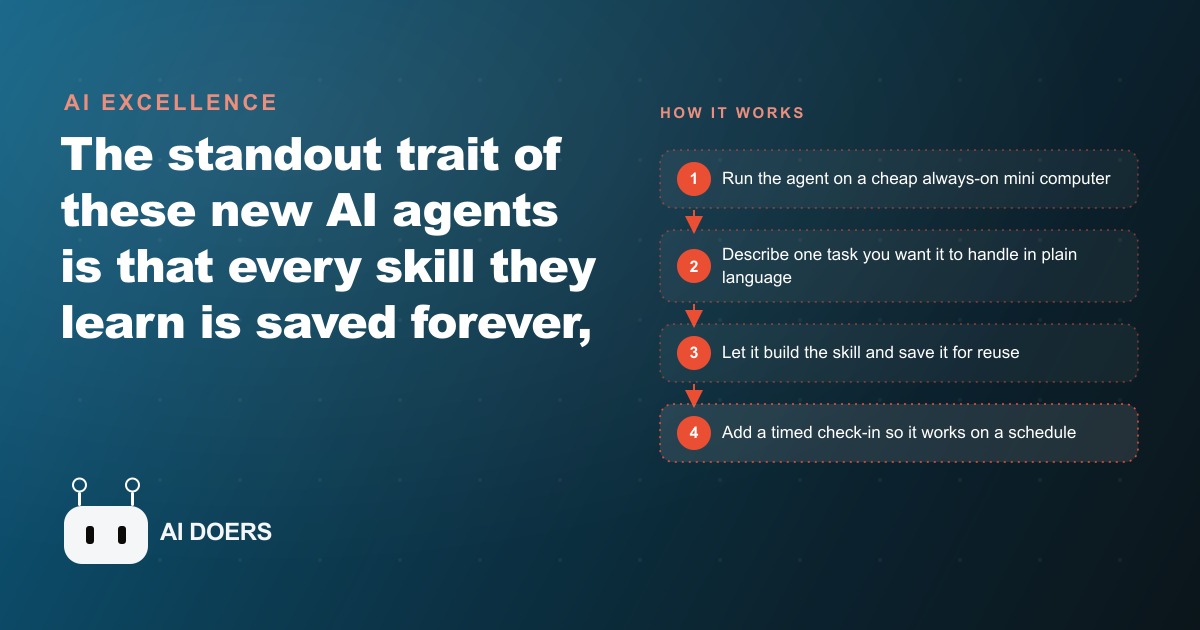
The agent I am describing runs on a small, low-power mini computer that costs around 100 dollars as a one-time purchase and sips a few dollars of electricity every month. It does not require an always-on cloud subscription or expensive recurring compute. It sits in the office or at home, runs continuously, and becomes more capable with each skill it learns, because every skill is saved permanently. The second time it encounters a task, it does not relearn the approach. It executes from the saved skill and moves on.
Week one: the owner decides which task to hand off first
The first decision the owner makes is not about technology. It is about identifying the single most predictable, repetitive task in their daily routine and confirming that the task follows a consistent enough pattern that an agent could learn it reliably. The owner of this landscaping company spends about 20 minutes every evening taking the day's field notes from the crew, formatted as voice memos or short texts from the crew lead, and turning them into a clean daily summary that goes into the company's note-taking system.
The format is always the same: which jobs were completed, how long each took, what materials were used, any notes about issues on site, and whether any customer follow-up is needed. The summary needs to be readable by the owner, the crew lead, and occasionally the bookkeeper. The task is not creative. It is not judgment-heavy. It is formatting work that follows a fixed template every single night, and the owner is doing it themselves because nobody else knows the format well enough.
This is the right first skill to hand to an agent. Tasks that require judgment, relationship nuance, or knowledge the agent was not present to acquire are the wrong candidates. The daily note summary is right because the inputs are predictable, the output format is fixed, and the value of doing it correctly is immediately verifiable by the owner. If the summary is wrong, the owner catches it in review. If it is right, the agent saves 20 minutes of an evening that the owner was spending on paperwork instead of rest.
Teaching the daily note summary: one week to build the first skill
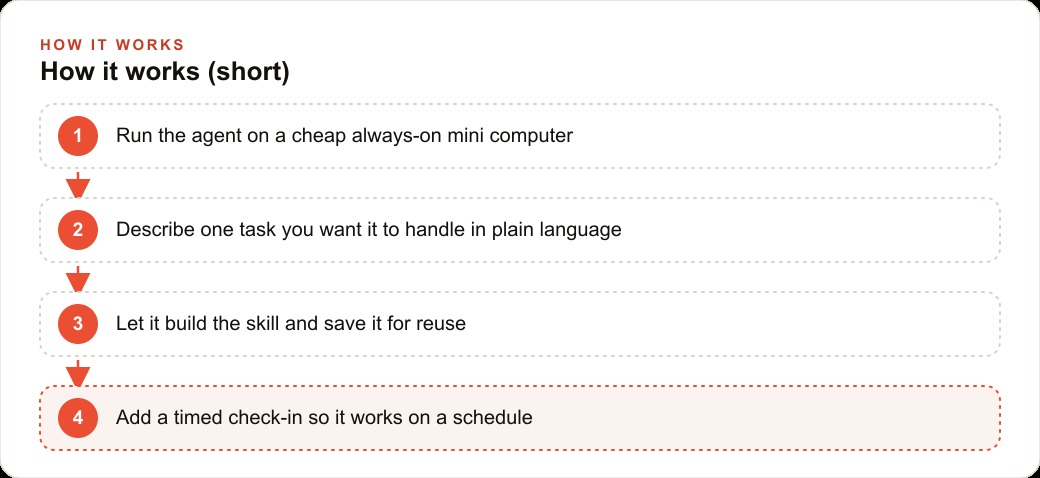
The owner describes what they want in plain language. The agent builds the capability, tests it on a sample of past notes, and the owner reviews the output. The first version usually needs a few corrections: the format of the job completion section is not quite right, a field is missing, or the issue notes are too brief. Each correction is described back to the agent in plain language and the agent adjusts. Most setups reach a reliable state within three to five test cycles, which takes a few hours spread across the first day or two.
After the adjustment phase, the owner runs the agent on real notes for five business days before declaring the skill locked in. This step is important. A skill that works on sample data but not on real data has not been truly learned. Running it live for one full week catches the edge cases: the day when the crew lead sends voice memos instead of text, the day when three jobs ran over and the notes are longer than usual, the day when a customer note is ambiguous. Each edge case the agent handles correctly during this live week adds to the robustness of the skill. By the end of week one, the daily note summary runs on schedule, the output is consistently clean, and the owner has verified it on five consecutive evenings. The 20 minutes it used to take now takes two to three minutes of review. That is the first 20 minutes per day returned to the owner, permanently.
Adding the Monday route report: the second skill takes half the time
By week two the owner is comfortable with the process and ready to add the second skill. Monday mornings the owner currently spends 40 to 45 minutes pulling together the completed jobs from the previous week, checking which ones ran long compared to the original estimate, and generating a brief summary that goes to the crew lead before the week starts. It helps the crew lead prepare the trucks and flag if any customer called about an issue from the prior week.
Teaching this second skill takes about half the time the first one did. The agent already understands the note format, already knows the company's job fields and terminology, and already has access to the data it needs. Describing the Monday route report to the agent is mostly about the output format: which fields to include, how to flag jobs that ran more than 15 percent over estimate, and how to sort the list. The agent builds the skill in a few hours, the owner tests it on two Monday mornings of historical data, and by the third Monday it is running automatically.
The time recovery from the route report alone is roughly 40 to 45 minutes every Monday morning. Combined with the 20 minutes per day from the note summary, the owner is now recovering about two hours and 20 minutes per week. That is real time, happening every week, from two skills that took about three days of setup in total.
By week six: three permanent skills, evenings mostly free
The third skill the owner adds is afternoon appointment confirmations. Every afternoon the agent drafts short messages confirming the next day's jobs for any customers where a confirmation has not yet been logged. The format is simple: a brief note with the scheduled time, the crew lead's name, and a reminder of what the job covers. The owner reviews the drafts once each afternoon and approves them with a single action. The first week the owner corrects three or four for tone. By the second week the corrections are minimal. By week three the agent has the right tone and the owner rarely needs to change anything.
By the end of week six, the owner's evening routine has changed substantially. The daily note summary runs on a schedule and lands in the note system by 7 PM without any prompting. The Monday route report is ready when the owner opens their phone on Monday morning. The afternoon confirmation drafts are queued for a single review that takes five minutes instead of 20. The owner's evenings are mostly free from the admin that used to fill them. The business has not added any staff. It has not changed its service offering. It is running the same number of jobs with the same crew. But the administrative overhead on the owner's time has been cut by more than two hours every week, permanently, by three saved skills running on a schedule.
The total cost at this point is the one-time hardware purchase of roughly 100 dollars and an ongoing operating cost of about 20 dollars per month for electricity and any subscriptions the agent uses. The two hours per week returned to the owner is worth far more than 20 dollars per month in any honest accounting of what an owner's time is worth.
What the security setup looks like and why it cannot be skipped
Before the agent touches any real account, the owner sets strict limits on what it can access. The agent has permission to read and write to the note-taking app. It has permission to draft messages in the confirmation queue. It does not have access to the financial accounts, the payment processor, or any customer billing information. Budget limits are set so that if the agent calls any service with a per-use cost, it cannot spend more than a small preset ceiling in any given day, which prevents a runaway task from generating unexpected charges.
The credentials the agent uses are kept in a protected store that is not accessible from the network. The owner reviews the activity log once a week, especially in the early weeks, to confirm that the agent is doing exactly what was described and nothing more. This review takes about five minutes and catches the kind of small drift that happens when the agent encounters an input it was not trained on and guesses at the output format. A few minutes of review in the first week is all it takes to catch these cases and correct them before they become habits.
Security is non-negotiable because the agent has real access to real accounts. A poorly configured agent can do real damage if a task goes wrong, whether by sending incorrect information to customers, triggering unexpected charges, or behaving unpredictably in an account with financial permissions. The discipline of starting with minimum access and expanding carefully is what keeps the risk proportionate to the benefit.
What the compounding curve actually looks like at week twelve
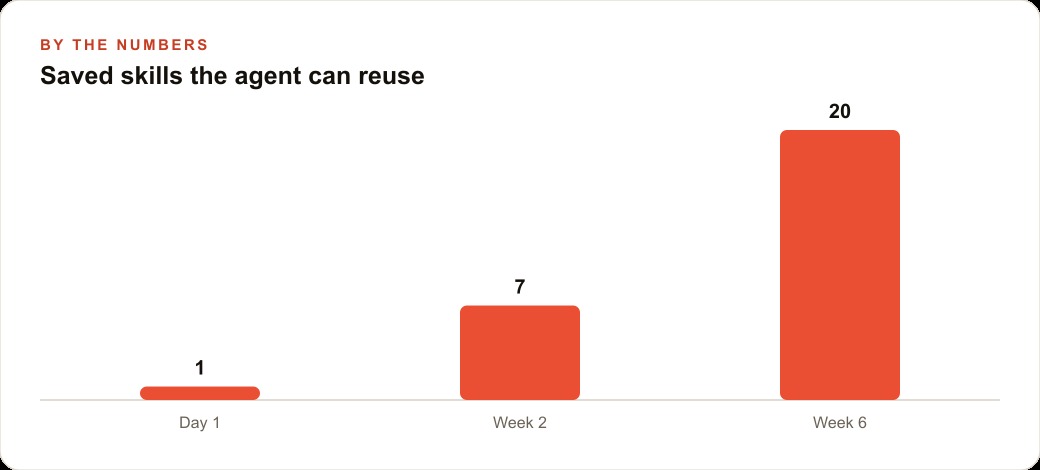
By week twelve, the agent knows the company's patterns well enough that each new skill takes a fraction of the time the first one took. The first skill took a full day of active setup spread across several days. The second took about half that. By week twelve, adding a new skill is a 30 to 60 minute process: describe the task, test on real data, verify for one week, lock it in. The agent now has seven or eight saved skills, each one running on a schedule or triggering automatically on a condition, and the cumulative weekly time recovery for the owner has grown to more than three hours per week across all the skills together.
The business at week twelve is running differently than the same business at week one, not because the product or service changed, but because the administrative overhead that used to consume a meaningful portion of the owner's week is now handled by an agent that costs 20 dollars a month and runs continuously. Every new skill that gets added extends that compounding. By the end of the first year, the agent will have learned 15 to 20 skills, and the owner will have recovered time that used to go to repetitive admin, freeing them to work on the parts of the business that actually require their judgment: relationships, quality, pricing, and growth.
The pattern works because of two properties that reinforce each other. The skills are permanent, so nothing learned is ever lost. And each new skill builds on the agent's existing familiarity with the business, so the learning curve shortens continuously rather than resetting with each new task. That compounding is the real argument for starting now and starting small. The owner who teaches one skill per week for the next six months will have an agent handling a meaningful slice of their back-office by the end of the year. The owner who waits for the technology to mature further before starting will simply have fewer skills saved and a longer runway before the value is felt.
Choosing the right next task to teach
Not every task is the right candidate for the next skill, and part of what I have learned watching this pattern play out is that the owner's instinct about what to automate is sometimes right and sometimes wrong. The right tasks share three characteristics: they follow a predictable input pattern, they have a verifiable output format, and they do not require judgment that only comes from knowing the customer personally or being present on the job. The daily note summary checks all three. The Monday route report checks all three. The afternoon confirmations come close.
The wrong candidates are tasks where the output needs to be adjusted based on relationship context: a client who is particularly anxious about timing and needs a warmer tone, a long-term account that gets different treatment than a new one, a situation where what to say depends on something the agent was not there to observe. Those tasks are not ready for the agent, and pushing the agent into them before it is ready produces output that is technically correct but relationally wrong, which is worse in some ways than no output at all.
The discipline is to be honest about where the task boundary lies and to leave judgment-heavy tasks on the human side until the agent has proven itself consistently on the structured ones. The agent earns expanded responsibilities by performing well on narrow ones first. That progression is not a limitation of the technology. It is the way any capable team member earns more autonomy over time, and it produces a much more reliable outcome than handing over complex judgment calls too early.
The self-correction mechanic and what it means for supervision
One of the most practically useful properties of these agents is that they retry and troubleshoot in the background when a task fails, rather than stopping at the first error and waiting for the owner to intervene. This self-correction means the owner is not babysitting every task after the initial setup. If the note summary fails because the crew lead used an unusual format for one field, the agent tries alternative parsing approaches and, in most cases, produces a clean output without any human involvement.
The self-correction mechanic does not eliminate the need for the weekly log review. It just means that by the time the owner reviews the log, most failures have already been resolved and the owner is reading about what happened, not being asked to fix something. The review becomes a quality check rather than a help desk call, and it takes five minutes instead of an unplanned hour. For a business owner who is already managing a full calendar, the difference between an agent that waits for help and one that resolves its own errors is enormous.
The limit of self-correction is worth knowing. The agent will retry a task using approaches that are variations on what it already knows. It will not invent a fundamentally new approach from scratch. If the input format changes in a way that is genuinely outside anything the agent has seen, it will either fail repeatedly or produce output that looks plausible but contains errors. That is why the weekly log review matters and why the adjustment conversation, describing the new situation to the agent in plain language, is the right response when a pattern of failures appears. The agent learns from that description and the skill updates without having to be rebuilt from scratch.
Scaling the setup to a second location or a larger team
Once the agent is running three or four skills reliably on one location or one team, the same setup scales to a second location with far less effort than the first one required. The skills that are location-independent, like the note format, the route summary structure, and the confirmation message template, carry over directly. Only the location-specific details need to be added: the second location's crew names, its customer database, its scheduling system. The agent builds on the existing skills and adds the location-specific layer on top.
For a landscaping company that expands from one crew to two, this means the second crew is on the same admin system within a week of onboarding, not a month. The owner is not rebuilding the setup from scratch. They are adding a layer to something that is already working. At three crews, the agent is managing a volume of daily admin that would require a dedicated part-time hire in a traditional setup, and it is doing it for the same 20 dollars per month that it cost with one crew. The economics improve significantly with scale, which is the reverse of what happens with most operational costs as a business grows.
That is exactly what we do at AI DOERS. Book a private 30-minute call with Madhuranjan Kumar and we will map the fastest path to it for your specific business.
Book your call →
Madhuranjan Kumar
Madhuranjan Kumar brings 20 years of performance-marketing experience and has managed over $200 million in Facebook ad spend for brands across the United States and beyond. His expertise spans the full modern marketing stack: Meta, Google Ads, TikTok, email automation, CRM, and the websites that hold it together. At AI DOERS he turns that track record into lead-generation systems for businesses across every industry.