
Why a Team of Arguing AI Agents Beats a Single Chatbot for Your Business
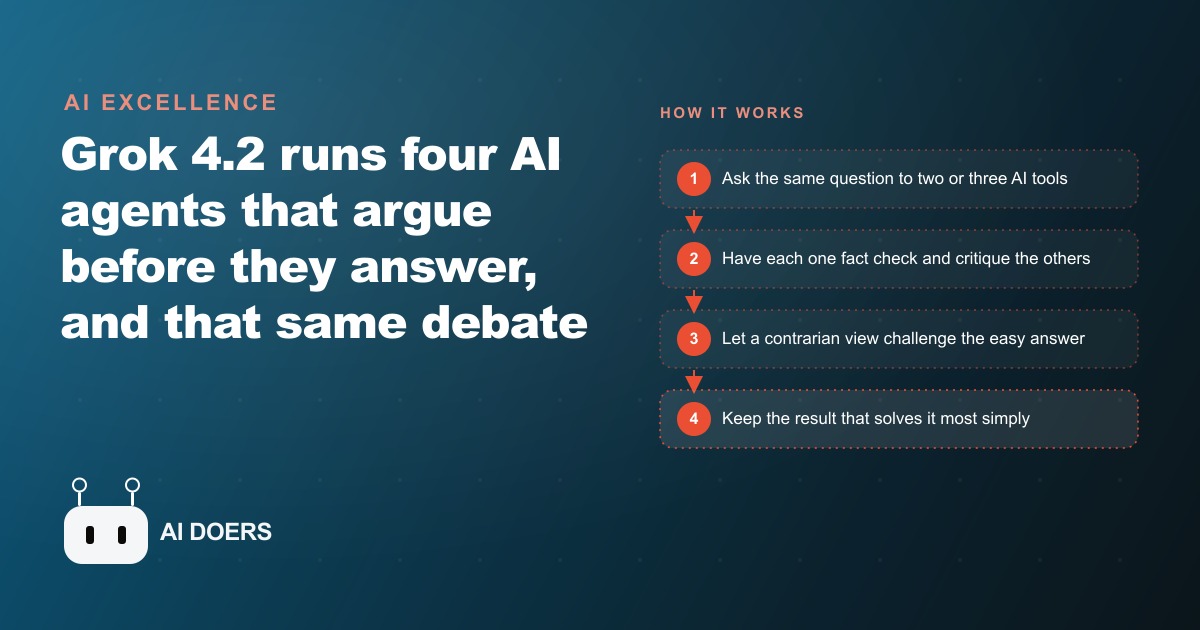
Grok 4.2 ships with four AI agents that debate each other before answering. You can copy that pattern with free tools to get sharper research, safer quotes, and smarter decisions.

A plumbing company owner in the Pacific Northwest handed a repipe estimate to a customer last spring and almost left four hundred dollars on the table because he trusted the first AI answer he got.
I am Madhuranjan Kumar, and this piece is about what he did differently on the next job, and the one after that, and why the debate pattern he built from free AI tools has become the most reliable decision-making step in his business. The broader context is Grok 4.2, which ships with four internal AI agents that argue with each other before producing a final answer. A coordinator assigns tasks, a researcher pulls information, a logic agent checks numbers, and a wildcard agent deliberately argues the other side to break the group out of shallow consensus. You do not need Grok to benefit from this architecture. You need to understand the pattern and replicate it with free tools you already use.
The estimate that was almost wrong by four hundred dollars
The job was a full repipe on a 1960s ranch house with copper throughout. The owner priced it the way he always had: he walked the house, counted the fixtures, estimated his labor hours based on the crawlspace access, and built the materials list from there. Then he asked a single AI tool to sanity-check his number. It came back with a confirmation. The estimate looked solid, so he sent it.
Three days later, reviewing the job again before the start date, he caught something. He had not included the permit fee for the county, which ran to three hundred and eighty dollars in that jurisdiction, and the inspection cost on top was another forty-two dollars. He had been doing enough jobs in that county that the fees should have been automatic, but they were not in the first estimate. The AI that confirmed his number had not flagged them either, because he had not described the job in enough detail for it to know what to ask about.
He caught it in time, went back to the customer, explained the oversight, and updated the figure. The customer understood. But the owner spent two days thinking about what would have happened if he had not caught it before the start date, and how many smaller misses had probably slipped through in the previous year without him noticing because there was no second pass built into the process.
The miss was not the AI's fault. The AI answered the question it was given. The problem was that the process had no contrarian voice and no built-in step where a second perspective was invited to look for what the first answer might have skipped. That is the exact structural problem the four-role debate pattern solves, and it is also why the Grok 4.2 architecture is worth studying even if you never use that specific product. The pattern is what matters, not the platform.
Setting up the four-role debate with free tools
The owner did not switch to Grok. He used the free tier of two AI tools he already had and added one structured step to his estimating workflow.
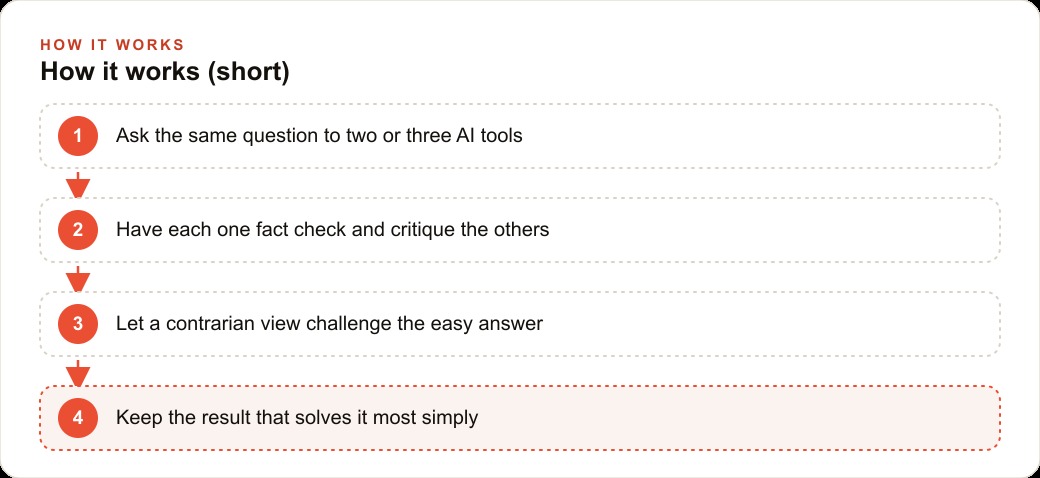
The pattern he built works like this. He describes the job in full to the first tool: scope, material list, labor hours, access conditions, jurisdiction, customer type, and any constraints he knows about. He asks for a complete estimate including every cost category, materials, labor, permits, inspections, and contingency. He saves that as his first draft.
Then he pastes the full job description and the first draft estimate into a second AI tool and asks it to play the role of fact-checker and logic reviewer. He gives it a specific brief: find every cost that might be missing, check whether the labor hours are consistent with the scope, flag any number that does not reconcile with the others, and identify any assumption the first estimate made that could turn out to be wrong. This second pass is the researcher and logic-checker in one, similar to the two separate roles in Grok 4.2 but collapsed into one step since he is running this manually with free tools.
The third step is the one that changed things most. He pastes the full job description, the first draft, and the fact-checker's notes into either tool and adds one more instruction: act as the contrarian. Your job is to argue that this estimate is wrong. Find the single most dangerous assumption in the estimate and explain how it could cost money. Argue for a different approach if one exists. Do not try to be balanced. Be adversarial.
The whole process adds between twenty-five and thirty-five minutes to his estimating workflow. On a job worth two thousand to eight thousand dollars, that is time very well spent. He treats it the same way a surgeon treats a checklist: the process exists not because every case has a problem, but because the cases that do have a problem are indistinguishable from the ones that do not until the damage is already done.
What the contrarian view caught that the first answer missed
On the next crawlspace repipe after he built this system, the contrarian step caught something the fact-checker had not.
The job was similar to the one that started this: a full copper repipe, crawlspace access, a four-bedroom house. The first AI estimate came in at four thousand three hundred dollars. The fact-checker found a small discrepancy in the fixture count and added sixty dollars. The contrarian came back with something different.
The contrarian pointed out that the estimate assumed an eight-hour labor day for the crawlspace portion, which is standard for a clean crawlspace with good clearance. But the job description mentioned limited access without specifying the height. If the crawlspace clearance was under twenty-four inches, which is common in 1960s construction in that region, a two-person crew would need significantly longer in that space, and one crew member would likely have to work solo on sections where two-person positioning was impossible. The estimate also assumed no vapor barrier complications, which the contrarian flagged as an untested assumption given the house's age.
When the owner went back to the site to check, the clearance in the main run was eighteen inches. He adjusted the labor estimate by four hours and added a contingency line for vapor barrier work. The adjusted total came to four thousand eight hundred and twenty dollars. He won the job at that price.
Without the contrarian step, he would have sent a bid four hundred dollars lower, absorbed the extra hours as a loss, and possibly turned a profitable job into a breakeven one. The value of a built-in adversarial voice is not that it always finds a problem. It is that on the jobs where a problem exists, it reliably surfaces it before the estimate goes out, when you still have time to do something about it.
Running the same debate on the service page copy
About six weeks into using the debate system on estimates, the owner started applying it to his service page and local content. His website had been built three years earlier and the copy was vague in the way plumbing websites often are: licensed, insured, serving the greater metropolitan area, available for emergencies, free estimates. Every competitor said nearly identical things.
He ran the debate pattern on his own homepage copy. He pasted the existing text into the first tool and asked: what claims on this page are vague, unverifiable, or interchangeable with every other plumbing company in this market? The list came back long. Every headline was generic. No page mentioned a specific job type, a specific neighborhood, or a specific customer outcome with any detail.
He then ran the contrarian step on the copy itself: act as a homeowner who found this page on a search and is skeptical. What is your biggest objection to calling this company? The answer was consistent across three separate runs: nothing on this page tells me why this company is different from the other eight plumbers who showed up in my search. They all say the same things.
He rewrote the homepage and the repipe service page using the debate output as a creative brief. The new copy led with crawlspace repiping specifically, mentioned three neighborhoods by name where the company had done notable jobs, included a real turnaround time with a guarantee attached, and replaced the generic "free estimates" line with a specific promise about same-day estimates on any job over a thousand dollars. He ran the contrarian pass one more time on the finished draft, and it caught two claims he could not easily back up. He cut those.
He applied the same approach to his Google Ads headlines and descriptions for the seasonal drain cleaning push and to his Facebook and Instagram ad copy for the winter pipe-protection campaign. The contrarian step on ad copy is particularly useful because it simulates the skeptical scroll: a homeowner moving quickly through a feed who needs one specific, credible claim to stop, not a list of generic promises that blend into every other ad.
Three months of weekly debates: what changed in the numbers
By the end of month three, the owner had run the four-role debate on every estimate over fifteen hundred dollars and on all of his marketing copy. Here is what the numbers showed.
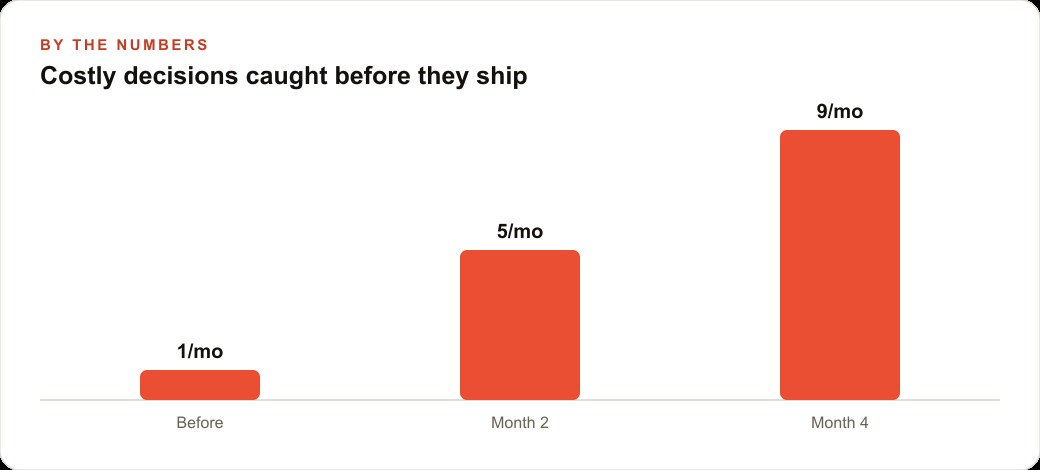
On estimates, he ran the debate on eleven jobs in the first three months. On four of those jobs, the contrarian or fact-checker step found a meaningful error or uncosted assumption: permit fees missed once, labor hours underestimated twice given access conditions, and one job where the contrarian flagged a material spec that did not match the local code for that neighborhood's age of construction. The adjustments on those four jobs added a combined nine hundred and thirty dollars in revenue that he would otherwise have absorbed as cost. The additional time the debate process required across all eleven jobs was roughly three hours total. Three hours of structured adversarial questioning recovered nearly a thousand dollars in margin.
On marketing, the changes were slower to measure but clearer in direction. His website click-to-call rate from organic search increased from two percent to four and a half percent over the three months after the copy rewrite. The specific neighborhood mentions drove three direct calls from homeowners who said they found the page because it named a street near them. None of those calls would have come from the original generic copy.
He also noticed something broader about his own decision-making that he had not expected. Running a deliberate contrarian pass on important decisions, even outside the AI system, changed how he evaluated options. He started asking the contrarian question in his head before committing to a supplier change, a crew addition, or a pricing adjustment. The habit the debate structure built transferred to situations where he was working entirely alone. The AI tools gave him a format. The format became a thinking pattern.
The debate pattern also changed how his crew operated. He started sharing the contrarian feedback from the crawlspace estimate with his lead technician before jobs, which opened conversations about site conditions that previously happened only after the job started and the problem was already costing time. The pre-job contrarian brief became a five-minute verbal habit before the crew loaded the van. That habit alone, the practice of asking what the estimate might have gotten wrong before arriving on site, is something the owner says he would have paid for separately if someone had packaged it as training. Instead it emerged naturally from the structure of the AI debate.
The practical summary is this. The four-role debate is not a technology upgrade. It is a decision-making discipline that happens to be cheap and fast to run with free AI tools. Pick any decision where a wrong number or a missed assumption costs money. Run the fact-checker pass to catch errors. Run the contrarian pass to surface the assumption you are most attached to and least likely to question on your own. Keep the answer that survives both. The plumber who almost missed the permit fee would tell you it takes thirty minutes and it earns its keep every single time.
That is exactly what we do at AI DOERS. Book a private 30-minute call with Madhuranjan Kumar and we will map the fastest path to it for your specific business.
Book your call →
Madhuranjan Kumar
Madhuranjan Kumar brings 20 years of performance-marketing experience and has managed over $200 million in Facebook ad spend for brands across the United States and beyond. His expertise spans the full modern marketing stack: Meta, Google Ads, TikTok, email automation, CRM, and the websites that hold it together. At AI DOERS he turns that track record into lead-generation systems for businesses across every industry.