
AI Agency Predictions For 2026: Where The Real Money Is Moving
The AI opportunity is not shrinking, it is evolving into full transformation partnerships. The winning moves for 2026 are leading with a high-converting audit, proving clear ROI, fixing core software first, adding adoption training, and owning your IP.

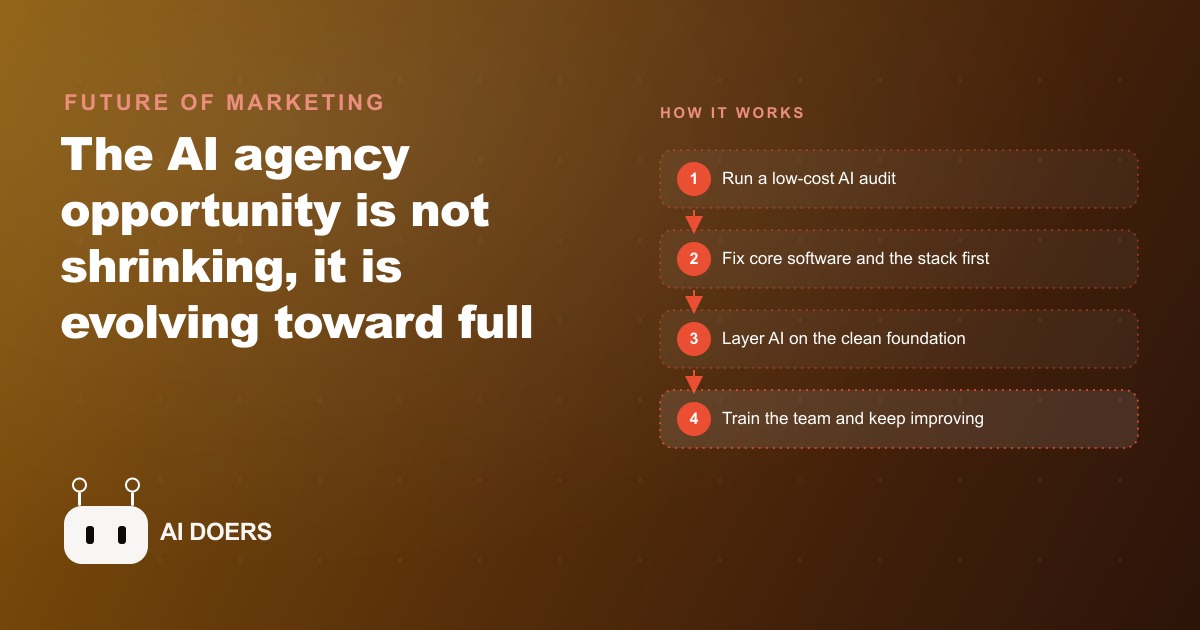
The AI agency opportunity is not collapsing. It is reorganizing. The businesses that were buying AI projects to see what might happen have been replaced by businesses that want a specific, provable return on a concrete problem. The agencies winning in 2026 are the ones that changed their entry point, their service mix, and their pricing model to match that new expectation. I am Madhuranjan Kumar, and what follows is the practical playbook for doing exactly that.
Lead with the audit, not the AI
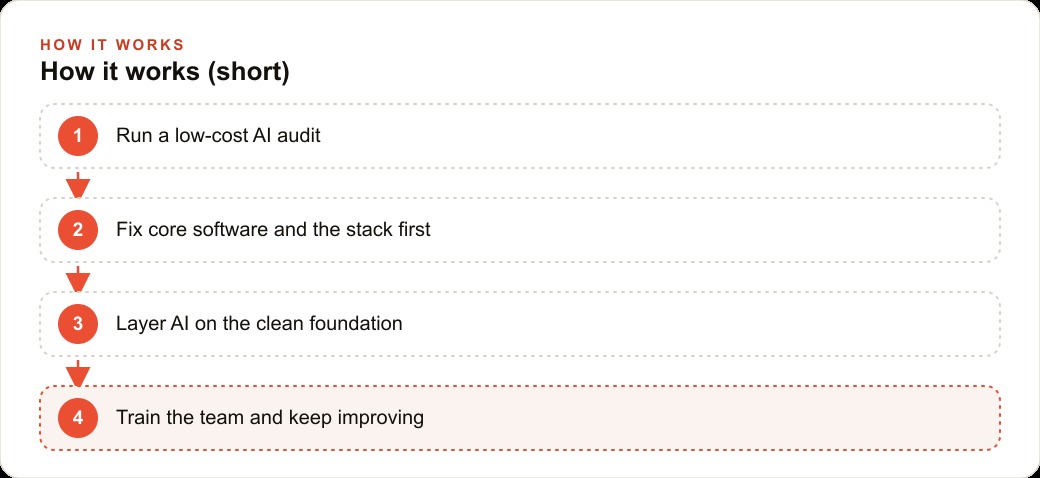
The entry offer that produces the most consistent conversion in the current market is a structured audit of the client's operations, not a pitch about what AI can theoretically do. The audit works as the front door for the same reason that a home inspection works before a renovation: it produces specific findings about specific problems rather than a general argument for why change would be good.
An AI audit for a business typically covers three to four weeks of focused observation: how leads come in and how many drop between first contact and first appointment, how work is scheduled and where double bookings or missed slots happen, how customer communication flows and where the gaps cost repeat business, and what the current software stack looks like and where data lives in disconnected tools that do not talk to each other. The output is a ranked list of operational problems with estimated labor cost per week for each one.
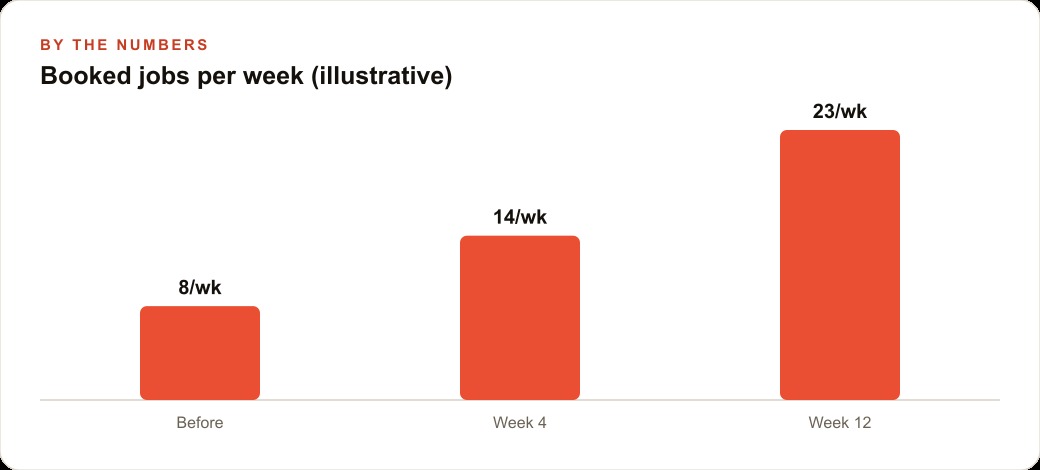
This audit structure produces conversion for two reasons. First, the findings are specific to this business, not generic best practices that apply to everyone. When a roofing company owner sees that the business is losing 23 leads per month to a slow follow-up process that could be partially automated, that is a different conversation than being told that AI can improve your follow-up. Second, the audit earns trust before a larger engagement begins. An agency that spends time understanding the business before proposing a solution demonstrates the judgment that expensive transformation work requires.
In programs that track this systematically, the audit is consistently the highest-converting entry offer, with average deal sizes for the transformation work that follows running well into five figures. Agencies that lead with the AI pitch instead of the audit pitch are competing on the strength of marketing claims against other agencies making similar claims. Agencies that lead with the audit are competing on the quality of their findings, which is a much more favorable position.
Fix the foundation before you layer anything clever
The most common reason AI projects fail at mid-size companies is that the AI sits on top of a broken operational foundation. Lead data lives in three places and none of them are current. The scheduling system is a combination of a whiteboard and whoever's phone they called last. The customer database has not been updated since the last software migration and contains records that are years old.
AI cannot reason accurately from broken data. An AI system that routes incoming leads based on territory does not work when the territory definitions are buried in a document that nobody has updated in 18 months. A voice agent that books appointments does not work when the calendar system is not reflecting actual crew availability in real time. The AI amplifies the quality of the operational foundation underneath it. A clean foundation produces useful output. A broken one produces confident-sounding wrong answers, which is worse than no system at all.
The counterintuitive insight from the best agencies running this model is that roughly 80 percent of the revenue in a typical transformation engagement comes from plain software development rather than AI specifically. Building the clean CRM, the real-time scheduling tool, the automated quote and follow-up flow. Modern coding tools let one skilled developer produce what used to require a small team, which means the margin on this work is strong while the bill rate is below what an enterprise software firm would charge.
Only once the foundation is clean does AI sit on top in a way that produces reliable results. A voice agent that routes leads to a clean, updated CRM performs well. The same agent routing to a spreadsheet of outdated contacts does not. The sequence matters more than the technology selection.
Build adoption training into the deliverable
The second most common reason AI implementations fail is that the system was built without any plan for how the people who need to use it would learn to use it. A new CRM that nobody knows how to navigate is worth the same to the business as no CRM. A voice agent that front-desk staff do not trust produces exactly the kind of workarounds that eliminate any efficiency gain the system was supposed to create.
A 15,000 to 20,000 education and adoption package added after the technical delivery is not an upsell. It is the insurance that the technical delivery produces its intended return. The businesses that skip this step consistently report lower satisfaction with AI implementations because the system technically works but operationally does not get used. Staff revert to prior habits because the new system feels unfamiliar and because no one made the case clearly for why the change is worth the learning curve.
The adoption package covers three things: how to use the new system correctly, why the new system produces better outcomes than the old approach, and what to do when something in the new system produces an unexpected result. The third element is often underemphasized. Staff who encounter a system error and have no guidance on what to do will default to the workaround they know, which is the old manual process. Staff who know exactly who to call and what to report when something goes wrong stay in the new system because they have a clear path forward when it is imperfect.
For a roofing company, the adoption package for a new lead routing and follow-up system covers how the dispatcher enters incoming leads, what the automated follow-up sequence looks like and when human intervention is needed, how to read the status dashboard, and who to contact if a lead appears stuck in the system. That document plus two hours of training with the actual team prevents the drift back to manual tracking that otherwise happens within three to four weeks of launch.
Price by outcome, not by hour
The shift from hourly billing to outcome-based pricing changes the client relationship in a fundamental way. Hourly billing positions the agency as a vendor executing instructions. The client wonders whether each hour is necessary. The agency wonders whether the client will dispute the invoice. The conversation centers on time tracking rather than on whether the business result is being achieved.
Outcome-based pricing positions the agency as a partner in a business result. The pricing is attached to a measurable change: leads booked per week, follow-up response time, quote-to-deposit conversion rate. The client is buying a result rather than a service. The agency is motivated to find the most efficient path to the result because efficiency creates margin rather than creating pressure to invoice more hours.
For a roofing company, an outcome-based engagement might be priced at a fixed fee for achieving a specific lead conversion improvement over 90 days. The agency's incentive is to build the most efficient system that produces that improvement. The client's incentive is to provide access and cooperation because they are paying for the result, not for the activity. Both parties are aligned toward the same goal rather than toward an invoice dispute.
The conversation that unlocks outcome pricing is the audit. An agency that has done a detailed audit and found that the business loses 23 leads per month to slow follow-up can make a specific case for what closing that gap is worth in annual revenue and price their engagement as a fraction of that value. An agency pitching without an audit is guessing at the value and cannot make a credible case for why the engagement is worth the price.
Own the IP before you leave the project
The most durable value creation for an AI agency is not the client work. It is the proprietary systems built during client work that apply across multiple clients and can be sold as a product rather than rebuilt from scratch for each engagement.
The mechanism is client work as research and development. When an agency builds a lead routing system for a roofing company and discovers that the same system architecture with minor customization works equally well for ten other home services businesses, the base system is a product. Not a bespoke project that needs to be reinvented for each client, but a configurable system that can be licensed across a vertical.
The contract language that enables this is worth getting right before any engagement begins. An agency that builds a reusable system under a contract that grants the client full exclusive ownership of everything produced cannot license that system to the next client. An agency that structures the contract to retain ownership of the base system while licensing the implementation to each client can compound the value of each build across an entire vertical.
The forward-deployed model combines all five of these elements. An agency that leads with an audit, fixes the foundation, prices by outcome, trains for adoption, and retains IP is building something that compounds in value as each engagement informs the next. The roofing engagement produces a better base system for the next home services client. The home services clients collectively produce a vertical-specific product worth far more than any individual client relationship. That is the path from running a project-based agency to owning something that could be sold as a software business.
The market for this kind of work is large and underserved. Most mid-size local businesses know they need to modernize their operations. Most of them have had at least one failed attempt at doing it themselves. The transformation partner who can audit the business, fix the foundation, train the team, and own the result is the solution they have been looking for. Being that partner, rather than just another vendor pitching AI, is what the 2026 market is actually paying for.
That is exactly what we do at AI DOERS. Book a private 30-minute call with Madhuranjan Kumar and we will map the fastest path to it for your specific business.
Book your call →
Madhuranjan Kumar
Madhuranjan Kumar brings 20 years of performance-marketing experience and has managed over $200 million in Facebook ad spend for brands across the United States and beyond. His expertise spans the full modern marketing stack: Meta, Google Ads, TikTok, email automation, CRM, and the websites that hold it together. At AI DOERS he turns that track record into lead-generation systems for businesses across every industry.