
Agent Zero: A 100% Private AI Agent That Runs Entirely on Your Machine
Agent Zero is a local AI agent that runs inside a Docker container and connects to Ollama models, so no data ever leaves your computer, which makes it the right tool for sensitive work like financial, medical, and legal records.
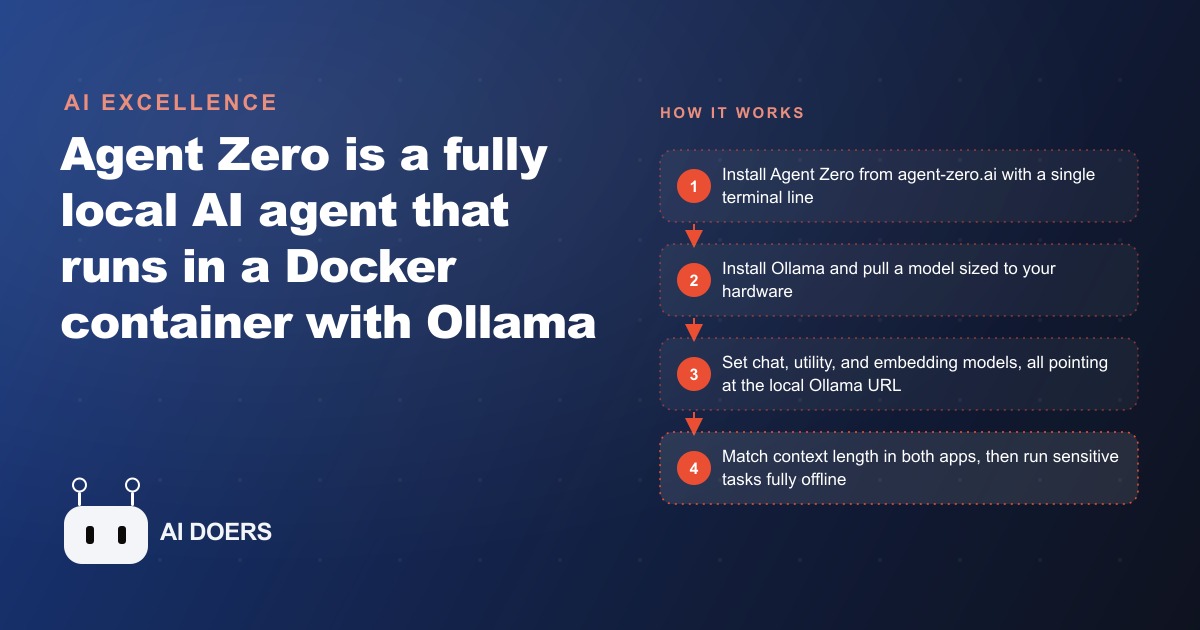
When Agent Zero runs in Docker with Ollama models, no data leaves the computer, and that single fact opens the door to a category of work that cloud AI agents categorically cannot do for businesses that handle regulated information.
The popular framing of local AI agents focuses on the question of capability: can a locally hosted model do what a cloud model can? That framing misses the more important question, which is about architecture. The Docker container that Agent Zero runs inside is not a setup detail or an implementation convenience. It is the design choice that defines what the tool is for. Without the container, Agent Zero is a powerful local agent. With the container, it is the only kind of AI agent that a law firm, a medical practice, a financial advisory, or an accounting firm can run in autonomous mode on real client files without a documented compliance exposure.
I am Madhuranjan Kumar, and the five facets of this architecture worth understanding deeply are: what the Docker sandbox actually changes about autonomous mode; why the three-model stack cannot be simplified into one; how a specific misconfiguration silently breaks most first setups; what on-premises operation changes for regulated professional work; and the concrete workflow at an accounting firm that only becomes possible because nothing leaves the building.
Why the Docker sandbox changes what "autonomous mode" means for a local agent
An AI agent in autonomous mode can issue terminal commands. It can read files, write files, install software, run scripts, and execute operations that affect the system it runs on. That capability is what makes an autonomous agent genuinely useful for multi-step tasks: it can take actions, observe the results, and take further actions in a loop without waiting for a human to execute each step manually. It can sort a folder of documents, extract structured data from each one, write a summary report, and organize the outputs into labeled subfolders, all in one unattended run.
This same capability is what makes an improperly sandboxed autonomous agent risky. A terminal command issued by the agent affects the system it has access to. Without isolation, a misunderstood instruction, a reasoning error, or a bug in a script the agent writes and runs could affect real files on Madhuranjan Kumar machine. Not maliciously, but because the agent is taking real actions in a real environment and mistakes are possible in any complex multi-step task.
The Docker container changes the risk profile of autonomous mode fundamentally. The container is a complete, isolated Linux environment with its own file system, its own processes, and its own network configuration. When Agent Zero runs inside the container, the terminal commands it issues affect the container's environment, not Madhuranjan Kumar machine's file system. If the agent writes a file to the wrong path, the file lands inside the container. If the agent runs a script that deletes something, the deletion happens inside the container. Madhuranjan Kumar machine and its real files are untouched. The container can be reset to a clean state after a run, and the isolation boundary holds across every autonomous session.
This is why the Docker container is not an implementation detail. It is the architecture that makes giving the agent broad permissions safe enough to be useful. Without the container, autonomous mode with broad permissions is a meaningful risk. With the container, autonomous mode with broad permissions is the normal operating mode, because the blast radius of any error is bounded by the container boundary. The distinction between these two architectures is the difference between a tool that requires careful supervision at every step and a tool that can run unattended on real document tasks while you focus on other work.
The three-model architecture and why each role cannot be collapsed into one
Agent Zero connects to three models simultaneously, each serving a distinct function that the others cannot serve equally well. The chat model handles the primary reasoning and output: it receives the task description, reasons about what steps are required, decides which terminal commands or file operations to perform, and generates the outputs the task requires. This model needs to be capable across a broad range of reasoning, writing, and instruction-following tasks, which is why the 20 to 35 billion parameter range is typically recommended for general-purpose hardware. Smaller models produce lower-quality reasoning on complex multi-step tasks. Larger models are slower than most hardware can serve efficiently for interactive use.
The utility model handles the background operations that run in parallel with the main reasoning loop: memory storage, memory retrieval, summarizing prior context for efficient access in long sessions, and other lower-complexity operations that run continuously. Routing these operations through the same chat model would waste the chat model's capacity on tasks that do not require its full capability, and would slow down the main reasoning loop by creating contention for the same resource. A smaller model, typically in the 7 to 13 billion parameter range, handles utility operations efficiently without affecting the performance of the main reasoning task.
The embedding model serves a different function entirely. It converts text into numerical vectors that represent meaning rather than literal word content, enabling semantic search over past sessions, prior task outputs, and accumulated memory. Semantic search is what lets the agent find a relevant piece of prior context even when the current prompt uses different words than the original document used. This task requires a model trained specifically for embedding generation, not a generative model. Running a generative model as an embedding source produces lower-quality semantic representations than a dedicated embedding model, because generative models are trained to predict the next token while embedding models are trained to produce compact, meaning-dense vector representations.
Collapsing the three roles into one model creates three simultaneous problems: the chat model becomes contended between tasks, the quality of utility operations degrades because the main model is not optimized for them, and the semantic search quality drops because the embedding representations come from a model not designed for that purpose. The three-model architecture exists because each function has distinct requirements that a single model of any size cannot satisfy equally well across all three simultaneously.
The context-length mismatch that silently breaks most first setups and looks like a different error
The most common failure in initial Agent Zero setups is not a missing model or a wrong API endpoint. It is a context length mismatch between two systems that appear independent but must agree on the same value to function correctly.
Ollama, which hosts the local models Agent Zero connects to, has its own setting for the context window size the model uses during inference. This value determines how many tokens of prior conversation, document content, and task history the model can hold in its active context at any one time. Agent Zero also has a context length setting that determines how much content it sends to the model in each request. These two values must match. If Ollama's context length is set to 32,000 tokens and Agent Zero's context length is left at its default of 4,000 tokens, the agent sends requests sized for a 4,000-token window to a model configured for 32,000, which is functional but wastes the available context and causes the agent to lose track of earlier steps in longer tasks. If Ollama's context length is set to 8,000 tokens and Agent Zero's is configured to 32,000, the model receives requests that exceed its configured capacity and produces errors or truncated outputs.
The failure mode that makes this mismatch hard to diagnose is that the error it produces does not say "context length mismatch." It produces output that looks like a model failure: incomplete responses, reasoning that loses track of steps established earlier in the task, or error messages that appear to reference the model's behavior rather than the configuration. A developer troubleshooting the issue typically checks the model selection, the base URL configuration, and the hardware resources before thinking to compare the context length values in both systems.
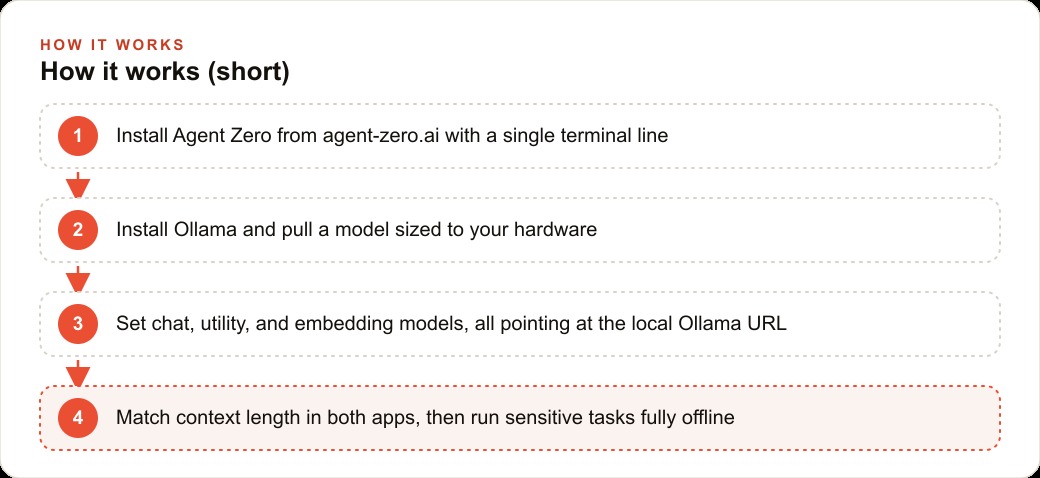
The fix is simple once the cause is identified: open the Ollama settings, set context length to 32,000 tokens or higher, then open Agent Zero settings and set the context length to the same value. Verify both numbers match before running any substantive task. The recommended minimum is 16,000 tokens. 32,000 tokens or higher is preferred for tasks involving longer documents or multi-step workflows where earlier steps must remain accessible in context throughout the run.
Setting a correctly matched, high context length is the single configuration change with the largest positive impact on Agent Zero's effectiveness at real tasks, because tasks that fail silently when context is limited succeed smoothly when it is not.
What running without an internet connection means in practice for regulated professions
The framing of local AI in most discussions focuses on cost or speed. Running inference locally avoids API fees and can be faster than round-tripping to a remote server for simple tasks. These are real advantages, but they are not the primary reason a regulated profession should care about local operation.
The primary reason is that regulated professions operate under data handling obligations that predate AI entirely and do not include exceptions for helpful software. A medical practice handling patient records operates under privacy requirements that specify what may be disclosed to third parties and under what conditions. A legal practice handles information that may be protected by privilege, confidentiality obligations, and regulatory requirements that limit transmission to outside parties. A financial advisor handles client information subject to its own regulatory framework. In none of these cases does the fact that the third party receiving the data is an AI model rather than a human entity change the applicable obligation. Sending a client's tax return, medical intake form, or legal document to a cloud AI service is transmission to a third-party server, regardless of how the AI provider describes its data handling in its terms of service.
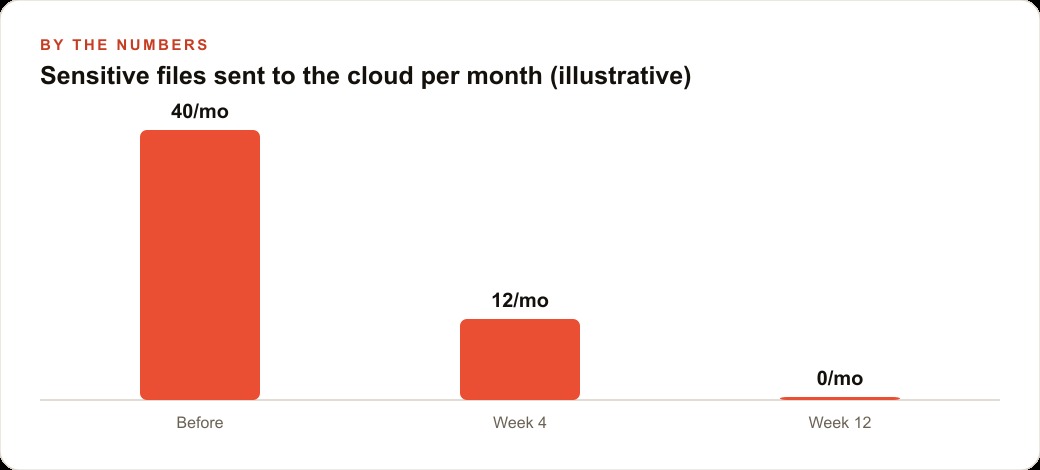
Running Agent Zero locally with Ollama models means the inference happens entirely on a machine the practice controls. The client file never leaves the building. The API call that would have transmitted the document to a remote server never happens. The regulatory question of whether that transmission was permissible never arises, because the transmission never occurred. For professions where the permitted uses of client data are tightly bounded and where the cost of a compliance finding is high relative to any efficiency gain, removing that exposure entirely is more valuable than any per-task cost saving.
The Docker container reinforces this benefit. Because the agent's actions are confined to the container environment, the risk of an autonomous agent inadvertently transmitting data through an unexpected network call is bounded by the container's network configuration. The container can be configured with restricted or no outbound network access, making the no-data-leaves guarantee architectural rather than procedural, and auditable rather than assumed.
The accounting firm tax season workflow that only works because it stays entirely on-premises
During tax season, a typical small accounting practice processes hundreds of client document packages across 10 to 12 weeks. Each package contains a mix of scanned prior returns, W-2 and 1099 forms, investment statements, expense records, and occasionally handwritten notes or photographs of receipts. The work of receiving a package and organizing it into a state where the preparer can begin the actual return takes a meaningful portion of the preparer's time per client: time spent handling documents rather than applying professional judgment to the filing itself.
An AI agent capable of reading a folder of documents, classifying each by type and year, extracting the key figures from each, sorting everything into labeled subfolders, and writing a plain-text checklist of what is present and what appears to be missing would reduce that per-client preparation time substantially. The obstacle for any cloud AI agent is the nature of the documents: each one contains a real client's real financial information, with social security numbers, income figures, and account details, none of which can be transmitted to an external server under the firm's professional obligations and the client's expectation of confidentiality.
The workflow that becomes possible with Agent Zero running locally on the firm's own hardware: a folder containing one client's full document package is placed in a designated input directory. The agent is given a prompt describing the task: classify each document by type and year, extract the key figures, sort everything into labeled subfolders by document type, and write a checklist identifying which expected documents are present and which appear to be missing. The agent works through the folder, reads each document using its vision and text capabilities, issues the file system commands to organize the outputs, handles errors it encounters without stopping, and produces the checklist without any document ever leaving the machine.
The time impact across a full tax season is meaningful. If the per-client preparation step that currently takes an average of 45 minutes drops to 10 to 15 minutes with agent assistance, across 200 client packages that is 100 to 150 hours recovered during the firm's busiest period. Hours that can go to actual preparation work, client communication, or quality review of the filings themselves. The compliance picture is clean: no client document was transmitted to any external service. The practice's obligations about data handling were met not by a contractual agreement with an AI provider or a policy statement in a data processing addendum, but by the architecture of the tool itself. Nothing left the building, so the question of whether leaving was permissible never needed to be asked.
That is exactly what we do at AI DOERS. Book a private 30-minute call with Madhuranjan Kumar and we will map the fastest path to it for your specific business.
Book your call →
Madhuranjan Kumar
Madhuranjan Kumar brings 20 years of performance-marketing experience and has managed over $200 million in Facebook ad spend for brands across the United States and beyond. His expertise spans the full modern marketing stack: Meta, Google Ads, TikTok, email automation, CRM, and the websites that hold it together. At AI DOERS he turns that track record into lead-generation systems for businesses across every industry.