
After Coding, AI Is Coming for Finance: What the Signals Show
Finance is the next industry the frontier AI labs are targeting after coding, and the move is already underway. OpenAI links consumer accounts through Plaid, Anthropic is pushing Claude into Wall Street and the big four firms, and the race has shifted from best chatbot to controlling the most important workflows.

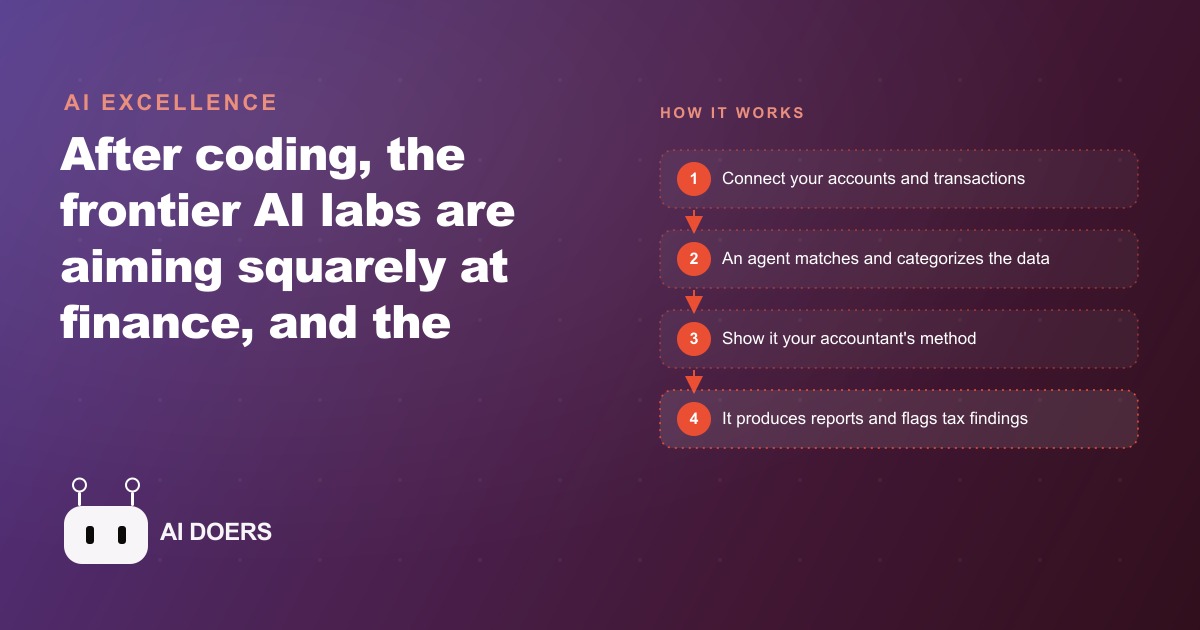
At a finance-focused event hosted by Anthropic, a reported slide read: coding has changed forever, finance is next. Seated nearby was one of the most prominent names in global banking. The tools to back that claim were already in production.
I am Madhuranjan Kumar, and the argument I want to make here is specific and uncomfortable: waiting to see how AI in finance plays out is already a losing strategy. The position that sounds prudent, watching carefully before committing, is actually the slower path, because the institutional infrastructure embedding AI into financial workflows is not speculative. It is signed, funded, and already running. The businesses that understand what is happening at the enterprise level right now will be building AI-assisted financial habits before those habits become table stakes for every competitor in their market.
The pattern playing out in finance is the same one that played out in software development. Eighteen months ago, using an AI coding agent gave a developer a meaningful speed advantage over peers who did not. Today, a developer who does not use one is simply working slower. Finance is on the same curve, and the window between early-adopter advantage and widespread adoption is shorter in this cycle than in the previous one.
The Labs Telegraphed Finance Before They Moved; Now They Have Moved
The frontier AI labs tend to signal where they are going before they arrive. In the coding wave, the signals were clear: benchmark after benchmark on code-generation tasks, product releases aimed at developers, partnerships with engineering tool companies. The signals for finance are just as clear, and the follow-through has already started.
Anthropic reports that finance is its second-largest revenue category after technology, with approximately 40 percent of its customers being financial institutions. Goldman Sachs, Visa, Citi, and AIG are among the reported names. When a lab with that kind of financial-sector commercial relationship points its product roadmap at finance with public specificity, it tends to follow through with real infrastructure and real pressure on incumbents.
The consumer side has moved too. OpenAI has enabled ChatGPT Pro users to connect their finances through Plaid, reaching across roughly 12,000 financial institutions. Users can surface portfolio performance, spending patterns, subscription costs, and cash flow in plain language without switching between apps or manually exporting data. That is not a feature. It is a new default behavior for how people interact with their financial information, and it will normalize quickly.
At the enterprise level, Anthropic is embedding through a partnership with Goldman Sachs and Hellman and Friedman worth a reported $1.5 billion in valuation support, and through a partnership with FIS, which processes transactions for roughly 12 percent of the global economy. The initial focus is anti-money-laundering compliance. AI agents tested at 64 percent accuracy on AML tasks where the human baseline sits in the mid-70s at far higher cost per decision. That gap does not need to close fully to flip the economics. It needs to get close enough that the agent handles the volume humans cannot, at a cost per decision that makes the tradeoff obviously favorable.
The distribution play through PwC is the most telling signal of all. PwC is building an office-of-the-CFO practice around a single AI platform and committing to certify 30,000 people in it. That single move embeds the tool into every organization that touches PwC for financial oversight work, without requiring each of those organizations to make an independent purchasing decision. The tool arrives through the accountant, which is how technology penetrates finance at scale.
90 Percent of the Way to CPA Quality at Near-Zero Marginal Cost
The practical question for a business owner is not whether the enterprise infrastructure is impressive. It is whether the tool can do enough of the actual bookkeeping work to matter. The honest answer, based on testing with real transactions, is that it can do most of it, and the part it cannot do is identifiable and handleable.
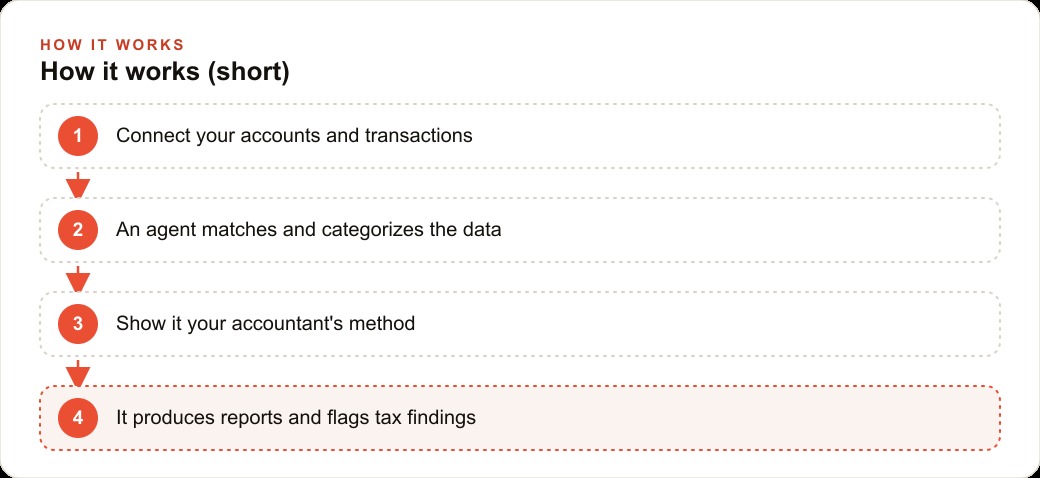
On a straightforward batch of transactions, an AI agent can match, categorize, and summarize with a speed and consistency that manual work cannot approach. A messy pile of hundreds of transactions from a busy month, the kind that usually requires several careful hours of work, can be matched and organized in minutes. The agent also writes a script to automate that process going forward, so the task does not have to be described again next month.
On the harder job of running a complete monthly close, the agent starts well but makes edge-case errors. When shown how a CPA structures the work, including which categories to flag for review and how to handle recurring entries, it corrects and gets to roughly 90 to 95 percent of the quality a human reviewer would reach, at close to zero marginal cost once the workflow is established. That remaining fraction is where the human CPA's time is most valuable: the edge cases, the judgment calls, and the tax strategy that requires full context.
The agent is also strong at surfacing potential tax findings worth discussing with an advisor. It flags deductible categories that have been inconsistently applied, identifies timing patterns that might affect the tax position, and produces a structured list of questions to bring to the next accountant meeting. The agent does not file the taxes. Its role in that context is preparation: doing the matching and organizing work cheaply so the human advisor can spend their time on strategy and judgment.
That division of labor, agent for the matching and categorization, human for the judgment and filing, is the model that makes AI-assisted bookkeeping both practical and safe. The businesses that understand this division will get real value from the tools. The businesses that either avoid the tools entirely or try to use them without human review will either fall behind or make expensive errors.
The Excel Question Is More Serious Than Most Business Owners Think
One of the more striking signals in the recent finance wave came from an unexpected source: a major hedge fund selling most of its position in one of the world's most valuable software companies, citing AI as the primary reason. The specific concern was whether the core office productivity suite, including the spreadsheet application that most businesses use as a default financial tool, remains essential once AI agents can build the database, write the analysis, and produce the report without a spreadsheet in the loop.
That question does not have a settled answer. The spreadsheet is deeply embedded in how businesses do financial work, and that embeddedness gives it durability. But the concern is serious enough to drive a seven-figure portfolio decision at a sophisticated institutional level, which signals that the threat is real rather than theoretical.
For small businesses, the practical implication is narrower but still worth considering. If you currently use a spreadsheet as your primary financial tool, that tool is built around the assumption that a human will pull the data, enter it, and interpret it. An AI agent can do each of those steps more quickly and, for the data entry and matching steps, more accurately. The spreadsheet remains the output format, but the steps of producing it shift toward the agent and away from the human. That shift means the value you get from your accountant or your bookkeeper changes: you are paying for judgment and strategy, not for data entry, and you should evaluate that relationship accordingly.
For Google Ads campaign management and other marketing functions where financial reporting is a regular deliverable, the same logic applies. The spend tracking, the performance-to-budget reconciliation, and the month-end summaries are all candidates for agent automation. The value the human provides is the interpretation and the decisions that follow from it, not the production of the numbers themselves.
The Enterprise Infrastructure That Filters Down to Every Small Business
The most important thing to understand about the current wave of AI in finance is that the enterprise moves, Goldman, PwC, FIS, are not happening in a separate world from the small business. They are the distribution mechanism that brings these tools to small businesses whether or not the owner makes an active decision about them.
When PwC certifies 30,000 people on a specific AI platform and builds its office-of-the-CFO practice around it, those 30,000 people then work with clients of every size. The small business whose accountant went through that certification program is now receiving AI-assisted advice whether or not the owner knows or asked for it. The accounting software that integrates an AI layer through a partnership deal brings that capability into every business that uses the software, regardless of company size.
This is the mechanism through which enterprise AI adoption filters down to small business. It does not require each small business owner to research and adopt the technology independently. It arrives through the professionals and software they already work with. The implication is that the question for a small business is not whether AI will touch their financial workflows but how prepared they are to work with it when it does.
The businesses that understand the tools before they arrive through their accountant or their software will be better positioned to use them intentionally rather than passively. They will know which tasks to route to the agent, which outputs to review carefully, and which decisions to reserve for the human advisor. That preparation is the advantage the early adopters are building right now.
A Dental Group Builds an AI-Assisted Finance Workflow
As an illustrative example, consider a dental group with three locations that produces a significant volume of financial transactions each month: insurance payments, patient billing adjustments, supply orders, equipment leases, payroll, and facility costs across three sites. The practice manager currently spends several evenings each month organizing this data before the accountant can work with it. The accountant then works with the organized data to produce the monthly summary and the quarterly tax analysis.
The AI-assisted version of this workflow starts with connecting the bank accounts and the payment processor to a secure session where an agent can read the transactions. The agent matches and categorizes the month's activity in a fraction of the manual time, separating insurance payments by procedure code category, patient receipts by collection method, and expenses by supplier and type. The practice manager reviews the output against a sample of source transactions to confirm the categorization logic held, which takes roughly an hour rather than an evening.
The agent then produces a draft monthly summary organized in the format the accountant prefers, after the practice manager showed it that format once in the first month. It flags items for review: a payment from a new insurance carrier that was not categorized, an equipment repair that might qualify for a faster depreciation treatment, an overpayment from a patient account that will need a refund or credit. Those flags become the agenda for the accountant meeting, structured and specific rather than a pile of documents the accountant has to search through.
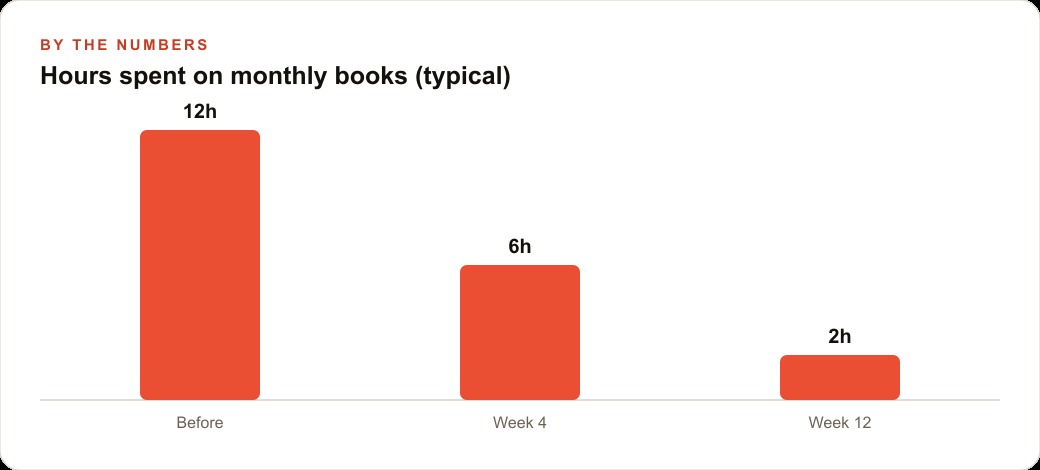
Illustratively, a workflow like this reduces the practice manager's monthly financial preparation from roughly 12 hours of manual work to roughly 2 hours of review and approval. The accountant opens a prepared file and spends time on the items that require judgment rather than on organizing the raw data. The quarterly tax analysis becomes faster because the categorization has been consistent throughout the quarter rather than corrected in a batch at the end.
The practice keeps the accountant for filing and strategy. The agent handles the preparation work that used to be the most time-consuming part of the financial cycle. The practice manager's time goes to reviewing agent output rather than producing it, which is a better use of their expertise and a better use of the practice's payroll.
For the Facebook ads spend tracking the practice uses for patient acquisition across the three locations, the same agent can be asked to pull the monthly ad spend by location and compare it to the booked appointment volume, giving the practice manager a clean picture of acquisition cost without a separate reporting step. That integration of marketing spend into the financial workflow is a small example of what becomes possible when the agent has access to multiple data sources at once.
Waiting Already Has a Cost
The argument that it is safer to wait until AI in finance is more mature has a hidden cost that most business owners do not account for: the months spent not developing the pattern recognition that comes from using the tools. Every business that has been running AI-assisted bookkeeping for a year now knows exactly where the tools are strong, where they make edge-case errors, and how to structure their financial data so the agent handles it cleanly. That knowledge took a year to develop, and a business starting today starts a year behind.
The tools are not perfect. The 90-to-95 percent quality figure means there is a fraction of the work where a human review catches something the agent missed. That fraction gets smaller as the tools improve and as the operator gets better at describing the task clearly. But it does not go to zero, and the businesses that have been working with that gap for a year are more skilled at finding and handling it than the businesses starting now.
The institutional infrastructure, Goldman, PwC, FIS, is being built now because the tools are good enough now for the financial applications being deployed. Small businesses that build AI-assisted financial habits now will enter the period when those tools are fully mainstream with a year of practice already behind them. The businesses that wait for mainstream to adopt will be learning at the same time as everyone else, without the head start.
The First Step Toward an AI-Assisted Financial Workflow
Start small and stay rigorous. Connect one account and let an agent match one month of transactions. Check its output against your statement before trusting it with more data. Always treat its tax suggestions as questions for your advisor rather than instructions to act on directly. Keep a human in the loop on anything that gets filed or submitted.
The single most important discipline in the early months is inspection. The speed of the tool means nothing if errors pass through unreviewed. Build the habit of checking a sample of the agent's output against source records every time, until you have a clear map of where errors cluster and what the tool handles well. That map is your guide to where you can trust the output and where you always verify.
The race in finance has moved from who has the best product to who controls the most important financial workflows at scale. Coding was the proving ground. Finance is the next decade. The businesses that understand that and begin building AI-assisted financial habits now will look very different from the ones that waited for the tools to become obvious.
That is exactly what we do at AI DOERS. Book a private 30-minute call with Madhuranjan Kumar and we will map the fastest path to it for your specific business.
Book your call →
Madhuranjan Kumar
Madhuranjan Kumar brings 20 years of performance-marketing experience and has managed over $200 million in Facebook ad spend for brands across the United States and beyond. His expertise spans the full modern marketing stack: Meta, Google Ads, TikTok, email automation, CRM, and the websites that hold it together. At AI DOERS he turns that track record into lead-generation systems for businesses across every industry.