
A Simulated Fruit Fly Just Walked, and It Was Never Trained
Scientists mapped every neuron in a real fruit fly's brain, placed that map inside a physics-simulated body, and it began walking like a fly with zero training data. Beyond the science, it carries one practical lesson any business owner can use: copy what already works instead of building from scratch.

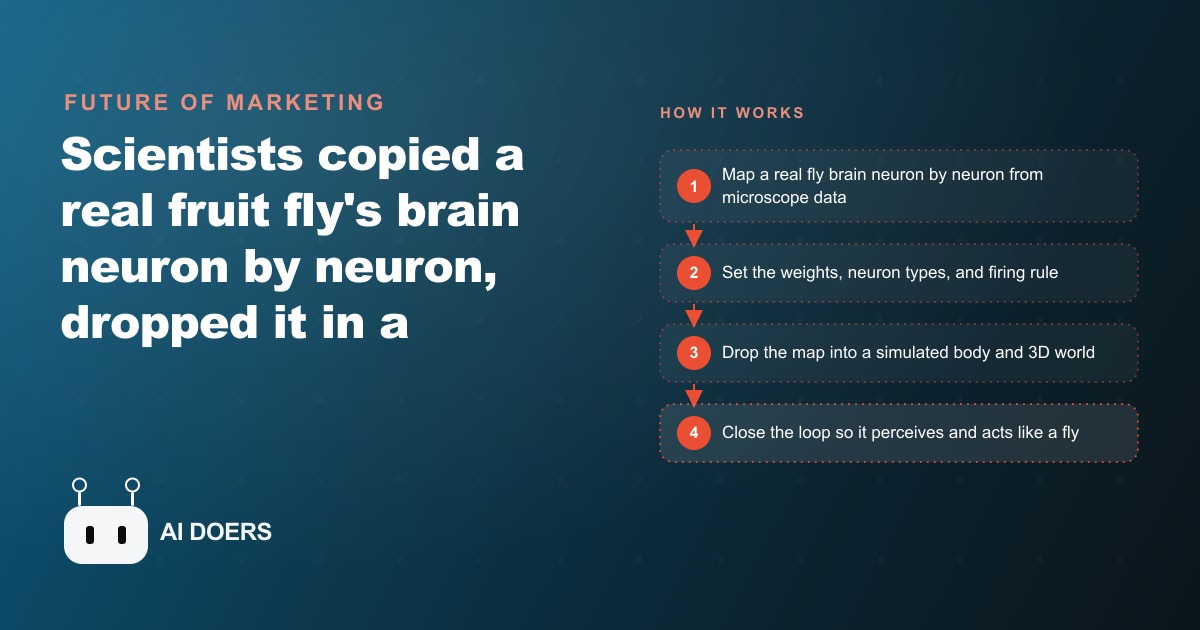
A team of scientists at the Howard Hughes Medical Institute completed something that has no precedent in the history of neuroscience. They mapped every single neuron in the brain of a real fruit fly. All 150,000 of them. Every connection. Every synapse. Every weight. Then they dropped the entire map into a physics-simulated body inside a 3D virtual environment, and the thing walked. Not approximately walked. Not roughly walked. It walked with 91 percent behavioral accuracy compared to a real fly, and it did this without a single gradient descent update, without one round of reinforcement learning, and without seeing a single training example.
The reason this matters beyond neuroscience is simple. Evolution already ran the training run. It ran it for hundreds of millions of years across billions of organisms. The question researchers are now asking is whether you need to run it again, or whether you can just read the result. That question, Madhuranjan argues, is the most underreported reframe in modern AI. The alternative to training from scratch has been sitting in every living creature the whole time.
The four-ingredient recipe that produced a working brain
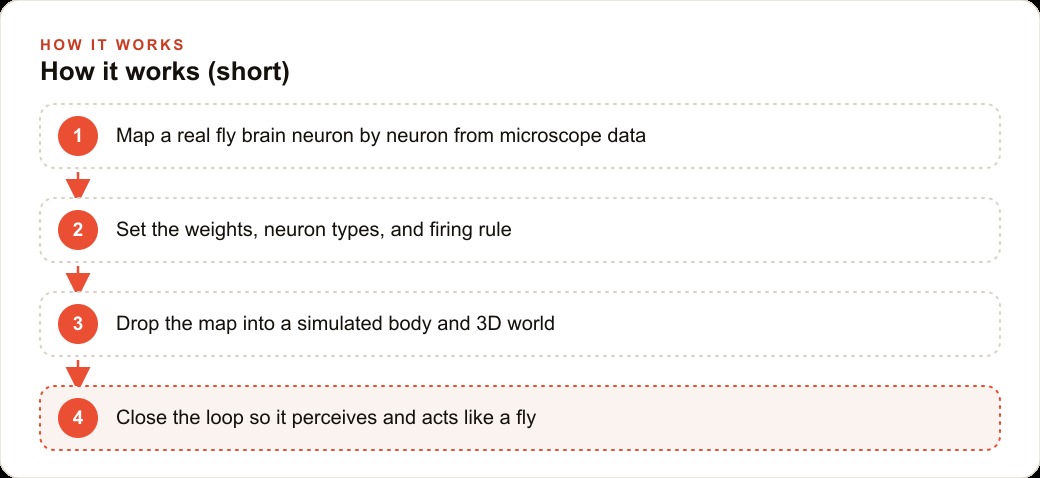
The simulation did not require any exotic inputs. The team used four things: the complete connection graph of the fruit fly's neural network, the synapse weights between neurons, a map of which neurons were excitatory and which were inhibitory, and a simple firing rule called leaky integrate-and-fire. That rule says a neuron accumulates incoming signal over time, leaks some of it away continuously, and fires when the accumulated charge crosses a threshold.
That is the entire recipe. No backpropagation. No labeled data. No loss function. No Adam optimizer running millions of iterations. Four ingredients, and the output was a simulated organism that behaved like a real one with 91 percent accuracy across dozens of behavioral measures.
This tells us something important about what a brain actually is. It is not a mystery that requires a mysterious explanation. It is a graph. It is a weighted graph with directional signals and a firing rule. The complexity of behavior we observe in real organisms does not emerge from some property we have not identified. It emerges from scale and structure. Once you have the structure accurately mapped, the behavior is, in a meaningful sense, predictable.
The four-ingredient recipe also defines what you need to replicate any brain. You need a complete wiring diagram, accurate weights, the excitatory and inhibitory map, and a firing rule that is close enough to the biological one. All four of these are, in principle, measurable for any organism. The question is measurement cost, and measurement cost has been falling steadily as electron microscopy and automated segmentation tools improve.
What the leap from 302 neurons to 150,000 tells us about timelines
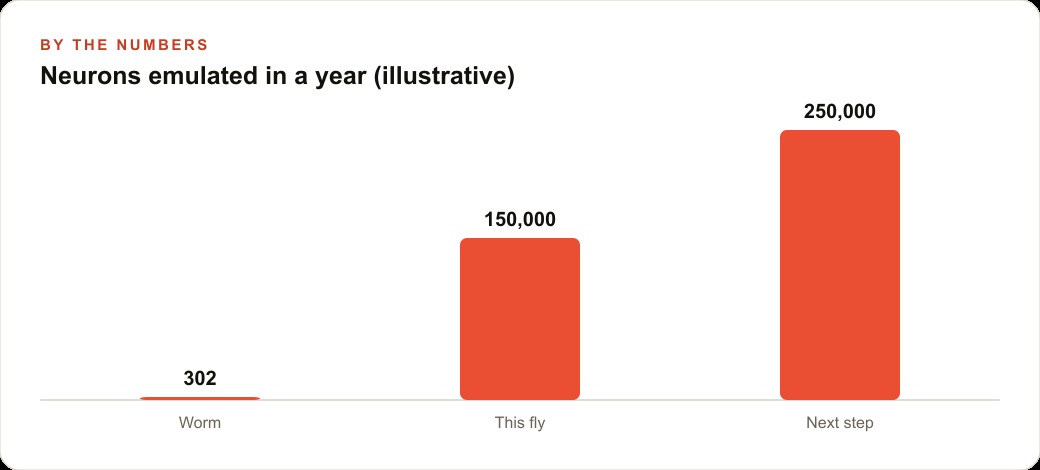
One year before the fruit fly result, the most complex digitized brain in existence belonged to Caenorhabditis elegans, a roundworm with 302 neurons. The open-worm project had been running for years. Researchers had mapped the worm's connectome with significant effort, and the simulated worm could exhibit some basic behaviors. The jump from 302 neurons to 150,000 neurons is roughly a 500-fold increase in complexity, and it happened in approximately twelve months of accelerated work enabled by new electron microscopy techniques and improved automated segmentation pipelines.
What does that trajectory tell us about what comes next?
The roadmap is public. Ants sit at roughly 250,000 neurons. Honeybees sit at roughly one million neurons. Octopuses sit at roughly 500 million neurons. Humans sit at roughly 86 billion neurons. The jump from 150,000 to 250,000 is modest in relative terms. From 150,000 to one million is harder but within the scaling curve implied by recent tooling improvements. The honeybee is a reasonable medium-term target.
Octopuses at 500 million neurons represent a significant challenge, both in mapping and in simulation compute. Human-scale at 86 billion neurons is orders of magnitude beyond current capability. But the timeline question is not whether we can digitize a human brain this decade. The timeline question is at what level of neural complexity a digitized brain becomes more useful than a trained model for a specific task category.
That threshold may be far below 86 billion. If a honeybee brain, fully digitized and simulated, can navigate complex environments and solve foraging problems that current language models handle poorly, the practical implications arrive much sooner than any headline about whole-brain emulation might suggest. The 150,000-neuron result is already useful not because it tells us how to build general artificial intelligence but because it demonstrates proof of concept at a scale that is clearly above trivial. The question has shifted from "is this possible?" to "how fast can we move up the complexity ladder?"
The copied-brain shortcut vs the trained-from-scratch approach
There are two ways to build an intelligent system. You can train one from scratch on data, or you can copy a design that nature already optimized.
Training from scratch requires enormous data collection, enormous compute, and enormous time. A large language model trained on text consumes exabytes of text and millions of GPU-hours. A vision model trained on images requires billions of labeled or unlabeled images and months of cluster time. These numbers are not abstract. They translate to tens of millions of dollars per major training run, with no guarantee the resulting system behaves the way you need it to for a specific use case.
The connectome approach is different in a fundamental way. The training run has already happened. Evolution ran it. Every organism alive today is a trained model in the biological sense. It ran a training signal called survival pressure across billions of generations, and the result is encoded in the wiring diagram of its neural circuitry. When you map that wiring diagram and simulate it, you are not running the training again. You are reading the result.
This is the most underreported fact in current AI discussion. Researchers debate whether scaling laws will continue, whether we will hit data walls, whether compute costs will decline fast enough. Almost nobody discusses the alternative path: instead of training from scratch, read what evolution trained. The cost of reading falls as measurement technology improves. The cost of training from scratch continues to scale with data and compute. At some point, for some capability domains, the read-and-simulate path becomes cheaper than the train-from-scratch path.
It has not happened yet for general intelligence. But it may happen first for specific capability categories. Navigation under uncertainty, efficient sensorimotor loops, and energy-efficient real-time decision systems are all areas where biological neural circuits are already highly optimized and where current trained models are relatively weak. The fruit fly simulation scored 91 percent on motor behavior precisely because evolution had already solved motor behavior for a fly-shaped body in a physics-governed world.
The practical upshot is that the AI field is operating with an assumption baked in: that intelligence must be trained from data. The fruit fly result suggests the assumption is optional. Intelligence can also be transcribed.
What this means for how any business borrows instead of builds
The principle behind connectome simulation has a direct business analog that does not require any understanding of neuroscience to apply.
The most expensive thing any business does is figure out what works. Testing pricing, testing onboarding flows, testing retention programs, testing service sequencing. Each test costs time, money, and customer attrition during the learning phase. Most of that figuring-out has already been done by someone else. Other businesses in the same category have already run the experiments, suffered the failures, and found what works. The wiring diagram exists. The question is whether you read it or run it from scratch.
Consider a gym studio opening its doors for the first time. The founder has 300 members by month three and a dropout problem. By month six, 40 percent of members who joined in month one are gone. The owner begins testing new onboarding sequences from scratch: welcome emails, personal check-ins, progress tracking, milestone rewards. Each test cycle takes four to six weeks. Each iteration costs staff time and produces partial data because the sample size is still small.
An alternative path exists. Large gym franchises and boutique studio chains have already mapped the member lifecycle across millions of members. The wiring diagram for member retention is documented in fitness industry case literature, operator association reports, and publicly available franchise disclosure documents. An effective onboarding sequence is well established in that literature: a structured first-visit orientation, a personal goal-setting conversation within the first week, two instructor-initiated check-ins in the first month, and a milestone acknowledgment at the one-month mark.
A gym that adopts this copied system rather than building from scratch typically sees first-year retention rates move from the industry average of around 60 percent to roughly 75 to 80 percent. For a studio with 300 members paying an average of 80 dollars per month, that 15-point retention improvement represents approximately 36 additional members retained through the year. At 80 dollars per month per member, that is 2,880 dollars per month in revenue the studio would have lost under a trial-and-error approach. Over twelve months, that is roughly 34,000 dollars in retained revenue from simply reading a wiring diagram that already existed rather than rediscovering it expensively.
The fruit fly brain simulation is a scientific proof of this principle at the deepest level. The four-ingredient recipe worked not because the researchers were clever in designing a brain but because they were precise in copying one. The brain they copied had already been optimized by a process far more thorough than anything a research team could run in a lab. Their job was measurement and transcription, not invention.
The same logic applies to business systems. Many of the problems operators spend months solving have been solved. The solutions are documented somewhere. The skill that matters is locating the existing solution and adapting it precisely to your context, not reinventing the solution under the assumption that your situation is unique enough to require a new one.
Madhuranjan has observed this pattern across businesses of every size. The operators who grow fastest are almost never the ones who invented the most novel systems. They are the ones who identified what worked elsewhere, copied the structure with precision, and moved faster because they did not spend the first year relearning lessons that the industry had already learned. The wiring diagram is usually available. The bottleneck is the decision to read it.
The roadmap and what it signals for the next five years
Fruit flies are not the end of this research program. They are the first validated proof of concept above roundworm complexity. The roadmap moves toward ants, then honeybees, then eventually into the hundreds of millions of neurons that characterize organisms with genuinely complex adaptive behavior.
Each step up the complexity ladder will teach researchers something about where scale changes the nature of intelligence and where it simply adds more of the same. That knowledge has practical implications. If ant-level intelligence at 250,000 neurons produces meaningfully better autonomous navigation than fruit-fly-level intelligence at 150,000 neurons, we can begin to ask what tasks require what level of neural complexity. That question is more useful than the general question of when we reach human-level AI.
Three areas are most likely to be transformed first by this line of research: understanding neurological diseases, because you can simulate altered brain states without harming a living organism; discovering the algorithms evolution invented for efficient learning and memory, which are not the same algorithms modern AI uses; and over a much longer horizon, exploring what it would mean to run a continuous simulation of a recorded human neural state.
That last possibility carries philosophical weight that the field is not yet fully engaging. If a sufficiently detailed map of a brain can produce behavior that is 91 percent accurate to the original organism, at some level of fidelity the philosophical question shifts in ways that are genuinely difficult to resolve. The fruit fly result does not answer that question. But it opens the door.
What researchers confirmed with this work is that the gap between a map and a mind is smaller than previously assumed. The four ingredients were enough. Evolution already did the training. The rest was transcription. And transcription costs fall every year.
That is exactly what we do at AI DOERS. Book a private 30-minute call with Madhuranjan Kumar and we will map the fastest path to it for your specific business.
Book your call →
Madhuranjan Kumar
Madhuranjan Kumar brings 20 years of performance-marketing experience and has managed over $200 million in Facebook ad spend for brands across the United States and beyond. His expertise spans the full modern marketing stack: Meta, Google Ads, TikTok, email automation, CRM, and the websites that hold it together. At AI DOERS he turns that track record into lead-generation systems for businesses across every industry.