
A 50x Polymarket Win And A Crypto Treasure Hunt: What It Teaches Any Business
A roughly 50 cent bet returned about 4,950, the 50x outcome it was designed for, and a gamified treasure hunt turned a prize into engagement. Both run on one instinct any business can borrow: risk little, structure the upside, make people pay attention.

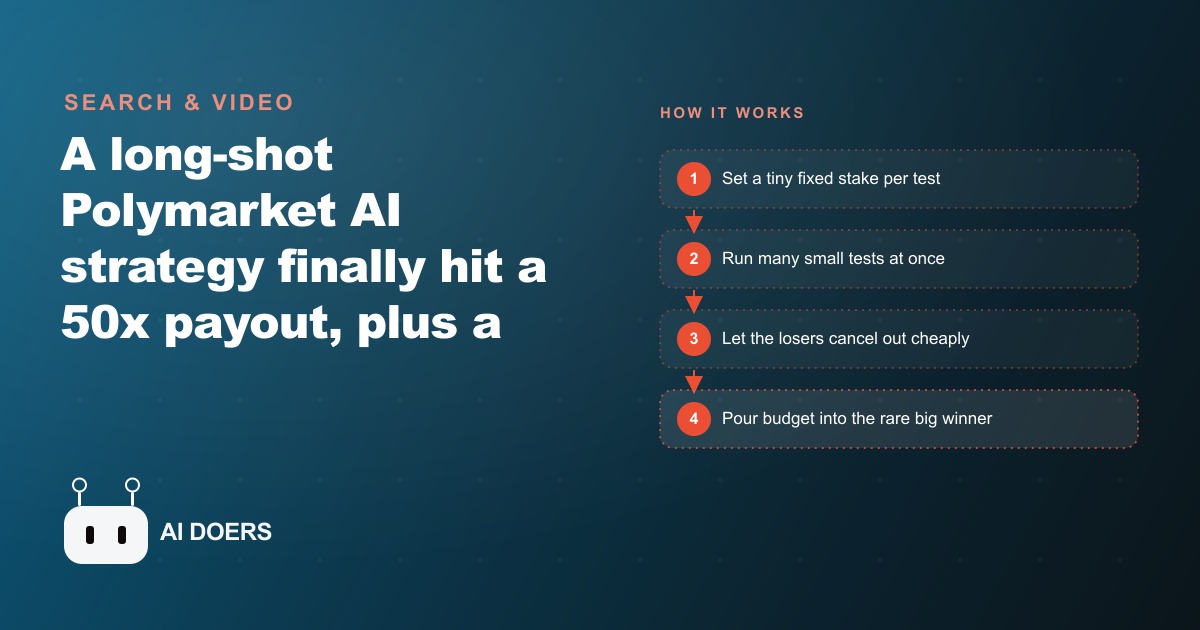
A position worth roughly 50 cents returned nearly 5,000 dollars. That is the 50x outcome this particular Polymarket strategy was designed to catch, and after 17 attempts it finally landed. Alongside it ran a different experiment: a crypto treasure hunt where a public wallet address was posted online and the private key was hidden inside Madhuranjan Kumar's content for the first person who found both to claim. I am Madhuranjan Kumar, and both ideas run on the same instinct any business can borrow without touching a prediction market or a blockchain.
The instinct is this: risk very little, structure the upside to be large, and make the participant lean in. That combination shows up in the two examples above, and it shows up in how the best-performing marketing experiments I have seen actually work.
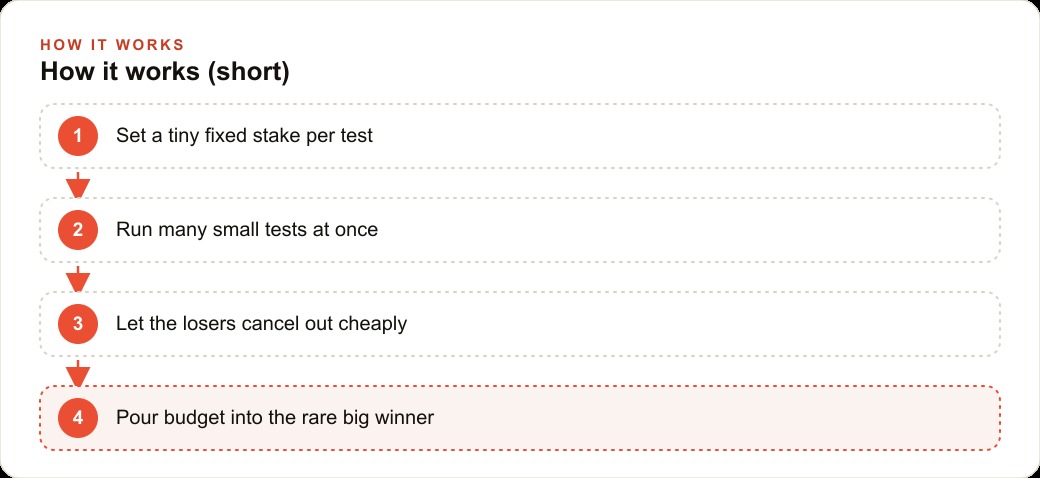
Set a fixed, tiny stake per test before you run anything
The discipline that makes asymmetric strategies work is the fixed stake rule. Before launching any experiment, decide the exact maximum amount you are willing to lose on a single attempt, and commit to that ceiling regardless of how confident you feel about any individual test. The 50-cent position size in the Polymarket example is not an accident. It is a decision made before the market opens, not after reviewing the odds.
In a marketing context, this translates directly. Before running a new ad creative, decide the exact test budget per variation. For a small business spending a few hundred dollars per month on paid social, a reasonable fixed stake per test might be 15 to 25 dollars over five days. That amount is small enough that the cost of being wrong is trivial. It is large enough to generate signal about whether the creative earns clicks.
The fixed stake rule also prevents the most common failure mode in advertising: concentrating budget on a single untested creative because the team found the process of creating it compelling. The process of creating an ad has no predictive relationship with how the market will respond to it. The only evidence that matters is the market's actual response. A fixed stake per test is what lets you collect that evidence cheaply enough that learning from failures is affordable.
For a business running Facebook and Instagram campaigns, this means structuring every new creative launch as a portfolio of small tests rather than a single committed bet. Spend 15 dollars each on five variations rather than 75 dollars on one. Let the five-day data tell you which direction the market responds to. Scale only that direction with the remaining budget.
Run many tests in parallel rather than perfecting one
The resting-order strategy in the Polymarket example is the parallel version of the same idea. Rather than placing one carefully considered bet and waiting to see if it fills, the strategy places many small orders across many markets simultaneously and waits for one of them to find a favorable moment. Out of roughly 2,700 orders placed, one filled. That fill rate sounds like failure. It is not. It is the design. The orders that did not fill cost nothing. The one that did produce an asymmetric return.
For an e-commerce store or local service business, the equivalent is running creative variations in parallel rather than iterating sequentially. Sequential testing is: run creative A, wait two weeks, run creative B, wait two weeks, run creative C. Parallel testing is: run A, B, and C simultaneously with small budgets, get signal on all three within a week, scale the winner, and cut the losers.
Parallel testing requires accepting imperfect information per creative because no single variation gets the full budget or the full timeline. That tradeoff is worth making. The speed of learning is higher, the cost of the learning is fixed, and the winning direction is identified faster. A business that tests five creative directions per month generates 60 data points per year about what its market responds to. A business that tests one direction per month generates 12.
Cancel the losers early and pour into the rare winner
The resting-order strategy is also cancellation-first. Orders that do not fill by a set time are cancelled automatically. The manual discipline of reviewing and cancelling non-performing experiments is built into the design rather than left as a later decision. That design choice prevents the most common mistake in both prediction markets and advertising: holding positions or ads past their useful signal period because discontinuing them feels like admitting they failed.
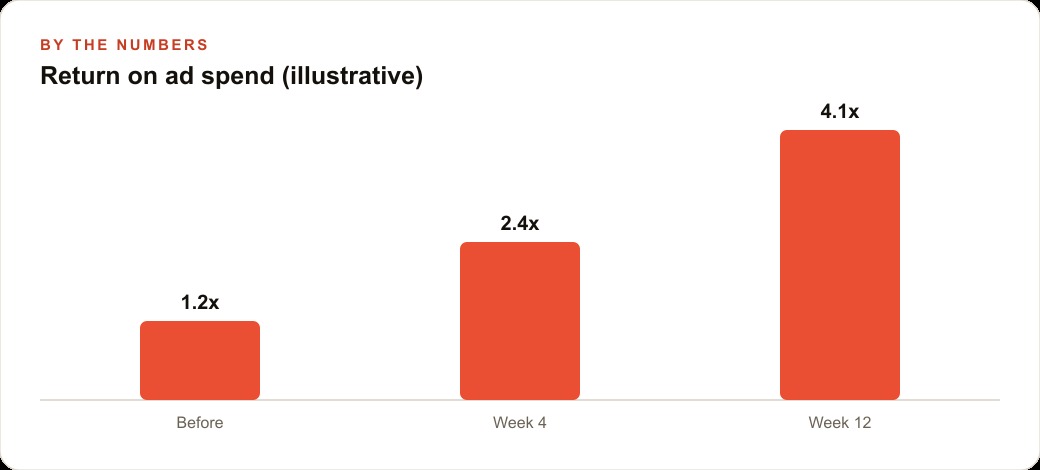
In an ad account, the cancellation-first approach translates to clear pausing criteria established before any test launches. A creative that has not reached a minimum threshold of click-through rate after a defined test period gets paused automatically, not reviewed for a third week of hope. The criteria are set before you can see the results so the decision is not influenced by how much work went into creating the ad.
The budget from paused tests rolls immediately into the winning creative or the next batch of tests, whichever the calendar calls for. This compounding allocation is what makes the parallel testing approach produce better results over time than a single-bet-at-a-time approach. The learning from each round informs the next round's hypotheses, and the budget concentrates progressively toward the directions that actually work.
For a business running Google Ads alongside paid social, the same pause criteria apply. A keyword or ad copy variation that does not perform at the target cost per click after reaching statistical relevance gets paused. The budget from those paused elements goes to the performing ones. Over three to six months, this creates an account structure where a large percentage of spend is concentrated in the directions that have proven themselves through actual performance rather than spread across a portfolio of hopeful experiments.
Design the hunt before you hide anything
The Follow the White Rabbit treasure hunt from this week's story had a specific structure that made it work as engagement rather than just as a giveaway: the clue required actually consuming the content, not just following the right account or sharing a post. The private key was buried inside a specific article that linked to a specific subpage. Finding it required reading, not luck.
That design decision is what produced genuine engagement rather than mechanical engagement. A giveaway where participants win by clicking share generates hollow metrics. A hunt where participants win by reading generates real attention that compounds into the kind of audience familiarity that eventually drives purchases. The first finders spent meaningful time with the content. That time is worth more to the business than a hundred shares from people who did not read anything.
Design the hunt mechanics before placing any clue. Decide how many steps the hunt has, what action each step requires, and how the final prize is claimed. The rules need to be clear enough that a motivated participant can follow them without insider knowledge, and the clue chain needs to be internally consistent so that someone who finds clue two can independently verify they have found clue two rather than wondering whether they missed something.
Test the hunt with someone who has no inside knowledge before it launches. Give them the starting clue and a time limit. If they are stuck after a reasonable effort, the hunt is too obscure. The goal is engagement, not elimination.
Pre-fund the reward and make the claim step frictionless
The treasure hunt in the example was pre-loaded with a small amount of Solana for gas fees alongside the prize. That detail is important: the finder could claim the prize in one click without depositing anything or navigating any additional steps. The design removed every friction point between finding the prize and receiving it.
For a business running a digital treasure hunt with a different type of reward, the same principle applies. A hunt that ends with a discount code should produce a code that works immediately at checkout, not a code that requires verification, manual approval, or a separate signup. A hunt that ends with a product should ship without requiring the winner to navigate a form with multiple fields that could cause confusion or abandonment.
Every additional step between winning and receiving costs participant trust. Each friction point slightly increases the probability that the winner does not complete the claim, and a winner who did not complete the claim is worse than no prize at all because they experienced the hunt without experiencing the reward, which is the sequence that produces the word-of-mouth value the hunt was designed to generate.
Pre-funding or pre-staging the reward before the hunt launches means the delivery mechanism is confirmed to work before anyone is waiting on it. The verification step costs nothing and prevents a class of execution problems that undermine the engagement value of the whole campaign.
Track secondary metrics so you can justify running another one
The primary metric of a treasure hunt, how many people found the prize, tells you almost nothing about whether the campaign worked as a business activity. The secondary metrics are the signal. How many unique visitors landed on the hunt-related pages during the run period? How many people signed up for email updates to be notified of the next hunt? How did time on site compare to the baseline period before the hunt? How many social mentions referenced the hunt by name?
These numbers tell you whether the hunt generated the attention and the genuine content consumption that makes it worth running again. A hunt that produced ten finders but also generated a hundred new email signups and a significant uptick in content page views is a campaign worth repeating and scaling. A hunt that produced ten finders and none of the secondary metrics moved is worth analyzing for what prevented the spread.
For an e-commerce business, the purchase-rate comparison between participants who engaged with the hunt and non-participants is a useful additional metric. Customers who found and claimed a prize through genuine content engagement typically convert at higher rates on subsequent visits than customers who received a passive discount, because the engagement process builds familiarity and trust that passive promotions do not.
The model from these two experiments is transferable without the cryptocurrency: risk small amounts per test, run many in parallel, cancel the losers cleanly, design the experience so winning requires engagement, make the reward frictionless to claim, and track the engagement metrics that tell you whether the investment produced real audience attention. The 50x win came after 17 attempts. The discipline is what made 17 attempts affordable enough to stay in the game long enough to hit it.
That is exactly what we do at AI DOERS. Book a private 30-minute call with Madhuranjan Kumar and we will map the fastest path to it for your specific business.
Book your call →
Madhuranjan Kumar
Madhuranjan Kumar brings 20 years of performance-marketing experience and has managed over $200 million in Facebook ad spend for brands across the United States and beyond. His expertise spans the full modern marketing stack: Meta, Google Ads, TikTok, email automation, CRM, and the websites that hold it together. At AI DOERS he turns that track record into lead-generation systems for businesses across every industry.