
5 Beginner Lanes to Break Into AI in 2026 (and How to Pick Yours)
The five most beginner-friendly ways to earn with AI in 2026 are voice agents, workflow automation, vibe coding, AI image and video, and consulting, and the winning move is to pick the single lane that genuinely interests you and ignore the rest.

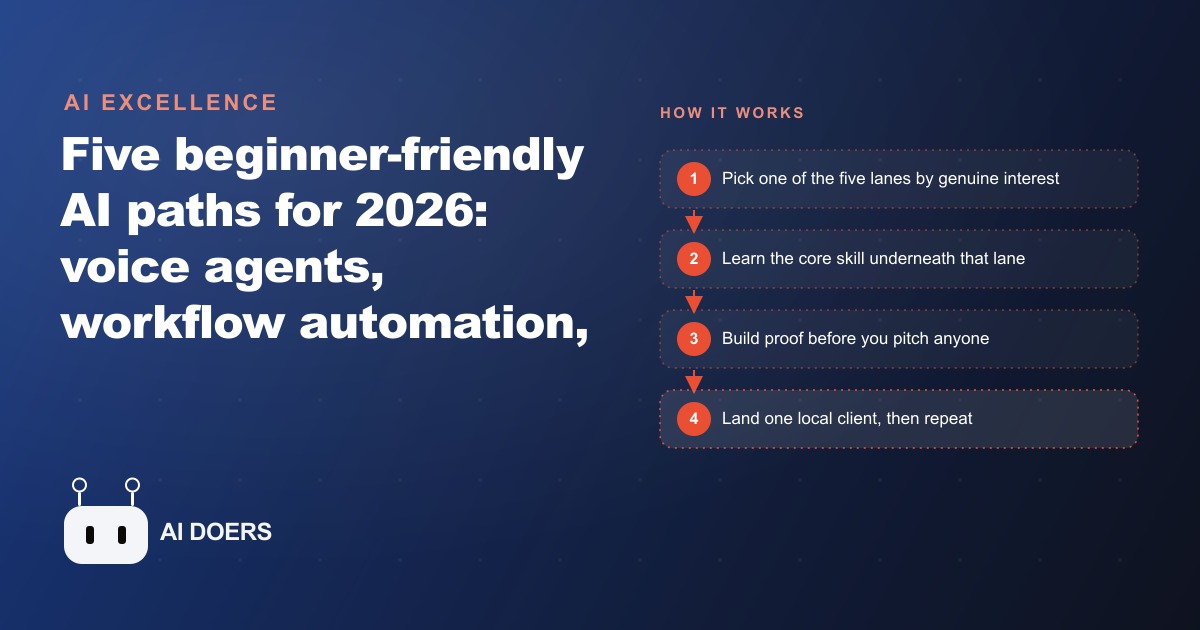
Businesses in every category are already paying for AI-related services in 2026, and most of them are paying whoever showed up first with something that worked, not whoever had the most technical background.
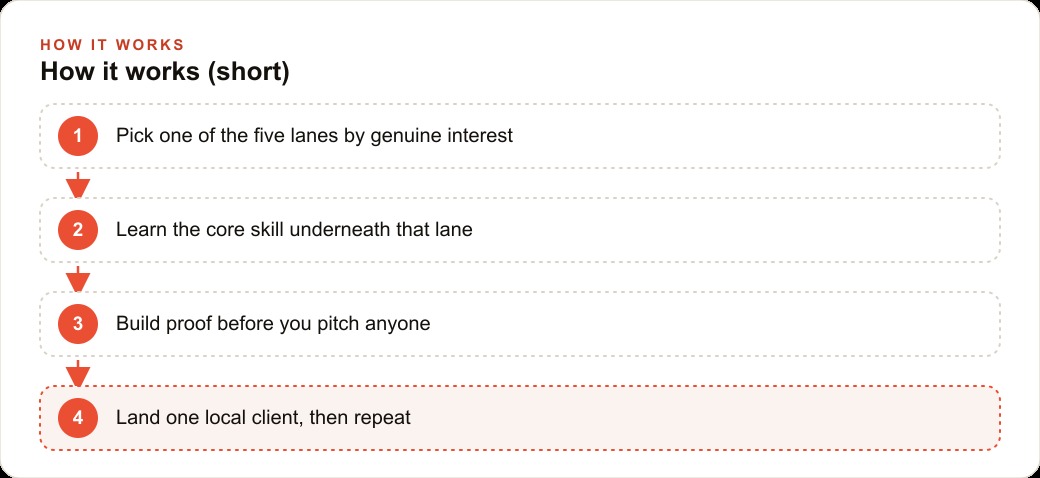
That is the detail that gets lost in most conversations about getting into AI. The barrier is not credentials. It is not a computer science degree or a Python certification or a deep understanding of how transformers work. The barrier is picking a lane, going deep enough on that one lane to deliver something real, and finding the first few businesses that will pay you while you learn. Every lane I am about to describe has paying customers already attached to it. The demand exists. The question is whether you are the person capturing it.
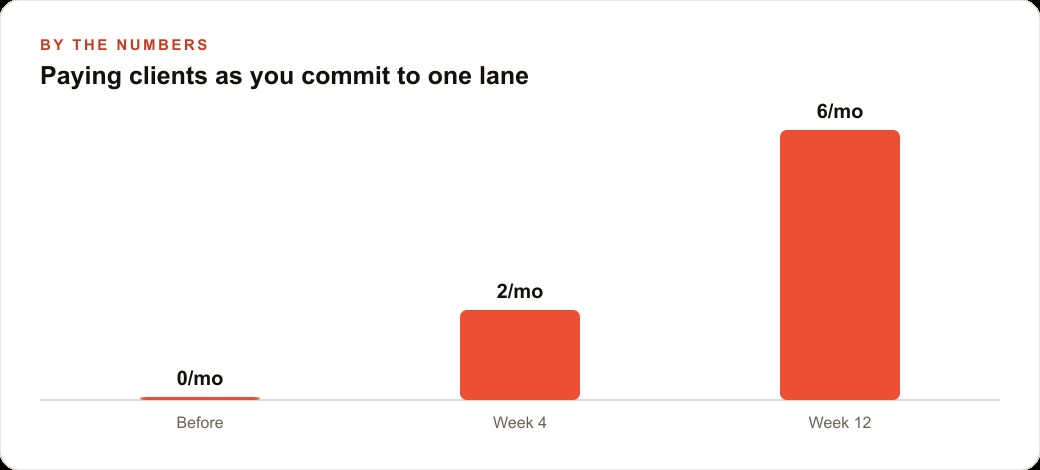
There is one rule that applies to all five lanes: pick one and ignore the other four, at least for the first twelve months. The fastest way to earn nothing from AI in 2026 is to dabble in all five simultaneously, collect knowledge without deploying it, and never build enough depth in any single area to be worth hiring. Interest is the forcing function. Pick the lane you would still be learning about on a Saturday afternoon with no financial pressure. That interest will carry you through the parts that are not fun, and there will always be parts that are not fun.
AI Voice Agents: The Receptionist Replacement That Pays Fast
Small businesses are spending significant money on missed calls right now. A dental office that misses ten calls a day is losing patients to a competitor who answered. A law firm that goes to voicemail during lunch is losing consultations. A home services company that cannot answer after 6pm is losing job requests to a competitor with a live operator. Every one of those businesses has a direct and quantifiable reason to pay for a solution.
AI voice agents answer calls, qualify the caller, book appointments, collect basic information, and hand off to a human when the situation genuinely requires one. They work around the clock without overtime. They do not have bad days. They handle multiple calls simultaneously without putting anyone on hold. For a small business spending $4,000 per month on a receptionist and still missing calls, an AI voice agent at a fraction of that cost is not a hard sell.
The income potential in this lane comes from several angles. You can build a direct service agency where you set up and manage voice agents for clients and charge a monthly retainer. You can build a community of other practitioners learning to build voice agents and charge membership fees. You can productize your setup process into a course. You can build a niche SaaS product on top of the existing voice agent platforms for a specific industry vertical, like medical practices or real estate agents. None of these require you to build the underlying AI voice technology from scratch. The platforms already exist. Your job is to configure, customize, and deliver.
The businesses in this lane that will pay you fastest are the ones where a missed call has a clear dollar value attached to it. Medical practices, legal offices, home services, auto repair shops, salons, and real estate agencies all fit this profile.
Workflow Automation That Talks to Your Existing Tools: The Easiest Entry Point
If you have never built anything with AI before, workflow automation is the gentlest entry point, and it also has some of the clearest ROI of any lane on this list.
Workflow automation tools like n8n and Make connect software applications without requiring you to write backend code. A workflow might pull new leads from a web form, add them to a CRM, send a personalized welcome email, notify a sales rep on Slack, and add the lead to a Google Sheet for tracking, all automatically and within seconds of the form submission. Businesses that do this manually, or that have gaps in these handoffs, are wasting hours of staff time per week on work that a configured workflow does in milliseconds.
The reason this lane has become accessible to beginners in 2026 specifically is that the major automation platforms now include text-to-workflow features. You describe the automation you want in plain language and the platform generates the initial workflow for you. You review it, adjust the connection details, test it, and deploy it. The technical depth required has dropped significantly. You do not need to understand API authentication in depth to get a working automation running. You need to understand what the client's business is trying to accomplish and be able to translate that into a workflow description.
The income model in this lane is typically a combination of a setup fee for building the initial automations and a monthly retainer for monitoring, maintaining, and expanding them as the client's needs grow. Clients often start with one workflow and keep adding more as they see the time savings compound. This creates a strong recurring revenue dynamic where each client becomes more valuable over time.
One practical application: connecting a business's Google Ads lead pipeline directly into their CRM and notification system, so every paid lead is captured, tagged with its source campaign, routed to the right sales rep, and followed up within minutes instead of hours. The ad spend stays the same. The conversion rate improves because the speed of follow-up improves. That is a workflow automation win that the client can see in their numbers within the first week.
Vibe Coding: Build Before You Pitch, Then Walk In the Door
Vibe coding is the practice of building software by describing what you want in plain language to an AI coding agent, iterating on the result through more plain-language descriptions, and shipping something functional without writing traditional code yourself.
The progression that most people in this lane follow is Lovable first, then Cursor, then Claude Code. Lovable is the most beginner-friendly entry point: a web interface where you describe what you want to build and it generates a working web application. Cursor is a code editor where an AI assistant helps you build and modify code in real time. Claude Code is a terminal-based coding agent that can handle complex, multi-file projects with deep context. You do not need to reach the Claude Code stage to earn money in this lane. Many practitioners generate real revenue while still primarily working in Lovable or Cursor.
The strategy that converts best in vibe coding is the same one that works in almost every service business: build before you pitch. Find a local business with a weak website or a missing tool, build a better version over a weekend using Lovable, and walk in the door with a working demo. You are not asking them to imagine what you might build. You are showing them what you already built. The close rate on a working demo is dramatically higher than the close rate on a proposal.
The most natural application of this skill connects directly to the CRM and website stack that businesses need to run their lead pipeline. A local service business with no CRM, a weak website, and no online booking system represents three billable projects for a vibe coder who can deliver all three using AI tools. The barrier to delivering them is now much lower than it was two years ago.
AI Image and Video at Scale: The Creative Weapon That Pairs With Distribution
AI image and video generation tools like Sora and its competitors have made it possible to generate high-quality visual content at a volume that was previously impossible for small teams. The lane here is not about generating individual pieces of content. It is about pairing generation with automation to produce, filter, and distribute at scale.
The workflow that makes this a business rather than a side project involves connecting a content generation tool to an automation pipeline. You define a brief, generate multiple variations automatically, filter for quality, and route the selected pieces to distribution. For a business running Facebook and Instagram ad campaigns that need fresh creative every week, this pipeline removes the bottleneck of waiting for a human designer to produce variations. The agent generates twenty variations overnight and the human reviews and approves the best five in the morning.
The income model in this lane is strongest when you pair generation capability with distribution expertise. Generating images is a commodity. Knowing which images convert in which contexts, how to structure a creative testing process, and how to optimize based on performance data is not a commodity. The practitioners in this lane who command the best rates are the ones who can tie their creative output to measurable business results.
The scaling dynamic is what makes this lane attractive for 2026 specifically. The cost per generated image continues to fall while the quality continues to improve. Businesses that need large volumes of visual content, e-commerce operators running hundreds of product ads, media companies producing content daily, agencies managing creative for multiple clients, all represent natural buyers for this capability at scale.
AI Consulting: Charge for the Audit, Build on the Referral
AI consulting is the most senior lane on this list, and also the one with the highest ceiling for income. The model is simple: audit a business's operations for AI integration opportunities, charge for the audit, and refer the implementation work to partner agencies or freelancers for a percentage of the project fee.
The audit itself does not require you to be an AI engineer. It requires you to understand business operations well enough to identify where time is wasted, where handoffs break down, where decisions are delayed because the right information is not available at the right moment. You map those gaps to AI solutions that already exist and quantify the potential value of closing each gap. The business pays for that clarity.
The referral model solves the execution problem. If a business needs a custom voice agent, you refer them to a voice agent specialist. If they need workflow automations, you refer them to an automation agency. You capture a referral fee or a project management cut without needing to build everything yourself. As you collect more referral partners, your coverage expands and your earning potential grows without adding more of your own execution capacity.
The entry barrier for this lane is credibility, which is also why it is the most senior lane. Credibility comes from content, testimonials, and demonstrated results. If you have been publishing about AI applications for six months, have two or three documented case studies where your recommendations led to measurable improvements, and can reference revenue lifts or cost reductions in specific contexts, you can command a meaningful audit fee. Without that foundation, the consulting pitch is difficult to land.
The fastest path to credibility in this lane is usually a combination of publishing consistently about a specific industry vertical and doing a few initial audits at reduced cost or free in exchange for documented case studies. The case study is the asset. Once you have two or three that show specific numbers, the next audit sells itself.
There is also a sixth lane that sits underneath all five of the ones I have described: content. Publishing about AI applications in any of these lanes builds credibility, generates inbound leads, and creates the documented track record that clients use to evaluate you before they reach out. Content is not a standalone income lane, but it is the compounding force that makes every other lane easier to monetize over time. A practitioner in the voice agent lane who publishes case studies and walkthroughs consistently for twelve months will find that the inbound lead quality after that twelve months is dramatically better than what they were chasing outbound at the beginning.
The combination I see producing the fastest results for beginners is picking one of the first four lanes (voice agents, workflow automation, vibe coding, or AI creative) and pairing it with consistent content publication about that lane from month one. You do not need to be an expert to publish. You need to be one lesson ahead of your reader, which you will be within your first week of hands-on practice. Publish what you learn. Document what you build. Show the numbers when you have them. That combination of demonstrated skill and public documentation is what makes you findable by clients who are already convinced they need what you offer and are looking for the right person to trust with it.
Across all five lanes, the pattern is the same. Demand exists. Businesses are already paying. The practitioners who are earning the most are the ones who went deep on one lane early, built real examples of real results, and made themselves findable before the opportunity fully matured. The window to be early in AI services is still open in 2026, but it is narrowing. Picking your lane now and going to work is the move that looks obvious in retrospect and uncomfortable in the moment. That discomfort is exactly why most people do not do it, and why the ones who do tend to benefit disproportionately.
That is exactly what we do at AI DOERS. Book a private 30-minute call with Madhuranjan Kumar and we will map the fastest path to it for your specific business.
Book your call →
Madhuranjan Kumar
Madhuranjan Kumar brings 20 years of performance-marketing experience and has managed over $200 million in Facebook ad spend for brands across the United States and beyond. His expertise spans the full modern marketing stack: Meta, Google Ads, TikTok, email automation, CRM, and the websites that hold it together. At AI DOERS he turns that track record into lead-generation systems for businesses across every industry.