
28 AI Updates This Week and What They Mean for Real Estate Investors
From free photo editors to AI-powered document review and real-time voice translation, this week delivered more practical tools for property investors than any prior week in 2025.

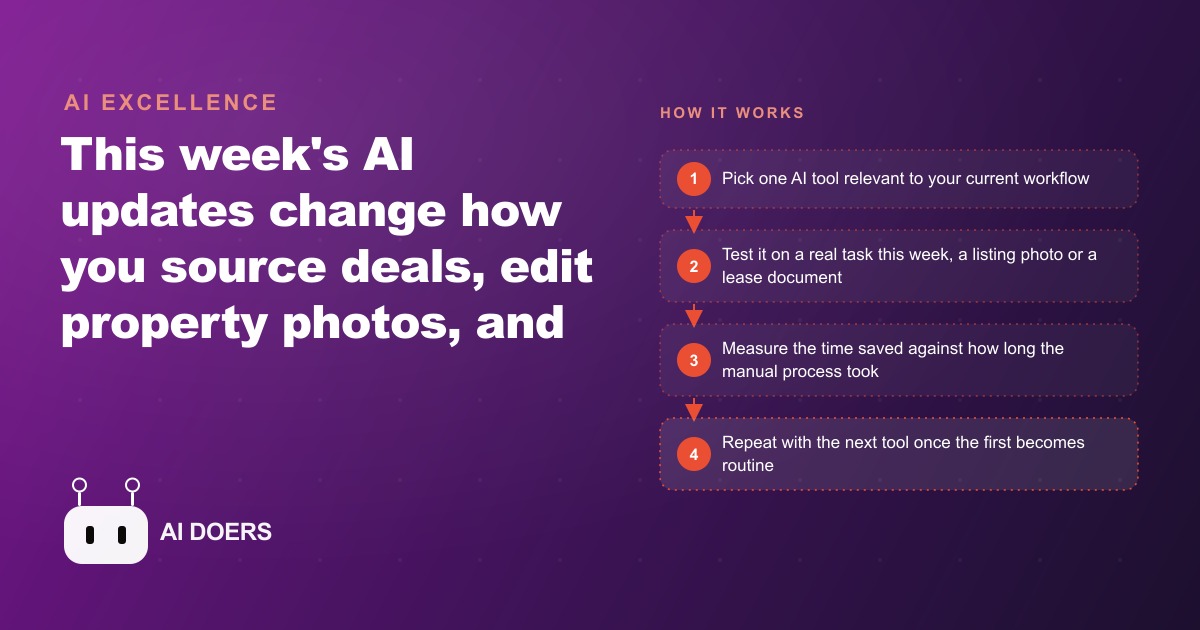
Twenty eight distinct AI releases landed in a single week, and the instinct of most busy professionals is to skim the list, feel vaguely behind, and do nothing. I am Madhuranjan Kumar, and I want to take that instinct apart, because the real story of a week this dense is not the count of tools. It is the quiet mechanism by which a handful of free releases hand a compounding advantage to whoever actually wires one into their week, and leave everyone else a little further behind than they were seven days ago. Let me pull the week apart facet by facet, using property investing as the lens, and show you where the leverage really sits.
The week in one honest sentence
Strip the hype and the week reduces to this: image editing that used to cost money and skill is now free and prompt driven, document review that used to eat hours is now a conversation, search that used to take five tabs now takes one request, and the language models underneath all of it keep getting more capable while staying free. Everything else, the new phone, the read aloud features, the far off model promises, is texture around those four shifts. The releases most discussed were the image tools, and they are the clearest window into what actually changed, so I will start there and work outward.
Why AI image editing is really spatial reasoning, not filters
The first facet worth taking apart is what these image models are actually doing, because it explains why the results hold up. Alibaba's Qwen Image Edit is openly available under a permissive license, which means anyone can use it at no cost. You upload a photo, type a description of what you want changed, and the model modifies the image. In testing it handled changing a shirt color, converting a daytime exterior to an evening scene, and adding a custom sign to a billboard, with results that survived a close look. A second model, known by the code name Nano Banana and widely believed to come from Google, pushes further, colorizing and restoring old photographs, blending two people from separate photos into one naturally lit scene, and converting only a specific object in an image to a different style while leaving everything else untouched.
Here is the part that matters. The reason it can convert just a bowl of ramen in a kitchen photo to a cartoon style, without touching the person or the background, is that the model builds an internal spatial understanding of the scene rather than pushing pixels around. It maps objects as distinct things occupying regions of a three dimensional space, so it knows the bowl is a separate object, not just a cluster of similar colored pixels. That is a genuinely different capability from the filters and clone tools professionals used before, and it is why a text prompt can now do work that used to require a skilled retoucher. Understanding this facet is what tells you the output is trustworthy enough to use, and where it might still slip.
The document facet: interrogation instead of reading
The second facet is quieter but arguably saves more hours. Adobe's PDF Spaces lets you load any document and ask it questions in plain language. Instead of reading a long technical file front to back, you interrogate it. For anyone whose work involves contracts, reports, or compliance documents, this changes the unit of effort from pages read to questions asked.
Consider the shape of the time saved. A reviewer facing a stack of inspection reports, title abstracts, and lease agreements used to budget hours per document. With a system that builds a knowledge structure from the file and returns targeted answers in seconds, the same review becomes a series of pointed questions: does the report flag the roof, is there a rent control clause, what is the legal description of the parcel. The document facet pairs naturally with the search facet, because Google's updated AI Mode now processes complex multi condition queries in one request instead of forcing you to run five separate searches and stitch the results by hand. Together, reading and searching, the two chores that eat most research time, both collapse.
The capability floor keeps rising for free
The third facet is the one people underrate because it is not flashy. Underneath the consumer tools, the open language models keep getting stronger and staying free. This week alone brought a model with hundreds of billions of parameters, another with a context window large enough to hold an entire book of documents at once, and a compact model built for efficient local use. The significance is not any single model. It is that the floor of what is freely available keeps rising, which means the capability gap between someone paying for premium tools and someone using free ones keeps shrinking.
For a research heavy professional, this facet is a quiet reassurance. You do not need to bet on one expensive subscription. The free options are increasingly good enough to run serious analysis, and the cost of experimenting is close to zero. The barrier, as I will argue at the end, was never money.
The compounding gap is the actual news
Now the facet that ties the week together, and the reason doing nothing is the real risk. When four capabilities like these arrive in the same week, the gap between the professional who adopts even one and the professional who waits does not stay flat. It widens immediately, and it compounds. The person who builds an image editing workflow, a document interrogation habit, or a single request research routine saves several hours a week, and they spend those hours getting further ahead, while the person who waited keeps doing the same work by hand.
This is why the count of twenty eight is a distraction. You do not need twenty eight tools. You need one, wired into a real task, this week. There is a useful parallel here. When people note that AI valuations may be in a bubble, the important lesson from the last comparable period is not that the technology was unimportant. It is that the people who built genuine skills and adapted their actual workflows came out ahead when the hype settled, while those who only watched, or only chased headlines without building capability, did not. The same dynamic is running now, and a dense release week is simply the gap widening faster than usual.
A worked example: a property investor across several markets
Let me assemble the facets into one concrete picture, framed with illustrative numbers. Take an investor working across a few markets, and look at where the week lands.
On presentation, instead of paying a retoucher for every listing hero image, the investor uses the free image editor. A property that photographs flat in morning light shifts to a golden hour version with one prompt. Sparse landscaping gets visually filled in. An unappealing neighboring fence in the background gets replaced with greenery. For international buyers, real time voice translation on the new phone means calls happen in the buyer's language without scheduling an interpreter. The clean, consistent visuals that come out of this also strengthen the Facebook and Instagram ad campaigns that drive inquiries, since better creative tends to lower cost per lead.
On due diligence, an investor reviewing ten potential acquisitions in a week might face several hundred pages of inspection reports, title abstracts, and leases. Instead of reading every page, they load each into the document tool and ask specific questions, pulling targeted answers in seconds. On research, the agentic search handles a multi condition query, multifamily properties in specific zip codes within a price range, in a single request rather than a dozen tabs. Those refined queries feed cleaner keywords into any Google Ads work the investor runs to source off market deals.
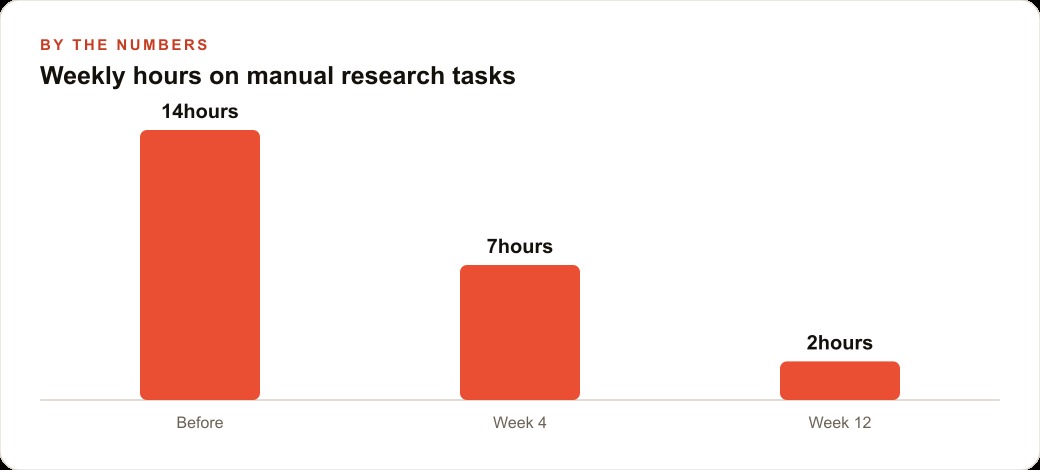
Now the numbers, as a shape rather than a promise. Suppose this investor spends roughly fourteen hours a week on manual research, photo prep, and document review before adopting anything. After building the image and document habits in the first month, that drops to around seven hours. By the twelfth week, with the routines settled and a couple more tools wired in, it falls to about two hours. The point of those figures is the curve: a compounding reduction in low value time, freed up to find and close more deals. That reclaimed time is the actual return, and it costs almost nothing to unlock.
The friction is not accuracy, but it is not zero either
Taking the week apart honestly means naming where these tools bite back. Image models produce results that look convincing at a glance but can carry subtle errors: a shadow falling the wrong way, text that reads correctly from a distance but contains a character level mistake, an element that does not match the physical reality of the property. Anything client facing needs a careful check before it goes into a listing or a proposal. Document tools have their own trap, which is assuming the AI read the right information from the right version of a file. Always confirm you loaded the final signed document, not a draft, and cross check any clause or figure that will drive a decision against the original text. These are not reasons to avoid the tools. They are the discipline that separates a professional using AI well from someone who trusts it blindly.
How to actually reach the newer image model
One facet deserves its own note because the access path is unusual and trips people up. The most capable of the new image tools, the one known by a code name and widely believed to be Google's, is not sitting behind a clean button. Right now it shows up mainly through a blind comparison playground, where you upload an image, write a prompt, and receive two outputs from two anonymous models. You vote for the one you prefer, and only then are the model names revealed. If the model you were hoping for was not in that round, you simply run the test again.
That sounds inconvenient, and it is slightly indirect, but there is no usage limit, so you can keep going until the result you want appears from the model you are targeting. In practice this means the frontier of image editing is available to anyone patient enough to click through a few comparisons, at no cost. It is a good reminder that access to the best tools is often a matter of knowing the path, not paying a fee. The people who quietly build an advantage are the ones who bother to learn these small access tricks while everyone else assumes the good stuff must be locked behind a subscription.
The freely available editor under a permissive license is more straightforward. You upload a photo, describe the change, and get a modified image back, and because the license is open, developers can even wire it directly into their own tools without licensing fees. Between the open editor for everyday edits and the blind playground for the sharper model, a professional has two free routes to image capability that used to require paying a retoucher. Knowing both, and when to reach for each, is itself part of the edge this week hands to whoever pays attention.
Access is the last facet, and it is nearly free
The final facet is the one that dissolves every excuse. Most of the week's tools are free or already bundled in subscriptions professionals hold. The image editor is free. The blind comparison playground where the newer model appears is free with no usage limit, so you can keep testing until the model you want shows up. The agentic search is available through existing accounts. The document tool rides on a subscription many already pay for. The one clearly paid piece is a coming spreadsheet assistant, and even there the math is simple: if it recovers a few hours a week of manual data entry, it clears its cost easily at any reasonable hourly rate. The content and research foundation you build with all of this also feeds SEO and organic search and the CRM and website stack where leads actually get worked, so a single habit pays off across several channels.
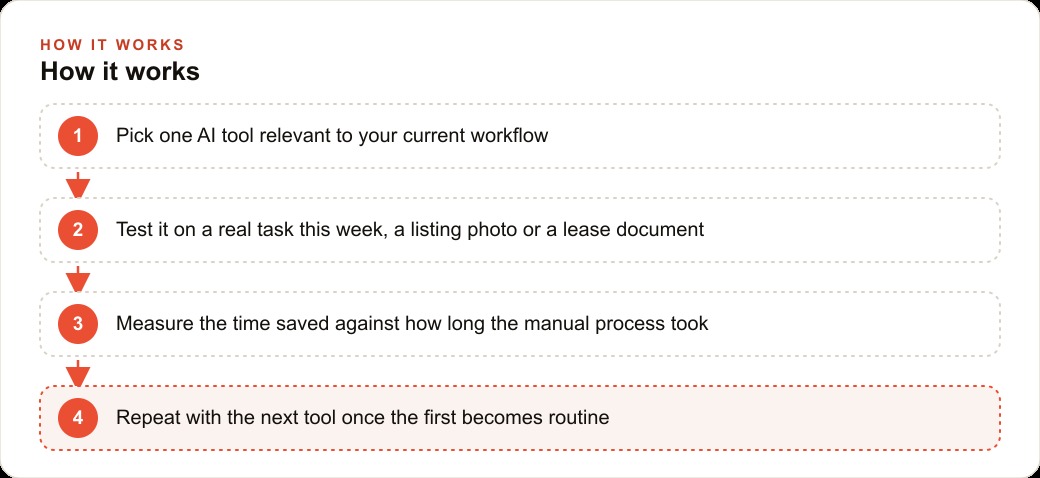
The real investment this week is not money. It is the hour or two required to test one tool on one real task. Go edit a single listing photo. Load one lease into the document tool and ask it three questions. Run one multi condition search. The professionals who spend that hour now hold an advantage that compounds for months. The only approach that guarantees you fall behind is waiting for the noise to settle, because by the time it does, the gap will already be wide. You can wire these workflows up yourself with the free tools above, or you can work with someone who has already built and tested them on real documents. Either path puts you ahead of standing still.
That is exactly what we do at AI DOERS. Book a private 30-minute call with Madhuranjan Kumar and we will map the fastest path to it for your specific business.
Book your call →
Madhuranjan Kumar
Madhuranjan Kumar brings 20 years of performance-marketing experience and has managed over $200 million in Facebook ad spend for brands across the United States and beyond. His expertise spans the full modern marketing stack: Meta, Google Ads, TikTok, email automation, CRM, and the websites that hold it together. At AI DOERS he turns that track record into lead-generation systems for businesses across every industry.