
12 AI Hacks That Each Take Less Than 60 Seconds
Cloning your voice, building a slide deck, editing video by editing text, and turning a folder of receipts into an accountant-ready report all take under a minute with free or low-cost tools, and a few of them quietly save a small business real hours every week.

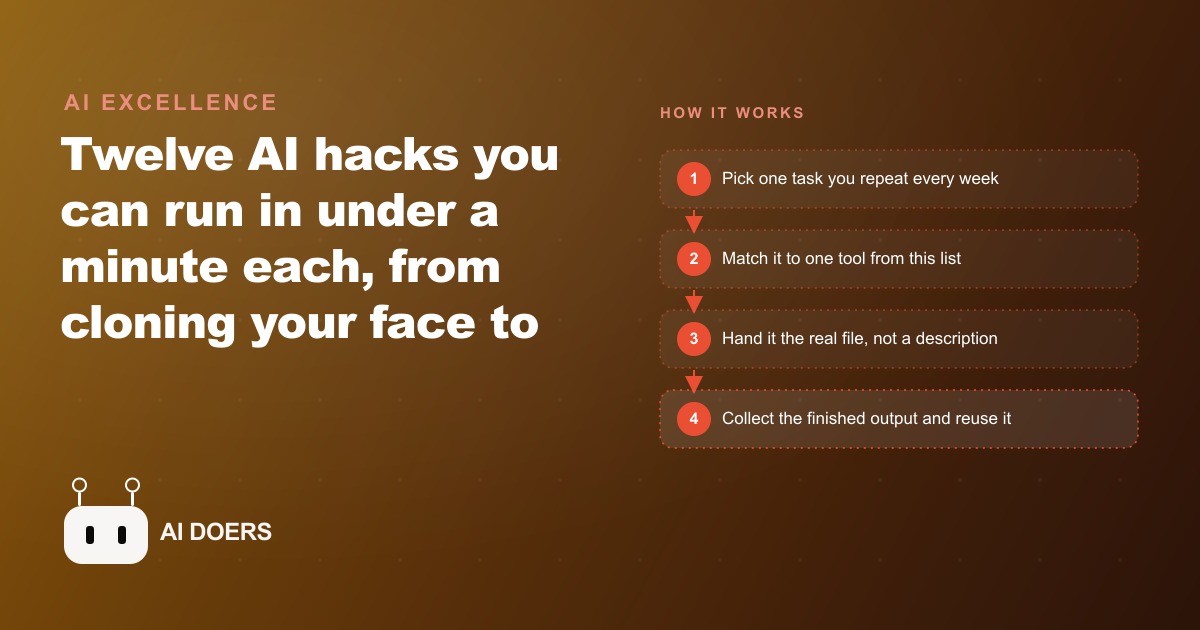
Small business owners are not short on tools. They are short on tools that cost under a minute to use and produce something real at the other end. That is the specific argument I want to make here, because the conversation about AI has been stuck for two years on capability and almost never on friction. Yes, AI can clone your voice. Yes, it can build you a slide deck. Yes, it can edit your video by letting you delete text. None of that matters until the entry cost drops low enough that a busy owner with fourteen tabs open and a client calling in ten minutes will actually try it. The twelve hacks I am going to walk through here are not experiments. They are practical workflows that fit inside sixty seconds, and the ones that compound the most are the ones that replace a task you were already doing manually every single week.
I am Madhuranjan Kumar, and I talk through AI tools with small business owners constantly. The pattern I keep seeing is this: the owners who get the most value from AI are not the ones who try the most tools. They are the ones who pick the single hack that fits the most expensive recurring task in their week and wire it in until it runs without thinking. After that one sticks, they add another. After six months of that pace, their week looks genuinely different. The ones who try fifteen tools in a weekend and implement none of them are in exactly the same position they were before.
So let me make the case for starting small, starting today, and starting with the one that matches something you are already doing.
The Sixty-Second Standard Is the Whole Point
The reason the time constraint matters is that it changes the risk calculation for a busy person. If a new workflow takes two hours to learn, the mental barrier is real. There is a cost to context-switching, a cost to fumbling through a new interface, and a cost to cleaning up if the output is wrong. If a new workflow takes sixty seconds and costs nothing on a free tier, the barrier essentially disappears. The only thing you risk is the minute.
This is not a trivial observation. When the cost of trying something drops to almost zero, the math on adoption changes completely. A tool that saves you forty minutes per week but takes two hours to learn has a two-week payback period from a time perspective alone. A tool that saves you forty minutes per week and takes sixty seconds to learn has a payback period measured in seconds. That is the shift that has happened quietly over the last eighteen months, and it is why I keep pushing owners to actually run one of these right now rather than adding it to a list of things to explore later.
The twelve hacks I am working through fall into three clusters. The first cluster is about creating digital copies of yourself, your voice, your face, your presence. The second cluster converts raw material into finished media. The third cluster hands entire recurring tasks to an agent and gets a clean output back. The third cluster is where the real business value lives, and it is where I want to spend most of the time.
Building a Version of Yourself That Works While You Sleep
Starting with the creative end of the list: Eleven Labs builds a voice model from a recording between ten and sixty seconds long. You speak naturally into any recorder, upload the clip, and from that point forward any script you type comes back in your own voice. This is not a novelty. For any business that produces educational content, product explainers, customer onboarding materials, or training videos, this collapses the production bottleneck from recording everything manually to writing the script and clicking play. The clone handles the narration.
HeyGen extends this further by taking a few minutes of video footage and building a full digital twin with your face, voice, and natural mannerisms. You drive video output from a script. The same tool handles multilingual dubbing with matched lip-sync, which means a product video recorded in English can be delivered in Portuguese, Hindi, or German without re-recording. For businesses exploring international markets or serving multilingual audiences, this is a real capability that used to require a production house.
Suno takes a different angle and turns a single descriptive sentence into a full song, complete with vocals, melody, and production, on a free tier. The immediate business use case is not obvious to most owners, but branded audio content for social media, background music for videos, and custom jingles for ads are legitimate outputs. More practically, a quick Suno track gives a video a professional audio layer without buying stock music or hiring a composer.
The 3D figurine hack, uploading a photo to ChatGPT or Gemini and getting a collectible rendering, then pushing that into Tripo 3D for a printable model, is the one most owners will try as a curiosity. The business case shows up for product-based brands, branded merchandise, event giveaways, and creator economies where a physical artifact has value. For most service businesses it is a fun experiment, not a workflow.
Converting Raw Material Into Finished Media in Under a Minute
NotebookLM is the most underused tool in this cluster. You upload a PDF of your own material, whether it is a research document, a set of client notes, a technical manual, or a policy document, and NotebookLM converts it into a short video overview or a styled infographic. The key word is your own material. The tool grounds everything in what you give it, so the output is not generically written AI content but a visual summary of your actual source. A twenty-page technical document becomes a two-minute explainer. A set of quarterly business notes becomes an infographic suitable for a presentation or a social post.
Gamma builds a complete ten-slide presentation with generated imagery from a single prompt in under a minute. This is not a replacement for a carefully designed pitch deck for a major client, but it is a serious replacement for the internal presentations, team update decks, and quick-turn client overview slides that eat thirty to sixty minutes of skilled time every time they come up. If you build two of those per week, Gamma gives you that time back permanently.
Descript is where this breakdown editing hack lives, and it is the one that most consistently produces a visible reaction when I demo it. You drop a video clip into Descript and it transcribes it into a text document. Deleting a line from the transcript deletes that segment of this breakdown. Underlord, the AI layer inside Descript, identifies and removes filler words across the whole clip in one click. Studio Sound cleans the audio. The result is that a fifteen-minute raw take becomes a ten-minute clean video in the time it takes to read and edit a document, which is a skill every literate person already has, compared to this breakdown editing skills most people do not.
For business owners producing content to support their SEO and content strategy, or building an audience on social channels, Descript removes the biggest friction point in the production chain. Most people who want to produce video content are stopped not by ideas or a camera but by the editing step. Descript makes the editing step feel like proofreading.
The Third Cluster Is Where the Real Business Value Lives
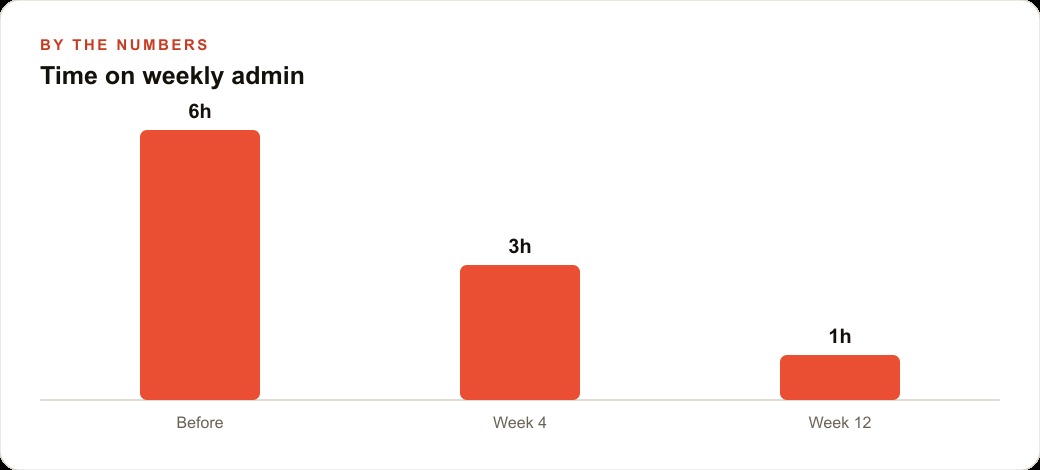
The agent hacks are the ones with the most material impact on how a week runs. A ChatGPT agent template called Daily Plan Brief connects to your calendar, Slack, and email and returns a prioritized schedule for the day. You do not set this up every morning. You set it up once, and every morning it reads your actual data and produces an actual plan. For owners who spend the first thirty minutes of every workday mentally reconstructing their priorities from scattered notifications, this is a real hour per week, every week.
Paste a spreadsheet into Claude and ask for an interactive dashboard. It builds one, with filters, charts, and a shareable link, in a few minutes. The output is not a raw chart dump. It is an interactive artifact that a team member or client can actually navigate. For businesses making decisions from data stored in spreadsheets that nobody wants to open, this converts that data into something decision-makers will actually look at. If you are running paid ad campaigns on Meta or Google, having a shareable performance dashboard that updates from your data rather than a static screenshot changes how you communicate results to clients or leadership.
The receipt reconciliation hack is the one that earns its place in the workflow fastest. Claude Cowork on the desktop app reads a folder of receipt images and PDFs. You point it at the folder, and it outputs a clean PDF summary plus an Excel file that a bookkeeper can open and use directly. No data entry. No squinting at crumpled receipts and typing numbers into a spreadsheet. The whole job runs hands-off. This is the task that eats the most time from small business owners doing their own books, and it is the one where the saved hours are easiest to verify.
A Week in the Life of One Business That Wired These In
Let me walk through what this looks like in practice with a specific example. The business is a service company with a small team, a recurring client base, and the usual weekly admin stack: receipts, status updates, client reporting, and content production.
On Monday morning, the Daily Plan Brief agent reviews the calendar and client messages and returns a prioritized task list. That replaces the fifteen minutes the owner used to spend every morning reading back through notifications and constructing the plan mentally.
On Friday afternoon, the owner drops every receipt from the week into one folder and points Claude Cowork at it. Forty minutes of manual data entry becomes a three-minute automated process that outputs a clean Excel file for the bookkeeper. Monthly time saved: roughly two and a half hours, which at a bookkeeper rate of sixty dollars per hour is one hundred and fifty dollars per month in recovered value, from a tool that costs nothing extra on a subscription already in use.
When a client update is due, the owner pastes the week's performance numbers into Claude and gets an interactive dashboard back with a shareable link. That replaces the thirty minutes of slide building that used to happen before every client check-in. If this business runs Google Ads or Meta ad campaigns for clients, that dashboard becomes the standard deliverable format rather than a screenshot of a platform interface.
For content, a technical note from a client project gets uploaded to NotebookLM and becomes a short explainer video the owner sends to the client as a follow-up, or posts to the company's LinkedIn page. The service manager records a three-minute introduction clip once, and Eleven Labs voices all subsequent content from the same presence. Video production goes from an afternoon to a thirty-minute script-writing session.
Total weekly time recovered in this scenario: roughly four to five hours. Monthly: sixteen to twenty hours. That is half a workweek per month, redirected from administrative production to the actual work the business exists to do.
The Input Quality Argument
I want to be specific about something that most people get wrong the first time they try these tools. The quality of the output is directly proportional to the quality of the input, and the specific form of the input matters more than most people expect.
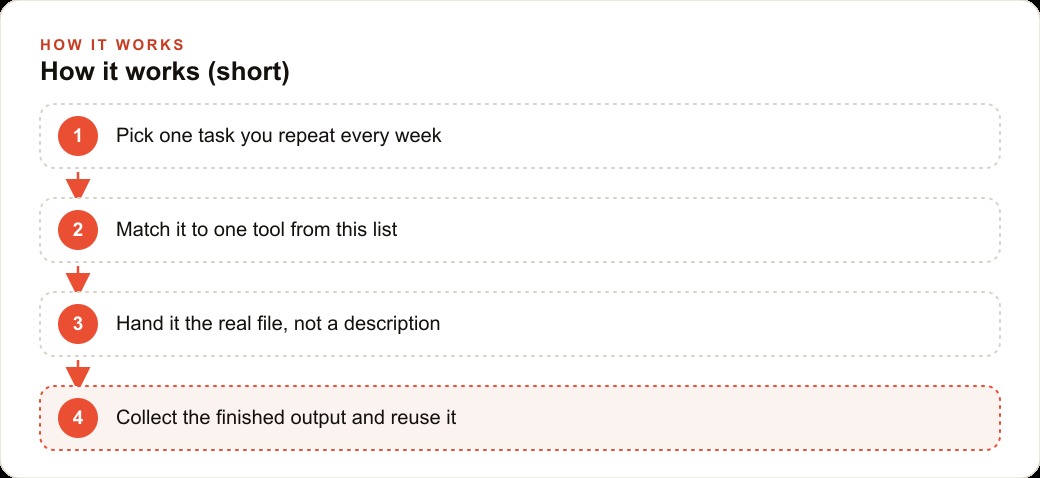
Do not describe your receipts to Claude. Give it the receipts. Do not describe this breakdown topic to NotebookLM. Give it the actual document. Do not tell Descript what you want to cut. Give it the actual clip and let Underlord find the filler. Every tool in this list performs dramatically better with real source material than with a description of the source material. This is not a minor difference. The gap between feeding a real file and describing a file in chat is often the difference between a usable output and a frustrating one.
The second input mistake is giving the tool too little context about the intended audience or use. Claude building a dashboard for your own reference can produce a different structure than Claude building a dashboard for a client presentation. Descript editing for internal review can be less precise than Descript editing for a published video. One sentence of context about who will see the output and what they will do with it consistently improves the result without adding any meaningful time to the process.
Why the Habit Compounds and the One-Time Use Does Not
A hack you try once saves you ten minutes. A hack you run every Friday saves you ten minutes every Friday for the rest of the year. At that pace, a single well-chosen workflow saves roughly eight hours per year from a setup investment of fifteen minutes. Across three workflows, that is twenty-four hours per year, which is three full working days, recovered from tools that either cost nothing or are already included in subscriptions the business is paying for.
This is why I am emphatic about picking one workflow and implementing it properly before adding another. The value is not in the first use. It is in the repetition. A tool that runs on autopilot every week, reliable enough that you stop thinking about it, is worth twenty tools you tried once and abandoned. The owners who get this right in the first month add another workflow in month two, and another in month three. By month six their week looks structurally different from the businesses around them that are still doing the same tasks manually.
For businesses building their customer acquisition through web content, CRM, or digital advertising, the time recovered from these admin workflows directly expands the hours available for strategy, creative, and client relationships. That is the compound effect that makes these sixty-second hacks feel significant twelve months later, even though each individual use feels almost trivially small.
The tools are ready. The entry cost is measured in seconds. The only remaining decision is which task you are starting with today.
That is exactly what we do at AI DOERS. Book a private 30-minute call with Madhuranjan Kumar and we will map the fastest path to it for your specific business.
Book your call →
Madhuranjan Kumar
Madhuranjan Kumar brings 20 years of performance-marketing experience and has managed over $200 million in Facebook ad spend for brands across the United States and beyond. His expertise spans the full modern marketing stack: Meta, Google Ads, TikTok, email automation, CRM, and the websites that hold it together. At AI DOERS he turns that track record into lead-generation systems for businesses across every industry.