
101 Ways To Use AI Daily: The Patterns That Actually Matter
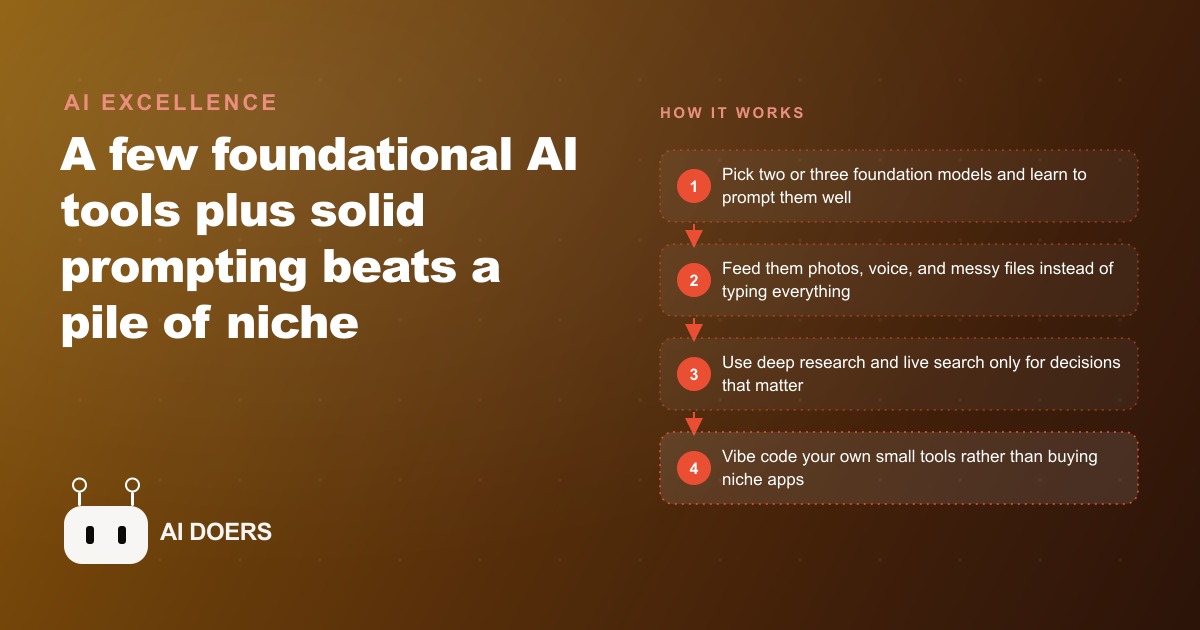
The real lesson behind 101 daily AI use cases is not to collect niche apps. It is to master a few foundation models, get good at prompting, and build small tools yourself so general models cover almost everything you need.

The most useful lesson in a list of 101 was the restraint
You would expect a catalogue of a hundred and one everyday ways to use AI to be a monument to app collecting. It is the opposite, and that is the whole point. I am Madhuranjan Kumar, and when I worked through a popular version of that list, the thing that stayed with me was not the sheer number of tricks. It was the restraint underneath them. Madhuranjan Kumar does not buy a separate app for every task. She leans on a small set of general models, mainly ChatGPT, Gemini, and Claude, and gets genuinely good at prompting so those few models cover almost everything. The list is long, but the philosophy is short: go deep on a handful of tools rather than wide across a pile of subscriptions.
I want to argue that this is the single most valuable reframe a business owner can take from the AI moment, because it inverts how most people approach it. The instinct is to treat every new capability as a reason to sign up for another vendor. The better move is to treat almost every new capability as one more thing your existing few models can already do if you ask them well. The cost of getting started, under that framing, is your attention, not another monthly bill. You learn to ask better questions, and suddenly one tool quietly replaces five.
Friction at the input is where most time is actually lost
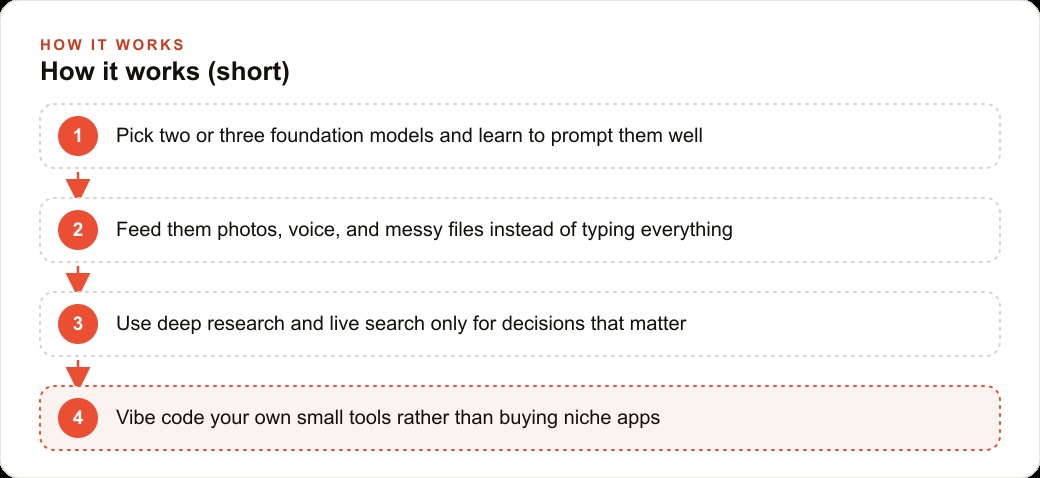
The first thread that runs through the list is that the model is rarely the bottleneck. The friction is in how you feed it. The fastest input is almost never typing. It is a photo. You point your camera at an object, a device manual, a confusing app screen, or a leaking fixture and ask what to do next, and that beats writing a paragraph of description every time. The moment you internalize that the camera is an input, a whole category of small daily frustrations collapses into a ten second question.
Voice is the second shortcut, and it changes the shape of a workday more than people expect. You ramble out loud in the morning about everything on your plate, then ask the model to turn that stream into a ranked to do list. You are not composing a careful prompt. You are thinking out loud and letting the model do the organizing, which is exactly the kind of low stakes, high frequency task that used to eat the first twenty minutes of every day. The lesson is not that any single trick is magical. It is that removing friction at the input, photo instead of typing, voice instead of composing, compounds across dozens of small tasks until it adds up to real hours.
Reserve the heavy tools for decisions that actually cost money
The second thread is a discipline about escalation. Not every question deserves the same firepower. For everyday lookups, a quick answer from a general model is plenty. For research that will shape a real decision, specificity is the whole trick. Instead of a vague query you ask a sharply targeted question, and you switch on deep research only when a shallow answer would cost you meaningful money or time. Tools like Perplexity sit in the middle as chat plus live search, and they even expose an API so you can run research in bulk without writing code, which matters once a task becomes a weekly habit rather than a one off.
I find this the most underrated habit in the whole list, because it is about restraint again. The temptation with powerful tools is to reach for the heaviest option every time, which is slow and unnecessary. The mature move is to match the tool to the stakes: a fast answer for the trivial, a targeted deep research pass for the consequential. Get that calibration right and you get the benefit of the powerful tools without paying the time cost of them on questions that never needed them.
The quieter half is creation, not lookup
Most people think of AI as a better search box, and that undersells it. The other half of the list is creation. You can hand a model a mess of audio, notes, and numbers and ask it to format the whole thing into a clean table, a chart, or an interactive dashboard you keep reusing. You can treat any model as a round the clock tutor that produces worked examples, study plans, and quizzes on whatever you are trying to learn. And when no app exists for a small job, you build one yourself. Vibe coding lets you spin up a simple tracker or a tiny internal tool with platforms like Lovable, Replit, or Claude Code without knowing how to program.
This is where the deep over wide philosophy pays its biggest dividend. The reflex when you need a small tool is to search for an app that does exactly that and pay for it. The alternative the list keeps demonstrating is to build the small thing yourself in an afternoon, because the general models are now capable enough to make that realistic for a non technical person. Every time you do, you avoid another subscription and you get a tool shaped exactly to your workflow instead of someone else's guess at it. The habit that ties creation and lookup together is the same one: reach for a model you already have before you reach for a new vendor.
Why this philosophy fits a small business almost perfectly
The reason this matters for business and not just personal productivity is that the bottleneck these patterns remove is the owner's time, and in a small business the owner's time is the scarcest thing there is. A roofer can photograph a damaged section and ask for likely causes and a repair checklist before quoting. An accountant can dump a messy export and have it shaped into a clean summary table in seconds. A retail owner can rehearse a tough supplier negotiation out loud using voice mode before the real call. A real estate agent can run one targeted research pass on a neighborhood instead of skimming ten tabs.
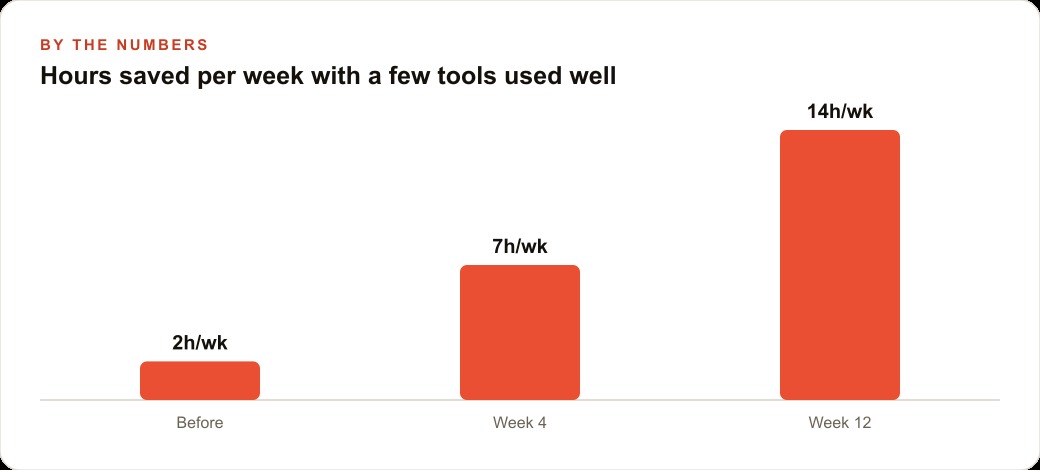
The pattern never changes across industries. You feed the model the rawest input you have, you keep your prompts sharp, and you only escalate to deep research or a custom tool when the payoff justifies it. The work itself stays the same. The friction around it drops. And because the whole approach rides on two or three general models rather than a shifting stack of niche apps, it is cheap to start and simple to sustain, which is exactly what a busy owner needs. The illustrative arc here, a couple of hours saved a week at first, climbing toward double digits by a few months in, is not about one killer feature. It is about many small frictions removed, over and over, by tools you already pay for.
A worked example: a med spa run on two or three models used well
Take a med spa, where the owner is usually the practitioner, the marketer, the front desk, and the bookkeeper all at once. Here is how I would set this up, and notice that the whole plan is about giving scattered admin work to a couple of general models rather than buying anything new. I would start with the photo habit. Staff snap a product label or an equipment manual and ask for the exact setting or contraindication instead of digging through a binder. Then the morning ramble: the owner talks the day's priorities into a phone and gets back a ranked list that separates client care from marketing from supplier calls.
For content, instead of paying for a social media app, the spa uses a foundation model to draft post captions, treatment explainers, and reactivation emails in the brand's voice, then refines them with better prompts. Those same drafts do double duty: the best ones become the copy behind Facebook and Instagram ad campaigns, and the treatment explainers quietly strengthen the site's SEO and organic search over time without a separate effort. For numbers, the owner pastes a month of bookings and revenue and asks a model to build a simple dashboard showing which treatments drive the most rebookings, which then informs where the clinic points its CRM and website stack follow ups. When the front desk needs a tiny tool, like a quick form to log walk in interest, that gets vibe coded in an afternoon rather than bought. And before a delicate conversation with a vendor or a difficult client, voice mode lets the owner rehearse it once. The spa keeps doing exactly what it did before. The difference is that two or three tools, used with good prompts, absorb the hours that used to eat the evening.
Why prompting beats collecting, in one honest comparison
It is worth making the deep versus wide argument concrete, because the collector instinct is strong and it deserves a fair hearing. Imagine two owners with the same problems. The first buys a niche app for each need: one for social captions, one for meeting notes, one for research summaries, one for simple dashboards. Each app is fine at its one job, but the owner now pays four bills, learns four interfaces, and stitches four exports together by hand, and when a fifth need appears they go shopping again. Their capability is capped by whatever apps happen to exist and by how well those apps talk to each other, which is usually not well.
The second owner learns to prompt two or three general models. Their captions, their meeting notes, their research, and their dashboards all come out of the same few tools, in the same place, with the same growing skill applied to each. When a fifth need appears, they do not go shopping, they just ask. The first owner's toolkit is a drawer of single purpose gadgets. The second owner's toolkit is a set of general instruments they are getting better at every week. Over a year the gap is not close. The prompting skill compounds, the app subscriptions merely accumulate, and the person who went deep ends up able to do things the collector never even thought to try, because their tools were never boxed into one advertised function.
Start with one habit, not one hundred
If the list has a trap, it is that a hundred and one ideas can paralyze you into trying none of them. So the closing argument is deliberately narrow. Start with one habit this week, not all of them. Pick a single foundation model and commit to reaching for it before you reach for a search engine or a niche app. Practice the photo shortcut and the morning voice dump until they feel automatic, because those two alone save more time than most paid tools. Once that sticks, add deep research for your next genuinely important decision, then try shaping one messy spreadsheet into a dashboard. Only after those basics are second nature should you attempt vibe coding a small tool, and even then keep it tiny.
The whole philosophy holds together because it asks for discipline rather than money. You do not need to be technical and you do not need to spend more. You need a few tools and the patience to prompt them well. The owners who get the most out of AI are almost never the ones with the longest list of subscriptions. They are the ones who picked a handful of general tools, built the habit of reaching for them first, and got a little better at asking every week until the tools felt like an extension of how they already think. You can absolutely build this practice yourself, and I would encourage any owner to start with one habit this week. If you would rather have someone map your specific workflow, pick the right two or three tools for your business, and wire up the prompts and small tools so they work from day one, that is exactly the kind of setup I do for clients, and you can bring me in to handle it.
That is exactly what we do at AI DOERS. Book a private 30-minute call with Madhuranjan Kumar and we will map the fastest path to it for your specific business.
Book your call →
Madhuranjan Kumar
Madhuranjan Kumar brings 20 years of performance-marketing experience and has managed over $200 million in Facebook ad spend for brands across the United States and beyond. His expertise spans the full modern marketing stack: Meta, Google Ads, TikTok, email automation, CRM, and the websites that hold it together. At AI DOERS he turns that track record into lead-generation systems for businesses across every industry.