
10 AI Tools Mapped to One Path: Learn, Sell, Teach
Most AI tool lists hand you software with no plan. This one maps 10 tools onto a single proven loop, learn the skill, sell the service, then package what you learned into a scalable offer.

The Realization That the Path Matters More Than Any Single Tool on the List
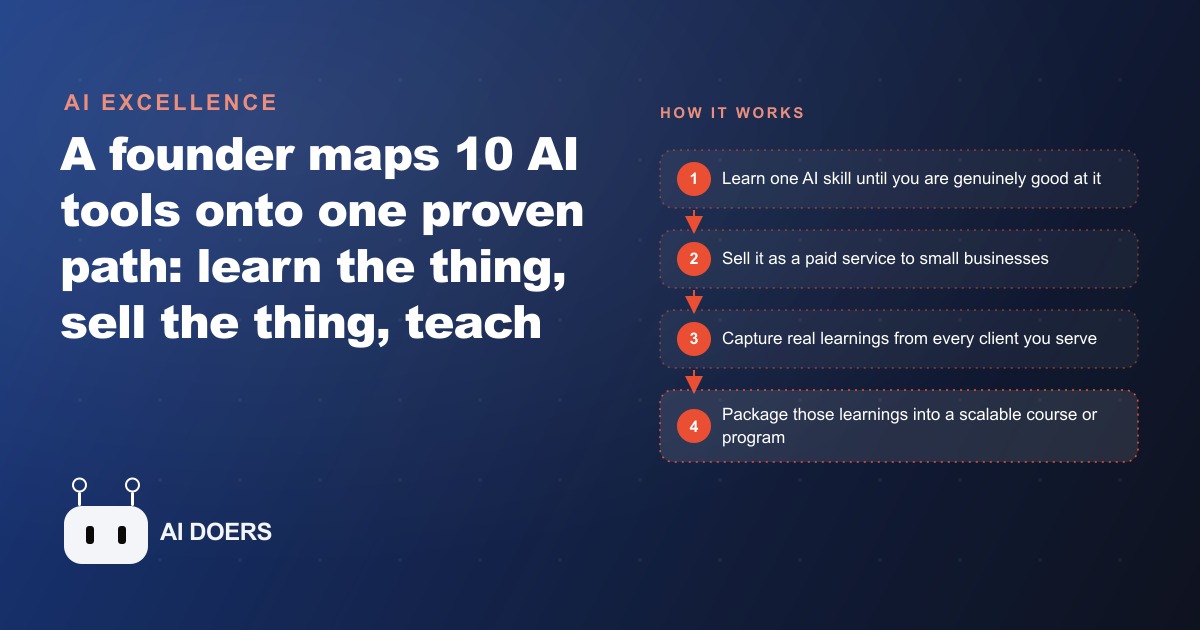
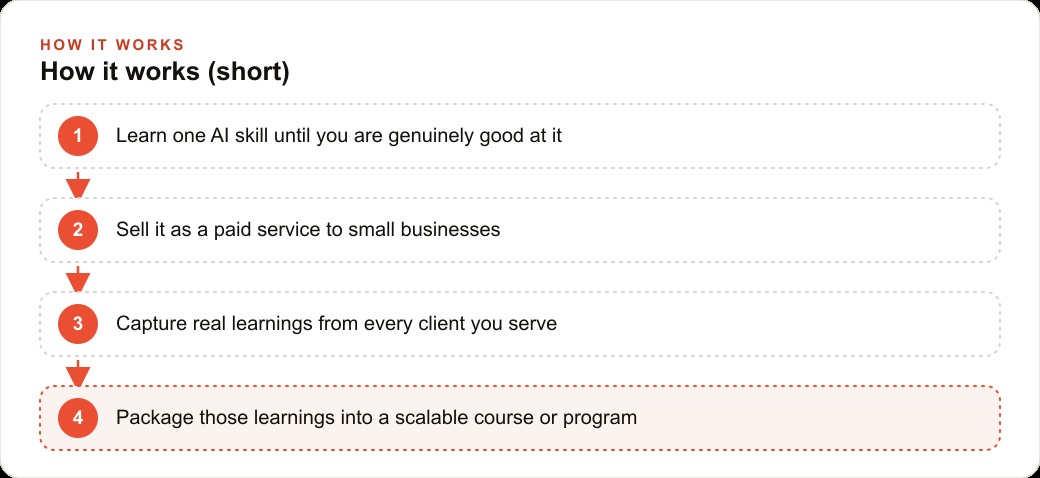
Ninety percent of AI tool lists are content strategies dressed up as advice. They gather ten or twelve names, describe what each tool does in two sentences, and leave the reader with a vague sense that opportunity exists somewhere in the pile. The list this article maps is different, and it is different because it starts with a loop, not a tool. The loop is: learn the thing until you are genuinely good at it, sell the thing as a paid service to real businesses, then package what you learned into a course or community while keeping the service alive. The ten tools matter only because they slot into specific phases of that loop. If you grab the tools without the loop, you have software without a strategy.
Madhuranjan Kumar has spent considerable time mapping this path because he has watched creators and agency owners run both versions: the tool-first version that stalls after initial enthusiasm fades, and the loop version that compounds month after month because the service is producing real proof while the content is producing real reach. The difference in outcomes is not subtle. The loop version is building a business. The tool-first version is building a resume.
What makes this path particularly suited to 2026 is the size of the gap between what small businesses know they should be doing with AI and what they are actually able to execute. That gap is the market. It is wide, it is paying, and it is open to someone who masters even one specific AI skill well enough to guarantee a result for a client. The question is not whether the opportunity exists. The question is which skill you pick and what order you build in.
Choosing the One Skill That Has Paying Buyers Right Now
The most expensive mistake a new service builder makes is trying to offer everything at once. ChatGPT consulting, website building, automation, voice agents, and proposal tools all appear on the same service menu, and the result is that no single skill gets deep enough to command a real price or deliver a reliable result. The path resolves this with a clear rule: pick one tool and spend 30 days getting genuinely good at it before adding anything else.
The selection framework is simple. Ask which AI skill has the clearest visible return on investment for a small business owner, so clear that the owner can see and touch the result within 30 days of paying for it. Voice agents score high on this test because the return is immediate and countable. An HVAC company that installs a voice agent on its after-hours line can count the jobs that booked overnight. There is no ambiguity about whether the tool worked. It either answered calls and booked appointments while the team was unavailable, or it did not.
For someone starting from zero technical background, the other high-scoring options are AI workshops for business teams and website or landing page builds using AI app builders. These share the same quality: the deliverable is visible, the client can interact with it on day one, and the value is obvious without explanation. These are the easiest sales because the client does not need to trust your numbers. They can see the result.
The workshop path, teaching a business team to actually use the AI tools they are already paying for, has a specific advantage. Almost every company with more than five employees has paid for some version of an AI assistant, and almost none of them are using it well. That gap is money sitting on the table for someone who can close it in a half-day session. A basic workshop for a practical business can price at $500 to $1,500, which is the first check that funds the next 60 days of tool subscriptions and outreach.
The First Client: How a Missed-Call Problem Became the Case Study That Sold Everything Else
In the HVAC example that anchors this walkthrough, the service builder picked voice agents as the skill. The logic was tight: HVAC is a high-ticket service where a single residential job for a new system can be worth $5,000 to $12,000. The phone rings hardest during heat waves and cold snaps, exactly when the owner and every technician are already on jobs. Calls that go unanswered during those peak periods are not annoyances. They are missed revenue with a calculable value.
The first client was a residential HVAC company in a mid-size metro market. The owner had noticed that weekends and evenings had a booking problem. The phones rang, no one answered, the caller moved on to the next result on the search page. An informal count over one summer suggested that 10 to 15 calls per weekend were going unanswered during busy periods. At an average job value of $400 for routine service and $6,000 for a system installation, recovering even a fraction of those calls represented meaningful money.
A voice agent built with Retell handled inbound calls after hours: greeting the caller, asking the nature of the problem, collecting the address, and booking a diagnostic visit directly into the technician's calendar. The setup took one week of focused work. The operator charged $1,200 for the initial build and $300 per month for ongoing management. In the first month, the HVAC owner counted six additional bookings that came in overnight or on weekends that would previously have been missed. At an average service value of $350, that is $2,100 in recovered revenue from the first month alone, covering the setup fee and leaving $900 in net new margin.
That six-booking figure became the core of the case study. Not "we built an AI voice agent," but "the HVAC owner recovered six jobs in the first month that the phone would have missed, worth $2,100 in service revenue." That specificity is what sells the next HVAC client without a long sales conversation. A number attached to a real outcome beats a feature description in every buying conversation.
Building the Outreach Stack While the Service Is Running
By the time the first client was two weeks in and the system was running smoothly, the outreach stack went live. The goal was to reach a targeted list of HVAC company owners with a short, specific cold email explaining the missed-call problem and what the agent does about it, without trying to be clever about it.
Instantly AI made this practical. A list of 800 HVAC businesses across a regional geography was loaded into the platform, segmented by employee count and review volume to focus on companies large enough to have a missed-call problem but small enough that no corporate layer stood between the owner and a buying decision. The email was three sentences: describe the problem, share the specific result from the first client, and ask for a 15-minute call.
Cold email conversion for focused B2B outreach at this message quality typically runs 2 to 4 percent of contacts to a booked call. On 800 contacts, that is 16 to 32 calls. From those calls, closing 20 to 30 percent produces 3 to 9 new clients. At $1,200 setup plus $300 per month per client, landing four clients in the second month means $4,800 in setup fees plus $1,200 in recurring management, totaling $6,000 in month two revenue. The first client is already generating $300 per month in recurring on top of that.
Gamma compressed the proposal step. After a discovery call, the conversation notes went into Gamma and produced a clean deck within 15 minutes showing the problem, the solution, the first-client case study numbers, the pricing, and a simple contract. The deck went out the same afternoon. Proposals that arrive while the prospect is still thinking about the problem have measurably higher close rates than proposals that arrive three days later when urgency has faded.
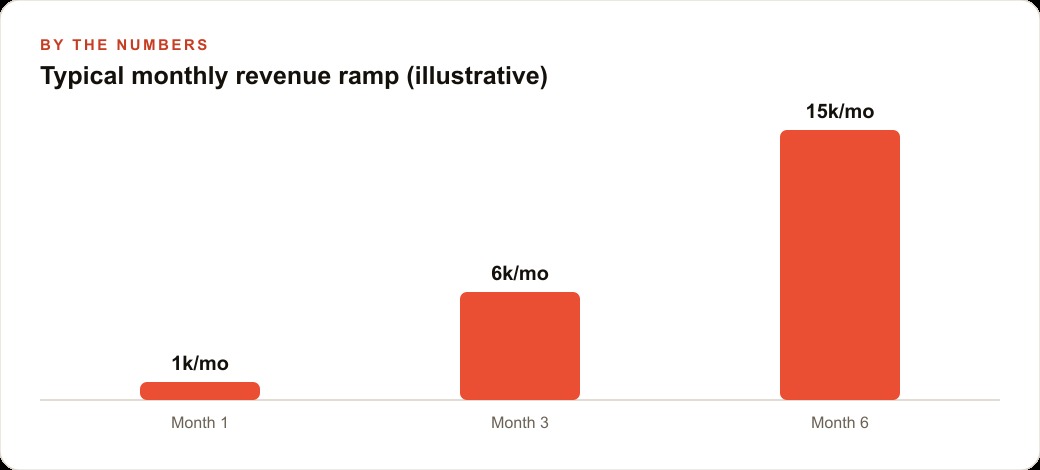
The month-one to month-six trajectory for someone executing this seriously looks like this: month one, one to two clients, $1,500 to $3,000 in total revenue. Month three, five to eight clients including recurring management fees, $4,000 to $7,000. Month six, twelve to eighteen clients, a mix of setup and recurring, $12,000 to $17,000. The $15,000 per month figure at month six is not a fantasy. It is the arithmetic of a small recurring-revenue service business with a clear value proposition and a working outreach system.
The HVAC Voice Agent That Turned Into a Teaching Business
By month four, the service had enough client depth to know the shape of the problem inside out. The questions clients asked during onboarding were consistent. The hesitations were predictable. The optimizations that improved booking rates followed a pattern. The scripts that worked for after-hours HVAC inbound differed from the ones that worked for emergency repair outreach, and both differed from the scripts that worked best for maintenance plan renewal calls. All of that institutional knowledge was sitting in a folder of call recordings and notes.
That knowledge is the raw material of a teaching business, but only because it came from real client work. If the same material had been assembled from YouTube videos and course notes without any paying clients behind it, it would be a theory without evidence. The client work is what makes the teaching credible, and the teaching is what scales the income beyond the hours the service requires.
Poppy AI entered the workflow at this point. It holds context from video transcripts, existing posts, and research notes, making it practical to produce content at volume without starting each piece from zero. Each client win, each insight from an onboarding call, each optimization that improved call-booking rates fed into a content system that produced three to four posts or short videos per week. The content attracted home-service business owners who saw their own problem described accurately, which produced more service clients, which produced more case studies, which produced better content.
This loop, service producing proof, proof producing content, content producing clients, is why the path compounds while the fake-guru model decays. The operator who stops doing the work after launching a course discovers that the material ages faster than the income from it. The operator who keeps the service alive always has something current and credible to say.
When to Add the Teaching Layer and What It Actually Requires
The question of when to launch the teaching layer has a simple answer: not before you have three to five clients with real results, and not before the service is delivering those results consistently without your constant intervention. If the voice agent setup still requires 20 hours of personal attention for each new client, launching a course teaching other people to do what you do will either teach them a process you are still figuring out or stretch you across too many demands simultaneously.
The teaching layer in this example went live at month five with a Skool community priced at $97 per month. The founding cohort was sourced from the content audience that had been building since month three. Forty-seven people joined in the first two weeks, generating $4,559 in month-one community revenue. With Fiducia layered on top for analytics, AI moderation, and appointment booking inside the community, the management load for 47 members was light enough to handle alongside the active service client roster.
HeyGen provided the course video consistency. Instead of filming new content in different locations with changing lighting and background, the AI avatar remained visually consistent across every module. The avatar is built from real footage, so it does not look synthetic to a casual viewer, but it removes the production complexity that derails most solopreneurs from ever completing a structured course. A module that would have required two hours of filming, recording, and editing took 45 minutes to script and generate. The time saved per module across a 20-module course is substantial.
The specific Skool community target for someone running this model at scale is 200 to 500 paying members, which at $97 per month produces $19,400 to $48,500 in community-only monthly recurring revenue. That figure sits on top of the service income, not instead of it.
The Discipline That Keeps the Whole Loop From Going Stale After Year One
The most underestimated risk in this model is not competition. It is stagnation. The service reaches a stable client base, the community reaches a comfortable size, and the urgency to keep learning fades. The teaching content starts describing what things were like a year ago instead of what is happening now. Members notice. Client results plateau. The compounding loop slows.
The discipline that prevents this is treating the service as the source of truth and the community as its audience. Every month, at least one new optimization, one new use case, or one new client scenario feeds from the active service work into the course material and the community posts. Members pay for current knowledge, not archived knowledge, and the distinction is only possible because the service is still running.
The tool stack needs the same discipline. Retell and Vapi both release new features regularly. Make.com adds new integrations. Cold email deliverability best practices shift with inbox algorithm changes. A service builder who is actively managing client voice agents in 2026 will know about these changes because they affect client results directly. A course creator who stopped doing client work will not, and that gap shows in the material quickly.
The other discipline is scope management on the teaching side. The community and the course should follow the service. If the service is voice agents for HVAC companies, the teaching is voice agents for home-service companies. If the service expands to cover property management or legal intake, the teaching expands correspondingly. What the teaching should never do is get ahead of the service. Teaching what you have not done is the fastest way to lose the credibility that the service spent months building.
The loop only holds if you keep doing the work. That is the hardest thing to hear and the most important thing to understand before starting. The tools on the list are secondary. The path is everything.
That is exactly what we do at AI DOERS. Book a private 30-minute call with Madhuranjan Kumar and we will map the fastest path to it for your specific business.
Book your call →
Madhuranjan Kumar
Madhuranjan Kumar brings 20 years of performance-marketing experience and has managed over $200 million in Facebook ad spend for brands across the United States and beyond. His expertise spans the full modern marketing stack: Meta, Google Ads, TikTok, email automation, CRM, and the websites that hold it together. At AI DOERS he turns that track record into lead-generation systems for businesses across every industry.